High-level dialogue proposes a Rio Synergies Action Group to advance Rio Convention synergies
-
27 août 2026
-
Press release

The proposed voluntary country-led Rio Synergies Group for Action would help countries translate climate, biodiversity and land priorities into more coherent planning, investment and implementation, while reducing duplication and reporting burdens.
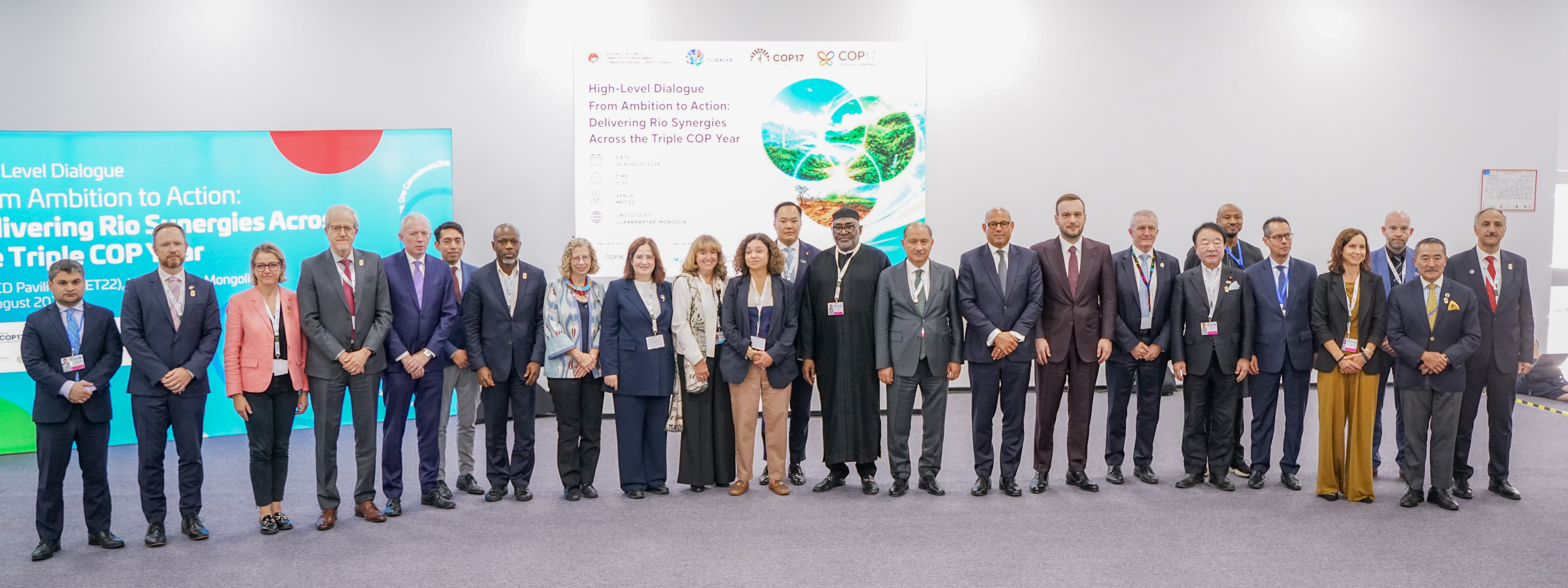
Ulaanbaatar, 27 August 2026 – In a push to transform political momentum into practical action, Ministers, current and incoming Rio Convention COP Presidencies, the Executive Secretaries of the three Rio Conventions, international organizations and financial institutions on 26 August at UNCCD COP17 held a High-Level Dialogue on strengthening cooperation across the climate, biodiversity and land degradation issues.
The event launched the COP31 Presidency Process, led by Türkiye, towards a proposed Rio Synergies Group for Action. The proposed Action group is intended to support a voluntary, country led implementation by connecting existing national priorities across climate, biodiversity and land with existing partnerships, technical expertise, implementation, knowledge-sharing, capacity-building and financing opportunities.
The aim is not to create another parallel structure, but to help countries connect the pieces they already have, national plans, science, projects, finance and partnerships, and make them work together more effectively on the ground.
Several countries, including Australia, Ireland, Japan, Maldives and Sierra Leone, and the heads of the UN entities supported the idea, emphasizing the multiple benefits of such a group to countries. A coordinated and integrated approach brings efficiency, cost-savings, reduces the planning and reporting burdens on countries and will help countries to respond practically to environmental challenges that communities experience as multiple, not single crises.
It can also help countries identify programmes and investments capable of delivering simultaneously for land restoration, climate resilience, biodiversity and development, rather than financing each agenda in isolation.
The High-level Dialogue, “From Ambition to Action: Delivering Rio Convention Synergies across the Triple COP Year,” is the first high-level opportunity during the 2026 Triple COP Year to consider how political momentum for Rio Convention synergies can be translated into practical, country-led implementation.
Convened by the Presidencies of UNCCD COP17, incoming CBD COP17 and incoming UNFCCC COP31, the Dialogue underscored the continuity of political leadership across the 2026 Triple COP Year, beginning with UNCCD COP17 in Ulaanbaatar, continuing in October to COP17 of the Biodiversity Convention under the Presidency of Armenia in Yerevan, and culminating with UNFCCC COP31 in November under the Presidency of Türkiye in Antalya.
The process offers interested countries and partners an opportunity to contribute to the co-development of the proposed voluntary, country-led Group, with a view to its formal launch at UNFCCC COP31 in Antalya.
Speakers explained why stronger synergy among the Convention’s matters now more than ever, proposed some guiding principles for such an Action Group and explained the multiple benefits to be gained through synergy.
Dr. Yasmine Fouad, UNCCD Executive Secretary said: “Rio synergies need to deliver in three areas: stronger national policy coherence with less bureaucratic burden for countries, tangible action on the ground and greater engagement of the private sector to mobilize investment. The real test is whether we can connect national priorities to integrated programmes, programmes to finance, and finance to implementation that delivers multiple benefits for people and landscapes. We do not need another layer of process. We need the systems we already have to work together more effectively and at scale”
Ms. Fatma Varank, Türkiye Deputy Minister of Environment, Urbanization and Climate Change of the Republic of Türkiye, who represented the incoming UNFCCC COP31 Presidency at the Dialogue, emphasized the need for coherence and efficiency in implementing agreements, and the importance of dialogue in building momentum for synergy towards COP31.
Synergy, she said, does not equal merging mandates, rather, it achieves greater scale, coherence, efficiency, reduced duplication and yields multiple benefits.
Mr. Andrew Berryman, Deputy Head of Mission, Embassy of Australia in Mongolia, representing UNFCCC COP31 Presidency of Negotiations said a voluntary, country-led and practical Rio Synergies Group for Action could strengthen coordination across institutions, including through leveraging existing mechanisms and delivering more with less.
Mr. Andranik Grigoryan, Government of Armenia representing the incoming Presidency of CBD COP17, said one of the lessons emerging from the global report reviewing progress in the implementation of the Kunming Montreal global biodiversity framework is the need for cooperation, integrated and coordinated action among stakeholders. The draft report is currently undergoing peer review and will be launched at CBD COP17.
Integrating action among the three Conventions at the national level, he said, can reduce institutional and regulatory burdens and enhance the process, for instance, by sharing science, capacity building on several agendas, and in finance, through shared solutions.
Astrid Schomaker, Executive Secretary of the Convention on Biological Diversity, said the study shows 80 percent of biodiversity delivers for climate, but only 22 percent of climate finance delivers for biodiversity, and that a re-set is needed in how we approach the mandates to help countries to align plans, reduce the reporting burden and avoid leaving people behind.
H.E. Mr. Shigeharu Aoyama, Japan’s State Minister of the Environment, said synergy should minimize trade-offs, while maximizing co-benefits, and highlighted the results of an Asia-Pacific synergies report: advancing synergistic solutions to the triple planetary crisis and the SDGs whose more than 104 case studies on synergy demonstrate the benefits of shared knowledge and tangible action on the ground.
Citing the same study, Inger Andersen, United Nations Environment Program Executive Director, reported that significant financial savings of up to 24 percent, equivalent to 6.4 billion United States dollars could be achieved by 2050. Synergy would be especially useful in developing plans on the ground and in reporting by the Conventions, she said.
H.E. Mr. Timmy Dooley, Ireland’s Minister of State at the Department of Agriculture, Food and the Marine and at the Department of Climate, Environment and Energy, said implementation should be interconnected, particularly with regards to national priorities, implementation partners, and connecting ambition with finance.
H.E. Ali Shareef, Minister of Climate Change, Environment and Energy of the Republic of Maldives said integration is “not a convenience” but borne of “necessity” for Small Island States (SIDs), and called for a dialogue on synergy that can close the gap SIDs encounter, for instance in indicators that are calibrated individually, and in the case of UNCCD, action that is limited to arid, semi-arid and dry sub-humid zones.
Simon Stiell, Executive Secretary of the United Nations Framework Convention on Climate Change, called for alignment between the politics and the realities and practicalities of the Conventions. He urged Parties to be very practical and to reduce the burden of reporting on countries.
Supporting the idea of an Action Group, Samed Ağırbaş, Climate High-Level Champion of the COP31 Presidency said there is no need for another parallel system. Rather, implementation that connects solutions is what is needed.
H.E. Ms. Ruth Davis OBE, United Kingdom Special Representative for Nature, stressed the need for practical progress – synergistic solutions – because people experience the land, biodiversity and climate change challenges as multiple crises, not as single crisis.
The outgoing Presidencies of UNCCD COP16, the Kingdom of Saudi Arabia, and UNFCCC COP30, Brazil, highlighted their past contributions to the Belém process and statement on the Rio Conventions and praised the progress and momentum building up towards COP31 in Türkiye.
Türkiye formally endorsed the Belém Joint Statement on the Rio Conventions, becoming the final incoming Rio Convention COP Presidency to join the shared political commitment.
Media contact:
Wagaki Wischnewski
Communications Officer/UNCCD G20 Global Land Initiative
M: +49 (0)173 268 7593/+976 99207536
email: wwischnewski [at] unccd.int (wwischnewski[at]unccd[dot]int)
Publications

Strong, sustainable, and resilient urban-rural linkages are central to efforts to combat land degradation, reduce out-migration, and achieve other sustainable development…