Desertification and Drought Day in Kilifi: Where the land holds the water
-
25 June 2026
-
Story
By Yasmine Fouad, Executive Secretary of the UN Convention to Combat Desertification
KILIFI, KENYA. This year's Desertification and Drought Day carries the theme Rangelands: Recognize. Respect. Restore. On the eve of the ceremony I went to see what those words look like on a different kind of ground, a coast where land and water meet. The mangrove site here was degraded by the same forces that strip a rangeland, and it is being pulled back from the edge by the same three verbs. The difference is that, on this coast, restoring the land and the water go hand in hand.
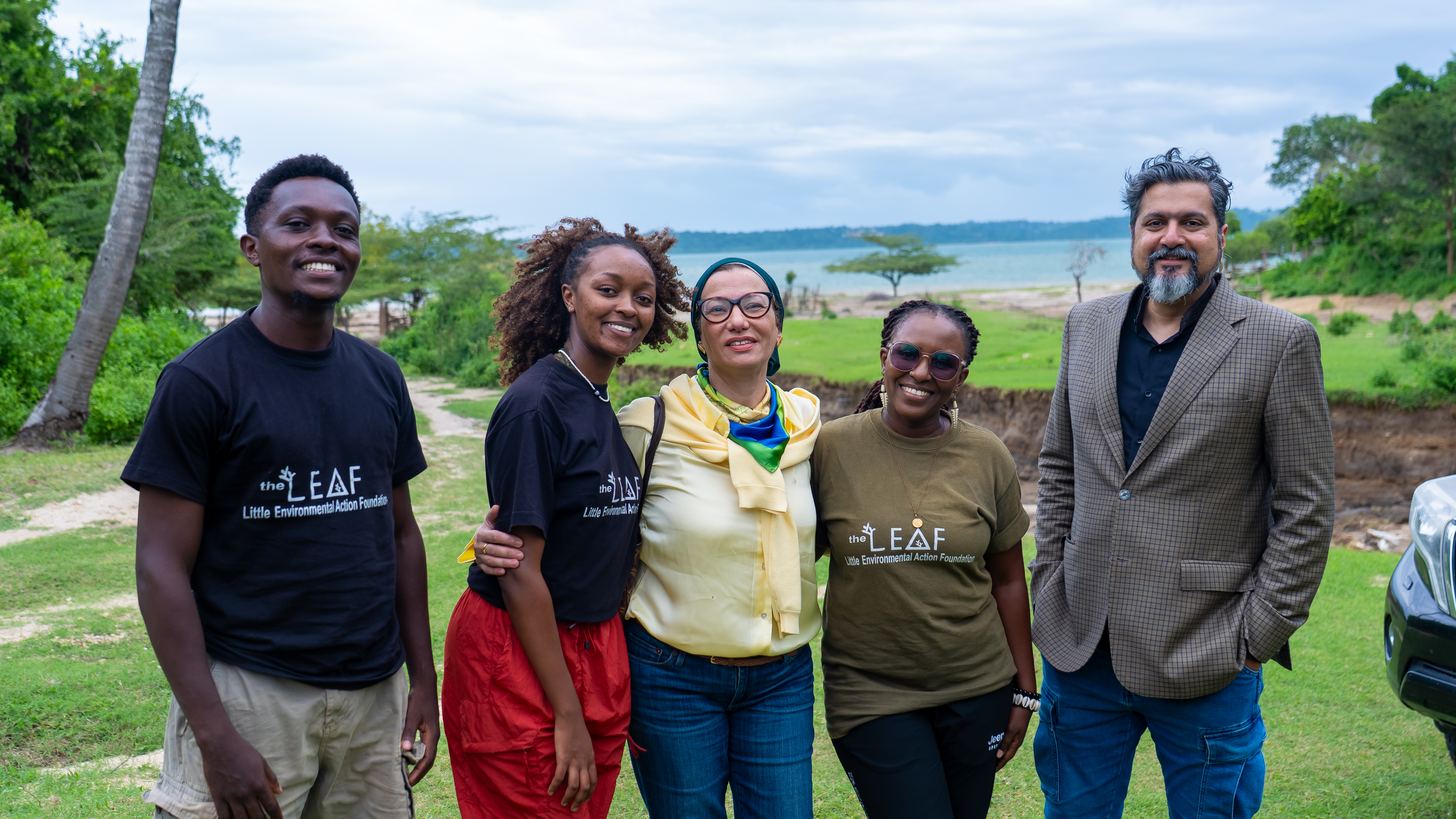
What I found was soil that used to kill seedlings before they had a chance. Too saline, too compacted, too far out of balance to hold a young root. The team from LEAF, the Little Environmental Action Foundation, and the women of Friend of Nature Community-Based Organization treated the ground, planted, and watched the saplings die. So they treated it again. Planted again. When one died they replaced it, a practice they call “beating up.” It is not a term from any manual. It is what years of trial reduce to, two words. It worked: survival now stands at 80%, on a project working toward 100,000 seedlings across roughly 100 hectares of Kilifi coastline [1].
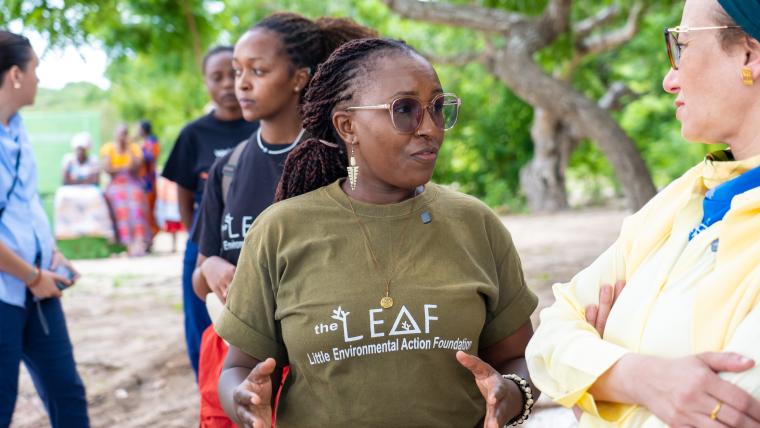
LEAF helps Friend of Nature run a nursery and buys the seedlings back to plant with the community, rather than treating the labor as a donation. The women earn income from growing trees, not from cutting them, which removes the reason to go back into the remaining forest and take more. Conservation that pays tends to outlast the funding cycle and the news cycle. That, in plain terms, is respect: not gratitude for free labor, but payment for skilled work. Friend of Nature is a women-led group, and asked how they felt about carrying this work to the world, the members answered at once: the African women are strong. After years of planting in soil that gave nothing back, it was a statement of fact.
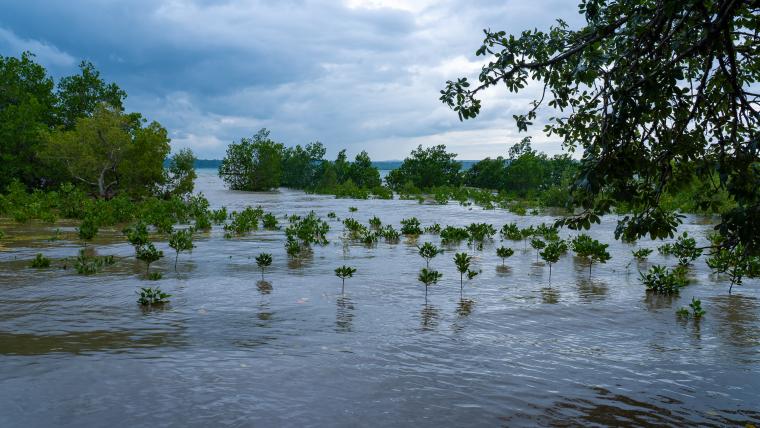
Stand on the restored ground and you can see why land and water cannot be separated here. In the waterlogged soil beneath the roots, a mangrove locks away more than 1,000 tonnes of carbon a hectare, close to four times a forest on dry land [2, 3]. Above it, the same roots cut wave height by more than 66% where the stand is healthy, and worldwide mangroves shield an estimated 15 million people from flooding each year and prevent more than 65 billion dollars in damage [4]. They keep the sea out of the freshwater, holding back the salt that would otherwise creep into the aquifers people drink from, a line that matters more with every centimeter of sea-level rise [5]. And below the waterline they are a fish nursery that an estimated 4.1 million fishers depend on for a living [6]. Heal the ground and the coast, the water table, the catch and the climate all steady together.
This is also what drought resilience looks like. Too often drought is understood only when rivers run dry or crops fail. Yet drought begins much earlier, when degraded land loses its ability to hold water. Restoring ecosystems such as mangroves helps landscapes retain moisture, recharge groundwater and buffer communities against growing water stress. Healthy land is one of the most effective forms of drought preparedness available to us.
More than half the world's mangroves could collapse by 2050, with nearly one in five already endangered [7], and between 1996 and 2020 the world lost more than 5,200 square kilometers of them, mostly to aquaculture, farming and coastal building [8, 9]. Up to half the world's rangelands are degraded too. Different land, same water table, same math. Kilifi does not reverse that alone. What it shows is that the loss can run backward, in years rather than generations, if the soil work gets done and the people doing it get paid.
This is also what drought resilience looks like. Too often drought is understood only when rivers run dry or crops fail. Yet drought begins much earlier, when degraded land loses its ability to hold water. Restoring ecosystems such as mangroves helps landscapes retain moisture, recharge groundwater and buffer communities against growing water stress. Healthy land is one of the most effective forms of drought preparedness available to us.
I made the visit on the eve of the Desertification and Drought Day, a short distance from Vipingo Central Primary School, where on 17 June Kenya's Deputy President gave the keynote and UNEP's Inger Andersen and I addressed the gathering. In August the work travels to COP17 in Ulaanbaatar, where water sits on the agenda as its own theme alongside rangelands. It is exactly the kind of project a COP on land restoration should be looking at: a community that made restoration pay for itself and ended up with land that holds water, holds fish, and holds together in a storm.
As I stood in Kilifi, I was reminded that the ultimate beneficiaries of restoration are not only today's communities, but also the children who will inherit these landscapes. Around the world, more than a billion children are already exposed to multiple climate hazards. Their future will depend, in part, on whether we restore the land, water and ecosystems that sustain life and opportunity.
Recognize the land. Respect the people who tend it. Restore what was lost. On this coast, restoring the land and restoring the water are the same act. Kilifi is the proof.

References
[1] LEAF Charity. (n.d.). Mangroves. Retrieved June 2026, from https://www.theleafcharity.com/mangroves
[2] Wang, M., et al. (2025). Mapping accumulated carbon storage of global mangroves from 2000 to 2020 at a 1 km resolution. Scientific Data, 12, 552. https://doi.org/10.1038/s41597-025-04881-5
[3] Calyx Global. (2025, November). Blue carbon. https://calyxglobal.com/research-hub/research/blue-carbon-what-the-rising-tide-of-coastal-conservation-means-for-the-voluntary-carbon-market/
[4] Menéndez, P., et al. (2020). The global flood protection benefits of mangroves. Scientific Reports, 10, 4404. https://doi.org/10.1038/s41598-020-61136-6
[5] Twilley, R. R., et al. (2021). Groundwater research in mangrove coastal ecosystems: New prospects. Treatise on Estuarine and Coastal Science. https://www.sciencedirect.com/science/article/pii/B9780128164372000100
[6] zu Ermgassen, P. S. E., et al. (2024). The global fish and invertebrate abundance value of mangroves [Preprint]. bioRxiv. https://doi.org/10.1101/2024.05.02.591889
[7] IUCN. (2025, October 27). More than half of all mangrove ecosystems at risk of collapse by 2050, first global assessment finds [Press release]. https://iucn.org/press-release/202405/more-half-all-mangrove-ecosystems-risk-collapse-2050-first-global-assessment
[8] Bunting, P., et al. (2018). The global mangrove watch: A new 2010 global baseline of mangrove extent. Remote Sensing. https://doi.org/10.3390/rs10101669
[9] UNDRR. (2023). Loss of mangroves. Hazard Information Profiles. https://www.undrr.org/understanding-disaster-risk/terminology/hips/en0207
Publications

Region of ancient traditions and modern perspectives