
Latest news & stories
A new report from the United Nations Convention to Combat Desertification (UNCCD), to be released Wednesday, 27 April 2022, offers both stark warnings and hundreds of practical ways to effect local, national and regional land and ecosystem restoration. UNCCD’s evidence-based flagship Global Land Outlook 2 (GLO2) report, five years in development with 21 partner organizations, and with over 1,000 references, is the most comprehensive consolidation of information on the topic ever assembled. It offers an overview of unprecedented breadth that includes new analyses of various future land scenarios and the potential contributions of land restoration investments to climate change mitigation, biodiversity conservation, poverty reduction, human health and other key sustainable development goals. Report embargo: Wednesday, 27 April 2022 09:00 US EDT / 13:00 GMT / 14:00 UK Summer Time / 15:00 CEST (check local time here) GLO2 is being released shortly before the UNCCD’s 15th session of the Conference of Parties opens in Abidjan, Côte d'Ivoire (COP15, 9-20 May, www.unccd.int/cop15). The first GLO edition in 2017 underscored the wide-ranging drivers, risks, and impacts of persistent land degradation, which have intensified considerably in the last five years – increasingly evident in the deterioration of human health and stable livelihoods. The new report sets out the rationale, enabling conditions, and diverse pathways by which countries and communities can design and implement a customized land restoration agenda. Advance access to the GLO2 report and a summary for decision makers, will be available next week. Advance embargoed interviews with report authors and officials are also available. A high-level virtual launch will be followed by a press conference Wednesday, 27 April 2022 The press conference will begin 27 April 2022 at 09:00 US EDT / 13:00 GMT / 14:00 UK Summer Time / 15:00 CEST (check local time here) You can find promotional material here. To register for the press conference, and to receive the advance embargoed media materials, please email the following to GLO2Launch@unccd.int Media organization First Name Last Name Position Email Telephone City Country A formal launch of GLO2 will take place Tuesday, 10 May 2022, during the high-level segment of the UNCCD’s 15th Conference of Parties (COP15, 9-20 May), Abidjan, Côte d'Ivoire. COP15 programme, registration and other media information: https://www.unccd.int/cop15 About The United Nations Convention to Combat Desertification The United Nations Convention to Combat Desertification (UNCCD) is the global vision and voice for land. We unite governments, scientists, policymakers, private sector and communities around a shared vision and global action to restore and manage the world’s land for the sustainability of humanity and the planet. Much more than an international treaty signed by 197 parties, UNCCD is a multilateral commitment to mitigating today’s impacts of land degradation and advancing tomorrow’s land stewardship in order to provide food, water, shelter and economic opportunity to all people in an equitable and inclusive manner. Contacts: Terry Collins, +1-416-878-8712 (m), tc@tca.tc Wagaki Wischnewski, +49-228-815-2820; +49-173-268-7593; wwischnewski@unccd.int

On a mission to save the world's soils from extinction, the Save Soil campaign reached Bonn on 13 April 2022. The 100-day journey led by Sadhguru will cover 30,000 km across 25 nations to call on the policymakers and the public to make soil regeneration a priority. The campaign led by Sadhguru on his motorbike received a warm welcome from the city of Bonn officials and the executive management of the UN agencies in Germany. Following a round of discussions, Sadhguru joined the UNCCD Executive Secretary Ibrahim Thiaw for a live chat that was streamed across the UNCCD platforms. A yogi, mystic and visionary, Sadhguru has been named one of India’s 50 most influential people, whose work touched lives of millions worldwide. An engaging voice at major global fora that address issues of socioeconomic development, leadership and spirituality, he also initiated a number of large-scale projects focused on social revitalization, education and the environment, as a way to gave millions of people the means to overcome poverty, improve quality of life and achieve community-based sustainable development. The Save Soil movement strives to rally the environmentally-conscious around soil conservation, advocating the power of individual actions for policy change and public engagement. During their discussion, Sadhguru and Mr. Thiaw agreed that land and soil restoration can be a simple and powerful solution to the key environmental challenges of today, including climate change, biodiversity loss and destruction of ecosystems. Realizing that everything we need in our daily lives comes from soil and that conscious actions can make a real difference is the first step to preserving this precious resource and reversing degradation. The UNCCD and the Save Soil campaign will reconvene at the UNCCD COP15 in Abidjan on 9-20 May 2022. Remember to follow us for more news!

The United Nations Convention to Combat Desertification (UNCCD) welcomes the pledge of 5.25 billion United States dollars announced today for the eighth replenishment of the Global Environment Facility (GEF8). The increase in GEF resources comes at a critical moment as many countries around the world are facing multiple challenges – from drought to conflicts, to the ongoing COVID-19 pandemic, all of which could turn policy attention away from sustainable growth and development approaches. Developing and the least developed countries, in particular, will benefit from the increased allocation by supplementing stretched national budgets to achieve the desired post-COVID-19 recovery. The announcement also comes a month before the 15th session of the Conference of the Parties to UNCCD, in Abidjan, Côte d’Ivoire, where governments will decide on the priority actions to take in 2022 and 2023. “Land is where life thrives. We applaud countries’ leadership and commitment to successfully replenish the GEF for next 4 years from July 2022. Today's announcement will ramp up efforts to combat land degradation that would have a positive impact on the restoration of ecosystems,” said UNCCD Executive Secretary Ibrahim Thiaw. The restoration by 2030 of the one billion hectares of land pledged would have vast economic, social and environmental benefits worldwide. Biodiversity conservation, climate change mitigation and adaptation, sustainable land management, recovery of ground water sources. In turn, these benefits could improve food security for communities and consumers worldwide. The Global Mechanism of the UNCCD regularly receives requests from countries for support to develop large-scale projects that can transform livelihoods and landscapes. It continues to provide technical assistance to stakeholders in developing project ideas that are eligible for GEF funding. The increased GEF8 allocation for the land focal area may encourage countries with worsening land degradation to take concrete action. About 130 of the 169 UNCCD country parties affected by desertification have shown great interest in restoring degrading land and pursuing sustainable land management. Since its establishment in 1992, GEF has played a catalytic role in land restoration and rehabilitation activities. The GEF became a financial mechanism of the UNCCD in 2010. GEF funding has helped countries to create the enabling environment needed to motivate other partners, including the private sector, to invest in large-scale restoration.

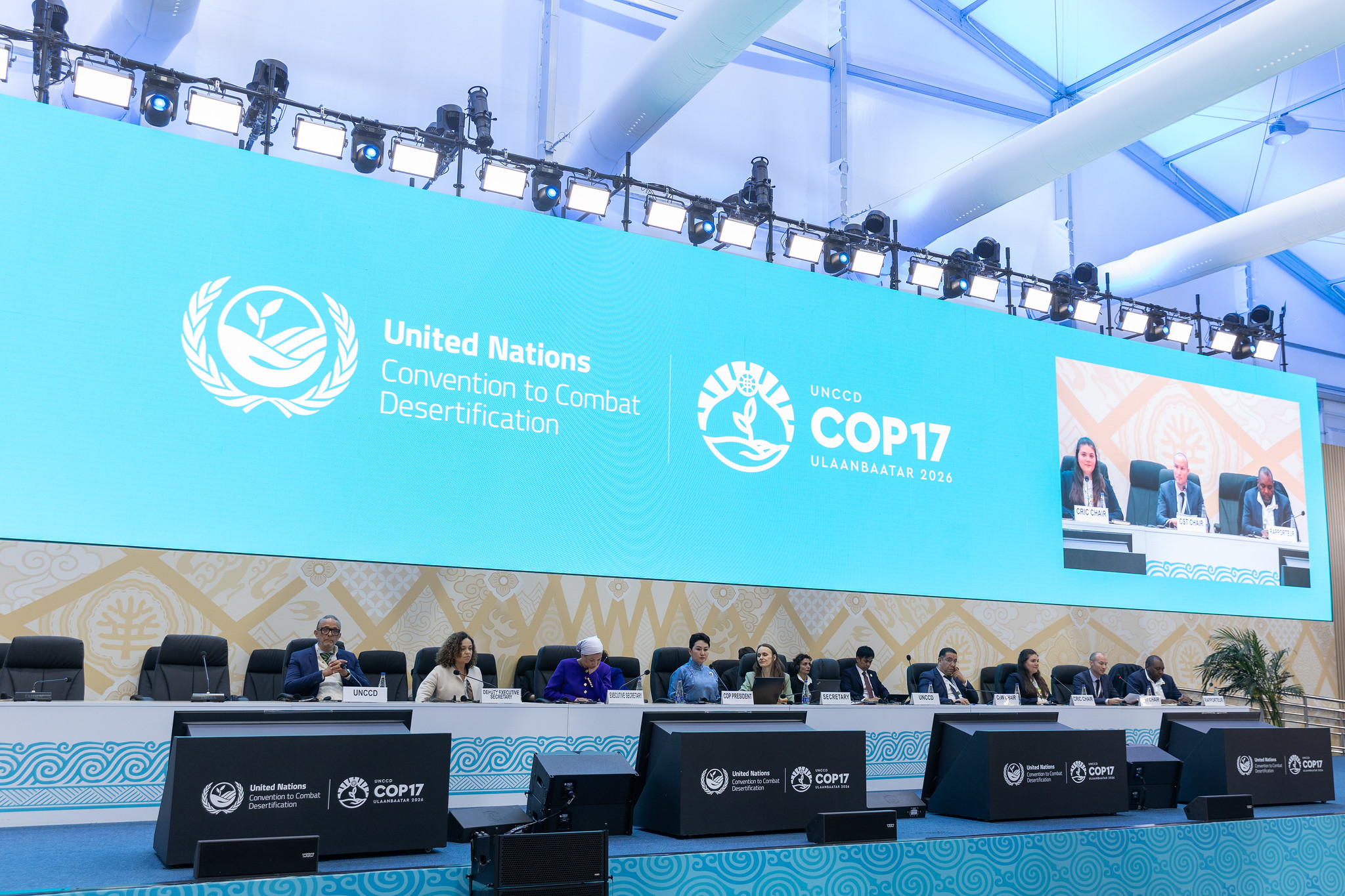
One month ahead of its 15th session of the Conference of the Parties (COP15) taking place from 9-20 May 2022 in Abidjan, Côte d’Ivoire, the United Nations Convention to Combat Desertification (UNCCD) has unveiled the highlights of the event’s programme and high-level participation.

The latest report from the Intergovernmental Panel on Climate Change (IPCC) released today sounds the alarm on the urgent action needed to keep the 1.5 degree temperature rise limit within reach, with global climate commitments falling drastically short of the target. At the same time, the IPCC assessment highlights the important role of land in tackling rising greenhouse gas emissions. “To keep the 1.5-degree limit agreed in Paris within reach, we need to cut global emissions by 45 percent this decade. But current climate pledges would mean a 14 percent increase in emissions,” United Nations Secretary-General Antonio Guterres said in his statement on the release of the Panel’s Working Group III AR6 Climate Change 2022: Mitigation of Climate Change report. In addition to major cuts in greenhouse gas emissions from fossil fuels, major cuts in other sectors will also be necessary. Land contributes a quarter of all emissions. At the same time, land-based ecosystems absorbed around 30 per cent of the carbon emissions generated through human activity in the last decade and could provide 20 to 30 percent of the mitigation required to ensure global warming stays below 1.5oC towards 2050 [1]. “The latest IPCC report offers a sobering, yet hopeful assessment, clearly showing that land-based solutions can provide a significant contribution to global efforts to tackle climate change,” said Ibrahim Thiaw, Executive Secretary of the United Nations Convention to Combat Desertification (UNCCD). “If managed sustainably, land can deliver large-scale greenhouse gas emission reductions. But this will require us to urgently rethink the way we approach agriculture, forestry and other land use activities,” he added. “The Sixth Assessment Report provides an important context to consider future global policy action on issues such as land restoration and early action on drought, which are on the agenda of the 15th session of the Conference of the Parties to the UNCCD to be held on 9-20 May in Abidjan, Côte d’Ivoire,” Thiaw observed. The IPCC report documents that net greenhouse gas emissions rose 12% between 2010 and 2019 and were 54% (21 GtCO2-eq) higher than in 1990 [2]. Overall, emissions from the land sector – agriculture, forests, land use and land use change – fell from 13 to 11 percent of the total emissions across all sectors during this period. “There is an urgency to restore the one billion hectares of degraded lands by 2030 to cut land-based emissions massively. We must strengthen the land’s ability to absorb and store carbon emissions – and that means ensuring it remains healthy. What’s more, restoring land back to health will also enable us to simultaneously increase food production from existing agricultural land and restore ground water sources that we are losing. – UNCCD Executive Secretary Ibrahim Thiaw The report warns that the land’s natural ability to hold and remove carbon is not infinite. Moreover, the carbon sink potential of land declines with every passing year of increased warming. More so, if we fail to take the actions needed to make the land resilient to climate change. The report lays out that there are both synergies and trade-offs between climate action and the pursuit of other Sustainable Development Goals (SDGs), many of which are tied to competing demands for land. For example, the pressure to convert natural forests or grasslands as demand for food, water and urban growth increases, land-based emissions may also increase. This is particularly the case for developing countries. This indicates it will be important to recover degraded land. To do this effectively, however, the obstacles to the effective use of land-based actions, including insecure land tenure and fragmentation in land ownership, must be overcome. And it will mean ensuring future land management is sustainable to avoid reversals, such as restored land being degraded once more. The IPCC confirms that addressing land degradation can have multiple synergies with the SDGs, particularly when supported by frameworks designed to help manage trade-offs while promoting responsible governance and the involvement of local communities and indigenous peoples, particularly when supported by frameworks such as Land Degradation Neutrality within the UNCCD [2]. To realize the opportunities land provides while addressing the challenges of the interaction of climate change and land degradation, UNCCD is developing policy tools to ensure future land use planning fully integrates municipal, agricultural and conservation objectives. In essence, doing the right thing in the right places at the right scales. The Convention also promotes policies that put carbon back where it belongs, in the soil, where it contributes to biodiversity, land productivity and even water security in the face of increasing drought. The Working Group III report is the last of the three reports issued by IPCC as part of the sixth assessment of the status of climate change. Working Group I Report, titled AR6 Climate Change 2022: The Physical Science Basis, was released in August 2021. Working Group II Report, titled, AR6 Climate Change 2022: Impacts, Adaptation and Vulnerability, was released in February 2022. The Synthesis Report will be the last of the AR6 products and is scheduled to be released in September 2022. References: [1] IPCC, 2022: Technical Summary. In Climate Change 2022: Mitigation Of Climate Change. Contribution of Working Group III to the Sixth Assessment Report (AR6) of the Intergovernmental Panel on Climate Change. Technical Summary [2] IPCC, 2022: Summary for Policymakers. Climate Change 2022: Mitigation Of Climate Change. Contribution of Working Group III to the Sixth Assessment Report (AR6) of the Intergovernmental Panel on Climate Change. For more information, contact: Xenya Scanlon, UNCCD Chief of Communications, xscanlon@unccd.int Wagaki Wischnewski, UNCCD Head of News and Media, press@unccd.int

UNCCD extends heartfelt congratulations to its Land Ambassador, music composer Ricky Kej, who has just received a Grammy Award in the Best New Age Album category for his album "Divine Tides," along with Stewart Copeland. This is the second Grammy win for Ricky, who is a passionate advocate for sustainable development and environment action. In his acceptance speech he shared his dream of the world as one family that is living in peace – within the human species and all entities on this planet: the wildlife, the forests, all the elements of nature – the air we breathe, the water we drink and the land we walk on. Ricky himself teaches respect for nature by example, choosing a vegetarian diet, opting to use public transportation instead of owning a car and having his carbon footprint audited quarterly to monitor his environmental footprint and stay on top of his climate goals. Together with his fellow Ambassador Baaba Maal, Ricky is also the author of the UNCCD Land Anthem, which has been produced in six languages.
