News & stories

Latest news & stories
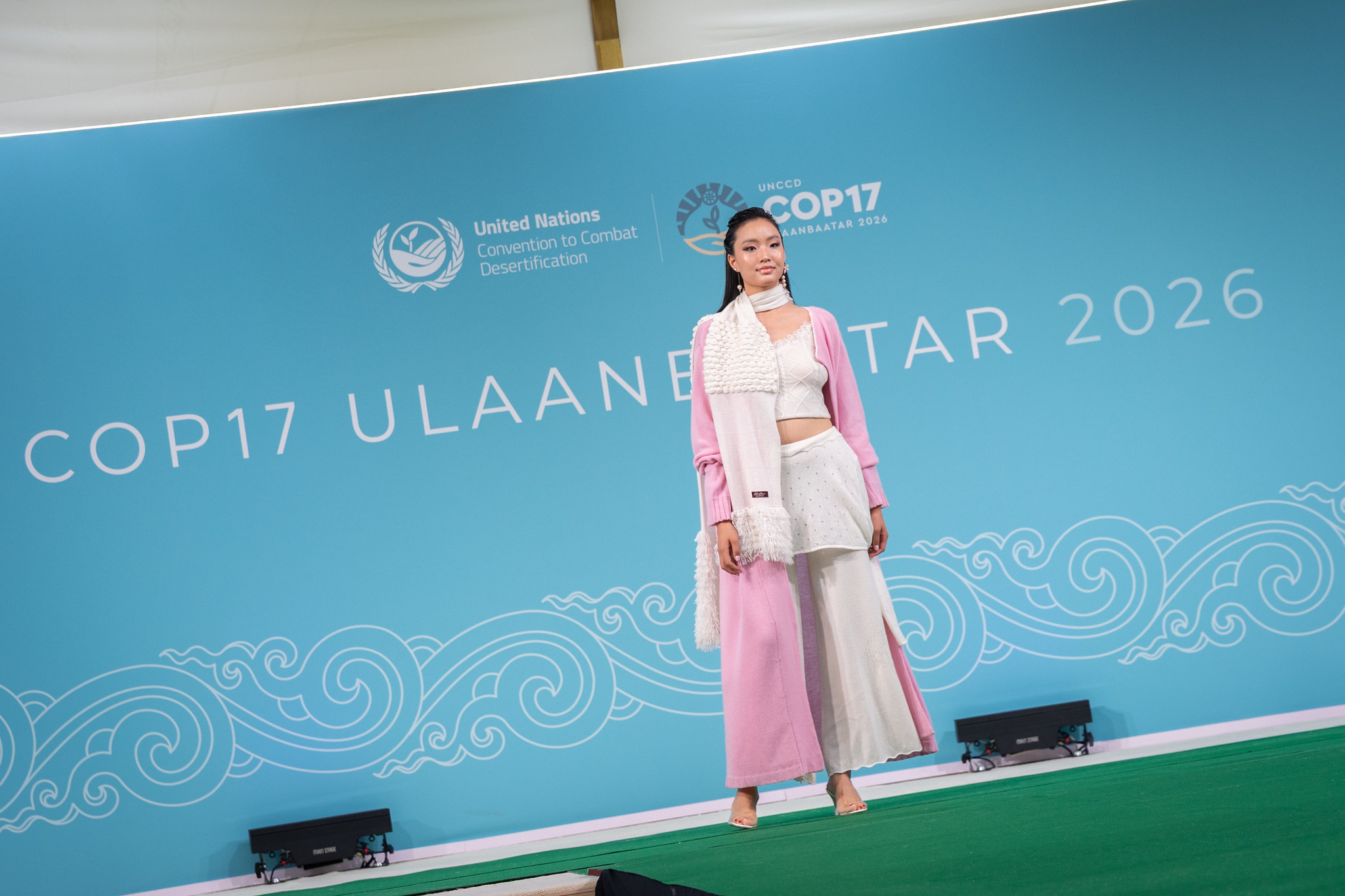
Cashmere can look weightless on a runway. Whether its footprint is equally light depends on the health of the rangelands that produce it. In Mongolia, around 190,000 herder households and 27 million goats are behind the fabled fiber that accounts for roughly 40 percent of the world’s raw cashmere. Its quality begins long before spinning or knitting, on vast rangelands that sustain animals and livelihoods but are also under growing pressure. Rangelands cover 54 per cent of the Earth’s terrestrial surface, and in Mongolia they make up more than 70 per cent of the country’s territory. Yet 81 per cent of Mongolia’s land is affected by degradation. This made Ulaanbaatar a fitting location for a new edition of Fashion4Land, which returned to UNCCD COP17 after its debut in Riyadh in 2024. What would it take to change the way clothes are designed, sourced, worn and regulated while retaining the talent, ingenuity and beauty that make people care about fashion in the first place? The forum brought together designers and manufacturers, global luxury brands and Mongolian producers, pastoralist advocates and policymakers around a simple premise: fashion begins on land. When discussing sustainable fashion, UNCCD Goodwill Ambassador Inna Modja sees an opportunity rather than a constraint. “Fashion has a unique ability to inspire, connect people and translate complex sustainability challenges into stories that everyone can understand,” she said. One such story is already famous. For Team Mongolia’s Milano Cortina 2026 Olympic wardrobe, GOYOL Cashmere’s Creative Director Munkhbayasgalan “Baysa” Delgerbat revisited clothing worn during the Mongol Empire, retaining details shaped by life on the steppe: a raised collar against the wind, an overlapping front for warmth and side slits designed for movement. “People don’t fall in love with a product because it is sustainable,” Baysa says. “People fall in love with story, with beauty, with craftsmanship.” A garment carrying cultural and material value, she argued, is more likely to be cared for, kept and eventually passed on. For Nan Hu of Nan Knits, the color of the fiber itself offers an exciting design opportunity. The brand leans toward the subtle shades of yak fiber — soft browns, dusky grays and creamy whites that become an irresistible palette rather than something to overwhelm with dye. For a designer known for experimental contemporary knitwear, the appeal lies in taking a well-known material somewhere unexpected. Sustainability, he argues, need not limit creativity – it can jump-start it. At LVMH, the raw material can mean something the industry has already made but was unable to sell. Alexandre Capelli described how designer Kevin Germanier gathers unsold products from the group’s boutiques, dismantles them and turns the material into new designs in which the initial object might be impossible to recognize. Other experiments with young designers involve regenerative flax, food-industry waste, discarded hotel linens and innovative materials for dyeing. The idea is not to make sustainability visible as an aesthetic. It is to make it part of how design happens. UNCCD Goodwill Ambassador Ricky Kej took that logic a step further. His #ReWear4Earth campaign began with a minor red-carpet heresy: wearing the same clothes to a next high-visibility event. Speaking at the COP17 Fashion4Land event, he challenged the disposable expectations encouraged by fast fashion and social media. “The Earth will not remember what we wore to our last party, but it will certainly remember how we treated it,” Kej said. “We do not need a different outfit for each Instagram photo.” But does a beautifully made garment worn for decades necessarily mean it is land-positive? Fashion4Land resists the convenient idea that “natural” automatically means sustainable. Cotton can place enormous demands on land and water. Wool and cashmere can contribute to overgrazing when production is poorly managed. Synthetic fibers depend heavily on fossil fuels and can shed microplastics. The question is: what is the impact of wearable beauty on the planet’s finite resources? For Battsetseg Batmunkh, Mongolia’s Minister of Foreign Affairs and COP17 President, that question reflects directly on livelihoods. New environmental requirements, she argued, should help producers improve rather than price herders and smaller businesses out of sustainable supply chains. “The future of sustainable fashion should be measured not only by the value of its products but also by how effectively it protects the land, ecosystem and communities upon which production depends,” she said. However, the more than 400 standards and certifications across textiles and fashion do not in themselves ensure that the industry’s environmental impacts are addressed. Mongolian producer Gantakhi Gantsetseg warned that repeated audits and certification fees can consume money without a cent reaching the rangelands they are intended to protect. The challenge is not weaker standards but smarter ones — compatible systems that reward measurable improvement in practice. UNCCD Executive Secretary Yasmine Fouad pointed to Mongolia’s ability to bring tradition into a modern industry while remaining “grounded at the land.” Fashion4Land’s next chapter, she said, should bring greater policy coherence, stronger partnerships and greater responsibility for “the people and the land together.” That evening, the COP17 Action Dome — a larger-than-life Mongolian ger — transformed into a runway. Each brand brought its own signature style to the catwalk: NOLUR spoke the language of quiet luxury in Mongolian cashmere; OYUNA wove nomadic heritage into contemporary design; Nan Knits took knitwear into new experimental territories; BODIOS brought the warmth, softness and comfort of Mongolian yak to the runway; TANGOLA traced yak fiber from high-altitude grasslands to the final stitch; GOYOL showcased the craftsmanship of a family-run Mongolian fashion house; GOBI celebrated cashmere’s natural colors and the traditional art of hand-combing; and Khanbogd turned Mongolian raw cashmere into finished fashion for the world, keeping the craftsmanship at home. Next time we are in the market for new clothes, let’s not forget: a stylish garment does not begin at the tailor’s table. Truly sustainable fashion helps keep the land healthy long after the runway season is over – and that is a pattern that never goes out of style. Photos : © UNCCD/Kiara Worth

At UNCCD COP17 in Ulaanbaatar, the Committee on Science and Technology examined how scientific evidence can help countries monitor land degradation, plan for drought and make informed choices about land management.

Drought resilience is not only about knowing when and where drought will occur. It is about understanding how well societies, economies, ecosystems and institutions can anticipate, prepare for and adapt to its impacts —and where action can make them better able to withstand the next shock.“We have become very good at observing drought. But we are still, in many ways, data-rich and decision-poor,” said UNCCD Chief Scientist Barron Orr at the launch. The challenge, he stressed, is to turn increasingly sophisticated drought information into actionable intelligence.”During the UNCCD COP17, the launch of Phase II (version Beta) of the International Drought Resilience Observatory (IDRO) brought together governments, scientists and international partners to address the challenge of how to turn growing knowledge about drought into stronger resilience.The launch introduced the Drought Resilience Index (DRI) to help countries assess their capacity to anticipate, prepare for and adapt to drought. By bringing together evidence across environmental, social, infrastructure and economic dimensions, the Index aims to show where resilience is weakest and where action and investment could make the greatest difference. The new tool has been developed under the International Drought Resilience Alliance (IDRA), with UNCCD and in collaboration with the Yale Center for Environment and Architecture and partner institutions from around the world. Now in beta, IDRO has been financed by Spain, which co-chairs IDRA with Senegal, and the European Union.From measuring drought to measuring resilience“As we are seeing from Europe to the Horn of Africa to the Panama Canal, drought does not stay where its starts,” said UNCCD Deputy Executive Secretary Andrea Meza, who noted that “its impacts cut across economies and ecosystems and persist over time. A drought affecting crops or water supplies in one place can disrupt energy, transport, supply chains and livelihoods far beyond where it began making it essential to manage drought risk in a cross-cutting manner and at all levels of governance”, she said.Meza added: “The same drought does not necessarily have the same impacts everywhere. Its consequences depend on the capacity of communities, economies and ecosystems to absorb the impact, adapt and recover. Resilience is about reducing that vulnerability, and IDRO can help us understand where it lies.”Meza placed IDRO within a broader global architecture for drought resilience, alongside IDRA, the Drought Resilience Investment Facility (DRIF) and the Riyadh Global Drought Resilience Partnership (RGDRP).Making resilience gaps visibleEdgar Gutiérrez, IDRO Senior Policy Advisor and former Minister of Environment and Energy of Costa Rica, described the Drought Resilience Index as “a practical decision compass —showing not only where drought risk exists, but where resilience is weakest, what dimension needs attention, and where action and investment can have the greatest preventive impact.”IDRO aids Users to explore how countries perform across three dimensions —Anticipate, Prepare and Adapt— and across four domains: the Natural Environment, Built Environment, People and Community, and Economy. Interactive maps, country profiles, underlying indicators and data sources, case studies and an AI-enabled function that helps interpret search results allow users to explore the evidence behind the Index.“A report is a snapshot, frozen at the time of publication”, said Anna Dyson, Founding Director of the Yale Center for Environment and Architecture (CEA). “IDRO turns the Drought Resilience Index into a practical tool, allowing users to go beyond a single score to understand what is driving resilience, identify priorities and support better-informed decisions.”María Jesús Rodríguez de Sancho, Director General for Forest Policy and Desertification Control at Spain’s Ministry for the Ecological Transition and the Demographic Challenge (MITECO), noted: “It is our hope that IDRO may contribute to bridge the gap between knowledge and action, by bringing together scientific evidence, local experience and policy-relevant information in a single platform.” Spain, which co-chairs IDRA with Senegal, has contributed one of IDRO’s in-depth case studies, alongside Australia, Brazil, Mongolia, Peru, Saudi Arabia, Senegal and the United States. Together, the case studies bring country experience into the platform, translating data and evidence into practical lessons that can be adapted to other contexts.Scientific and international partnersSenegal’s role as IDRA co-chair was also reflected in the launch, with Aliou Gory Diouf, Minister of Environment and Ecological Transition, highlighting the importance of international cooperation in strengthening drought resilience.The launch also brought together scientific and technical partners behind IDRO. Andrea Toreti, Senior Scientist and Head of the Copernicus EMS Drought Observatory at the European Commission’s Joint Research Centre,highlighted the need for drought intelligence to evolve alongside advances in science and technology. Valentin Aich, senior Water and Climate specialist with the Global Water Partnership and World Meteorological Organization, emphasized the importance of translating resilience assessments into practical support for decision-makers, while Hind Wildman, Co-founder of Yale CEA, highlighted the value of making complex information accessible to different audiences.Ina Marčiulionytė, Ambassador and Head of Delegation of the European Union to Mongolia, also underscored the importance of strengthening resilience through cooperation and better evidence. With Phase II, IDRO aims to support earlier, more targeted action, helping countries reduce the vulnerability for communities, economies and ecosystems.

Land is often discussed at global conferences in hectares, targets and indicators. For the people who live from the land, it is also home, livelihood, culture, memory and identity. At UNCCD COP17, held in Ulaanbaatar in August, that reality was evident in discussions on land tenure, rangelands, science and knowledge, finance and implementation. Across them, one practical issue kept surfacing: how to bring the knowledge of people who manage the land into decisions on its use, assessment and restoration. Throughout COP17, the role of Indigenous Peoples as well as local communities in restoring and sustainably managing land featured prominently in formal discussions. Parties and observers emphasized the value of bringing Indigenous knowledge together with science and of strengthening land rights and tenure security. Representative of civil society organizations and Indigenous Peoples also called for community-generated data to inform reporting and for communities to be engaged as partners in implementation and decision-making. Some of those priorities were reflected in the final decisions. On land tenure, Parties encouraged inclusive and participatory dialogue from local to national level, drawing on all forms of available knowledge, and recognized customary and communal rights of access to natural resources. The decision on rangelands recognized pastoralists as critical stewards, acknowledged mobility as an adaptation and resilience strategy and called for knowledge accumulated by pastoralists to inform efforts to close knowledge and data gaps. The specific agenda item on civil society participation, however, was not considered at COP17 and will return at COP18. Outside the negotiating rooms, practitioners and Indigenous participants brought these questions down to the level of everyday experience. Maedeh Salimi of Iran, a programme director at the Center for Sustainable Development and Environment (CENESTA), works with pastoralists, smallholder farmers and fishing communities. She described land as far more than a source of income. A community’s culture, food system, social structure and future are tied to its territory, she said. Indigenous Peoples as well as local communities therefore need a direct role in decisions affecting those territories as rights-holders. Several voices at COP17 stressed that useful evidence does not come from formal science alone. Ecologist Ermias Betemariam of the Nairobi-based Landscape Alliance says young scientists need to learn not only from books but also from communities, farmers and pastoralists — to “read landscapes and people” alongside scientific literature. Tai Pelli, a Borican Taíno from Puerto Rico with the United Confederation of Taíno Peoples, put the same point more directly. “We cannot make Indigenous knowledge secondary or inferior to what modern science has,” she said. “I think that if we work together, we can make a huge difference.” One example of that collaboration came from South Africa. At a DryNet event on community-driven rangeland management, participants presented restoration work where grazing plans are co-designed with communities rather than delivered to them. Farmers implement the plans with locally recruited eco-rangers, including young people and women, while restoration is linked to training, market access and livelihoods. The experience demonstrated that technical interventions are only part of the equation: restoration is more likely to last when communities have ownership, functioning local institutions and economic opportunities tied to the land. UNCCD Executive Secretary Yasmine Fouad speaks at the opening of the COP17 Indigenous Peoples' PavilionAt an event on Indigenous data and resilient territories, participants explored what people on the ground can add to information gathered from above. Satellite data can show that something has changed; communities can often explain what that change means and why it happened. Indigenous representatives and practitioners working in the Amazon, the Congo Basin and West Africa described monitoring systems that combine satellite imagery, GPS, drones and mapping with knowledge built up over generations. In the Peruvian Amazon, Indigenous monitors collect territorial data to identify threats and guide conservation and restoration. Pastoralist groups carried many of these priorities into a collective declaration. The Ulaanbaatar Declaration, adopted by pastoralist and Indigenous peoples at the Global Pastoralist Gathering ahead of COP17 and presented during the COP’s open dialogue, describes pastoralists as rights-holders, knowledge holders and solution providers. It calls for recognition of mobility and customary governance, free, prior and informed consent, meaningful participation, direct access to finance and the need to recognize pastoralist knowledge systems alongside scientific knowledge. For Erjen Khamaganova, a Buryat-Mongol representative of the World Union of Indigenous Spiritual Practitioners at COP17 and a founding member of its Elders Council, knowledge of the land is also inseparable from responsibility. Frameworks and finance cannot deliver implementation without real engagement at community level, she said. Her own vision of land is rooted in ancestral ideas of two-way responsibility between people and Mother Earth — a relationship in which caring for land is an obligation upheld across generations. The question of knowledge and stewardship ultimately leads to another: who has a voice in the work of the Convention. During COP17, the UNCCD Indigenous Peoples Caucus, the Local Communities Caucus, Civil Society Organizations Panel, Youth Caucus and Gender Caucus came together to call for meaningful participation in UNCCD decision-making and for their role to be fully reflected in the Convention’s work. “We are here to offer solutions that are born from our close relationship with nature and with the land,” said Jennifer Tauli Corpuz of the Indigenous Peoples' Caucus. While COP17 did not resolve every question around participation, it marked the first formal meetings of the Indigenous Peoples Caucus and Local Communities Caucus and brought together the largest representation of Indigenous Peoples in the history of a UNCCD COP. Parties took note with appreciation of the declarations of Indigenous Peoples, the youth the local communities and the Mayors and included them in the COP17 proceedings. They did the same with the declaration by civil society organizations and summaries of the two civil society open dialogues. The land tenure decision also asks the secretariat to support the convening of all four UNCCD caucuses as a way to enrich discussions on land tenure and implementation. The participation debate remains unfinished, but the programme for COP18 puts civil society participation back on the agenda and provides for the caucuses to convene again when Parties meet in Egypt in 2028. Photo : © UNCCD/Kiara Worth

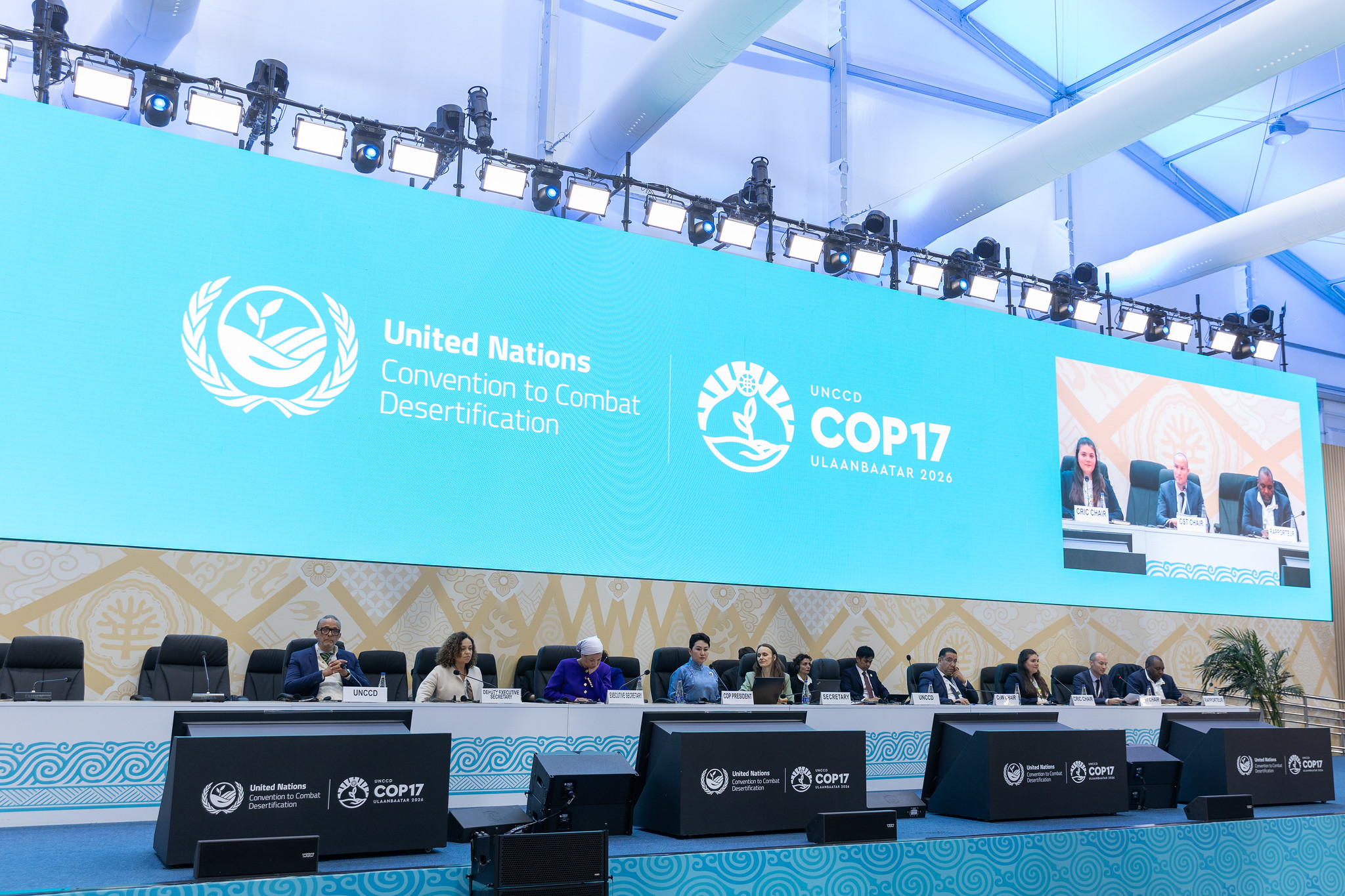
US$1.3 billion portfolio of finance for land restoration and drought resilience across 23 countries, with rangelands at its centre through a US$1.2 billion portfolio spanning 45 projects Progress toward Land Degradation Neutrality (LDN), with Brazil presenting a new voluntary 2030 LDN target comprising 17 sub-targets, while Central Asia has already achieved half of its LDN targets.The Riyadh Global Drought Resilience Partnership, launched by Saudi Arabia at COP16, moved closer to operational delivery in Ulaanbaatar, advancing work on a proposed pooled fund to support around 70 vulnerable countries. UNCCD and Luxembourg launched the Drought Resilience Investment Facility, which aims to mobilize up to US$400 million in public and private capital for drought resilience. ULAANBAATAR, MONGOLIA, 28 August 2026 — After two weeks of negotiations on how to tackle land degradation, desertification and drought, the seventeenth session of the Conference of the Parties to the United Nations Convention to Combat Desertification (UNCCD COP17) concluded today in Ulaanbaatar, Mongolia. Across the negotiated and Action Agenda tracks, Ulaanbaatar brought together key elements of implementation: political direction, science, finance, investment-ready projects, partnerships and stronger participation by the people who manage the world’s land. The biannual meeting of the UNCCD's 197 Parties put the world’s rangelands — which cover 54 per cent of the Earth's land surface, support around two billion people and are stewarded by some 500 million pastoralists — at the centre of the global land agenda. Launched in Ulaanbaatar during the International Year of Rangelands and Pastoralists, the Rangelands Flagship Initiative brings together US$1.2 billion across 45 projects, the largest single mobilization for rangelands in the Convention’s history. Alongside the negotiations, COP17 delivered a series of initiatives and financial commitments aimed at accelerating action on land restoration and drought resilience. Governments, development banks, funds and companies announced a US$1.3 billion portfolio of finance across 23 countries on five continents, at different stages of development. This includes US$644.5 million identified as new finance, of which US$216.4 million is already confirmed and moving towards implementation. UNCCD Executive Secretary Yasmine Fouad said: “We came to Ulaanbaatar saying that COP17 must be a COP of implementation. We leave with more of the architecture needed to make that possible. - political decisions, stronger science, innovative financing mechanisms, investment pipelines and partnerships that can move solutions to scale. But Ulaanbaatar will not be judged by what was announced inside this conference. Its legacy will be measured by what happens next: whether countries are better prepared for drought, whether degraded land and rangelands are restored, whether finance reaches viable projects, and whether the people who manage the land see a real difference in their lives.” H.E. Battsetseg Batmunkh, Minister for Foreign Affairs of Mongolia and UNCCD COP17 President, said: "As the Host Country and President of the 17th Session of the Conference of the Parties to the United Nations Convention to Combat Desertification, Mongolia has worked in the spirit of ensuring open, transparent, inclusive and consensus-driven atmosphere for the discussions and striving to bring Parties’ positions closer in order to achieve tangible results. Within the International Year of Rangelands and Pastoralists, Mongolia has demonstrated to the world that pastures form a strategically important ecosystem which connects food, environment, economy, biodiversity and herdcers’ livelihoods. In exercizing the Presidency of the 17th Session of the Conference of the Parties to the United Nations Convention to Combat Desertification, Mongolia was guided by the principle of “from promises to implementation and from discussions to real work”. H.E. Sandag-Ochir Tsend, Minister of Environment and Climate Change of Mongolia and Chair of the National Committee for the Organization of UNCCD COP17, said: "Mongolia successfully hosted the 17th session of the Conference of the Parties to the United Nations Convention to Combat Desertification (UNCCD COP17), bringing countries from around the world together to advance practical solutions to desertification, land degradation, and drought. One of the conference’s most significant outcomes for Mongolia was securing support from Parties, international organizations, the private sector, and civil society for the “Steppe Plan”a key policy legacy of COP17. Under the Steppe Plan, the Government of Mongolia officially launched three international initiatives: the Rangelands Flagship Initiative, the Water–Land Nexus Initiative, and the Nature-based Solutions for Sustainable Infrastructure Initiative. These initiatives have created new opportunities to develop projects, strengthen international cooperation, and mobilize investment in these priority areas. Although COP17 concludes today, our work does not end here. Our next priority is to translate the decisions adopted, partnerships established, and investment commitments secured at the conference into tangible action and to ensure that the initiatives launched from Mongolia’s steppes deliver measurable results." From commitments to implementation The conference took place against a stark global backdrop. Up to 40 per cent of the world’s land is degraded, while countries have committed to restoring more than one billion hectares by 2030. More than 70 countries now have national drought plans, compared with only three in 2013, but financing and implementation continue to lag behind the scale and speed of the challenge. Against this backdrop, Parties called for greater mobilization of financial resources, capacity-building and technical cooperation to strengthen proactive drought management, particularly in African countries, without neglecting other affected developing countries. A significant body of new evidence presented in Ulaanbaatar highlighted both the costs of inaction and the benefits of investing in healthy land. New reports examined the economics of restoring the world’s rangelands, the growing human and economic impacts of drought, the particular challenges facing Small Island Developing States and Central Asia, and the value of investing in soil health. The findings showed that 18.8 million hectares of land are degraded across SIDS, while in Central Asia more than 80 million hectares — over a quarter of the region — are already degraded, affecting 24 million people. At the same time, all five Central Asian countries have adopted voluntary Land Degradation Neutrality targets, half of which have already been met. Together, the reports showed how land degradation and drought are affecting food and water security, livelihoods and economies across diverse regions, while making the economic case for prevention, sustainable land management and restoration. Alongside this new evidence, Brazil presented a major national commitment through its voluntary Land Degradation Neutrality (LDN) target for 2030, comprising 17 sub-targets linked to national policies, plans and programmes. The target includes the recovery or restoration of more than 163,000 km², including through native vegetation recovery and agroforestry systems, while a further 3.51 million km² are covered by measures aimed at preventing degradation through conservation and sustainable land management. Together, the 17 sub-targets cover approximately 3.67 million km². This commitment supports Brazil’s efforts to achieve Sustainable Development Goal 15.3 by avoiding, reducing and reversing land degradation, while strengthening food and water security, biodiversity and climate resilience. A new global architecture for drought resilience Following sustained negotiations, Parties decided to continue discussions at COP18, building on progress made at COP16 and COP17, with a view to adopting a decision on the proactive management of drought at all levels. Parties also decided that drought will remain a stand-alone agenda item at COP18 and at each ordinary session thereafter. The Riyadh Global Drought Resilience Partnership, established at COP16, moved towards implementation in Ulaanbaatar. Its first Assembly of Partners advanced work on a proposed pooled fund intended to help around 70 low- and lower-middle-income countries through capacity-building, investment-ready programmes and financing for drought resilience. COP17 also saw the launch of the Drought Resilience Investment Facility (DRIF), the first global catalytic financing platform dedicated to drought resilience. Co-created by UNCCD and Luxembourg with support from the International Drought Resilience Alliance, the Facility aims to mobilize up to US$400 million in public and private capital for investments in water security, sustainable agriculture, nature-based solutions and land restoration. Its first strategic partnership with the Global Environment Facility will explore opportunities to unlock private and philanthropic finance. Phase II of the International Drought Resilience Observatory also introduced the world’s first Drought Resilience Index, providing countries with a new tool to assess their capacity to anticipate, prepare for and adapt to drought and to better target policies and investment. Finance for land moves up the agenda COP17 also sought to narrow the gap between global land commitments and the finance available to deliver them. z zzzz An estimated US$355 billion a year is needed through 2030 to meet global land restoration commitments, compared with around US$77 billion currently invested, leaving an annual financing gap of US$278 billion. Private finance accounts for only around six per cent of global investment in land restoration. Governments, development banks, funds and companies announced a US$1.3 billion portfolio of finance for land restoration and drought resilience across 23 countries on five continents, at different stages of development. Of this, US$644.5 million is identified as new finance, with US$216.4 million already confirmed and moving towards implementation. The portfolio spans rangeland and landscape restoration, drought resilience and locally led adaptation. Discussions in Ulaanbaatar also focused on addressing barriers that have kept investment in land low, including how to make land, soil health and drought resilience more visible and trackable within existing nature-finance categories. Participants also explored greater use of guarantees, first-loss capital, insurance and project-preparation facilities to turn restoration plans into investment-ready projects. Host country Mongolia launched the first national Business 4 Land (B4L) Hub, alongside sustainable finance principles, a national green taxonomy and a target for 10 per cent green lending by 2030. Russia followed with its own national hub, while Luxembourg moved to establish a B4L Foundation and Germany supported a B4L Finance Expert Group. Rangelands: from overlooked ecosystems to economic assets Hosted by Mongolia during the United Nations International Year of Rangelands and Pastoralists, COP17 gave particular prominence to rangelands and the people who manage them. Parties recognized pastoralists as essential stewards of rangeland ecosystems, highlighting the importance of transboundary mobility and the value of pastoralists’ knowledge and experience. Despite their global importance, rangelands remain largely overlooked in policy and investment: they contain roughly onethird of the world’s key biodiversity areas, yet feature in the national climate plans of only 24 countries, compared with 181 for forests. New economic analysis presented in Ulaanbaatar estimated that rangelands generate US$21–47 trillion in ecosystem services every year — up to nearly half of global GDP — through benefits including food production, water, carbon storage and biodiversity. Restoring rangelands typically returns US$4–6 for every dollar invested, rising to as much as US$36 when wider public benefits such as water supply are included. The Rangelands Flagship Initiative announced at COP17 seeks to translate that economic case into investment, bringing together projects supporting sustainable rangeland management, restoration and pastoralist livelihoods. The Global Environment Facility is supporting coordination of the initiative through a US$3.3 million investment in the UNCCD COP17 Legacy Project. Over the past four years, the Fund has also approved more than 50 projects worth over US$300 million benefiting rangelands and pastoralist communities. Indigenous Peoples and local communities convene new caucuses at COP17 The conference marked the first formal meetings of the UNCCD Indigenous Peoples Caucus and Local Communities Caucus, following the decision by Parties at COP16 in Riyadh to establish the two bodies and provide dedicated spaces for their perspectives and priorities within the Convention. It also brought together the largest representation of Indigenous Peoples in the history of a UNCCD Conference of the Parties. A high-level special event on Land and People Day highlighted Indigenous Peoples as rights holders, knowledge holders and implementation partners, focusing on Indigenous knowledge systems, customary governance, sustainable pastoralism, land stewardship and direct access to finance for Indigenous-led action. Across COP17, Indigenous Peoples, pastoralists and local communities called for stronger land and mobility rights, greater direct access to finance, meaningful participation in decision-making and recognition of Indigenous and traditional knowledge in land restoration and drought resilience. Discussions also highlighted women and youth leadership, including calls to invest in young people as land restoration leaders and strengthen their participation in action on land and drought. From Mongolia to Egypt The next session of the UNCCD Conference of the Parties, COP18, is expected to take place in Egypt, in 2028, carrying forward the momentum built in Ulaanbaatar. Looking ahead, Egypt has emphasized the importance of strengthening cooperation and promoting integrated approaches to land degradation, climate change and biodiversity loss that strengthen food and water security and resilience. COP18 will provide the next major milestone for countries to assess progress on land restoration and drought resilience and build on the outcomes reached in Ulaanbaatar. Notes to editors For media enquiries and interview requests: UNCCD Press Office: press@unccd.int COP17 decisions are available here: https://www.unccd.int/cop17/official-documents About UNCCD The United Nations Convention to Combat Desertification (UNCCD) is the global vision and voice for land. We unite governments, scientists, policymakers, private sector and communities around a shared vision and global action to restore and manage the world’s land for the sustainability of humanity and the planet. Much more than an international treaty signed by 197 Parties, UNCCD is a multilateral commitment to mitigating today’s impacts of land degradation and advancing tomorrow’s land stewardship in order to provide food, water, shelter and economic opportunity to all people in an equitable and inclusive manner.

Closing DayOn Friday, 28 August, delegates gather as the seventeenth session of the Conference of the Parties (COP17) to the United Nations Convention to Combat Desertification concludes with the adoption of final decisions and reports, bringing the two-week conference to a close.KEY EVENTS FOR MEDIACOP17 Closing Press ConferenceWhen: 17:00Where: Press Conference RoomSpeakers:Yasmine Fouad (UNCCD Executive Secretary)Battsetseg Batmunkh (COP17 President and Minister of Foreign Affairs of Mongolia)Journalists are invited to attend the final press conference, where leadership present the main outcomes and reflections on COP17, outlining key decisions adopted by the Parties at the close of the session.Side EventsSide events throughout the day will cover rangelands and pastoralism, finance, drought resilience, land tenure, healthy soils and the land-water nexus.Journalists are encouraged to consult the official COP17 programme for the full schedule and latest updates : https://www.unccd.int/cop17/programmeMEDIA RESOURCESCOP17 programmeUNCCD COP17 websiteHost country websiteUNCCD Action Dome websiteUN WebTV – Live broadcast of key plenary sessions with live interpretation in all six UN languagesUNCCD COP17 Visual Assets and Branding ResourcesEarth Negotiations Bulletin – daily coverage, photographs and analysisFor media enquiries and interview requests: UNCCD Press Office: press@unccd.int
