Stories
Latest
This World Soil Day, UNCCD invites you to enjoy the Kids4Land e-book. It is a collection of entries from our recent art competition, where we have invited children from all over the world to share with us their vision of the land they would like to live on in the future. Together with their artwork, the kids also shared some profound messages. Beyond reminding us that we don't inherit our land from our ancestors but rather borrow them from our children, the kids have demonstrated that they ready to care for the future of their planet. "I tried to show what I’d like my future land to look like: a peaceful and united place, with humans and animals living on the land free of pollution and full of natural beauty and resources."" — Shoma from Bangladesh I want the land of the future to be beautiful. There's no drought because it rains everywhere, even in the desert. The rain brings out colorful rainbows, lots of water on the land and plenty of fish. And every child grows healthy and happy." — Hu Qingqing from Singapore "Nature is the most important thing, we have to look after it, we are nature too. We mustn’t forget that our countryside and animals are under threat from pesticides and climate change, we have to care for every part of the planet." — Benjamin Fallow from the UK Together with the German cartoonist Özi, we went through all the pictures and selected the 30 best, representing every region of the world. The finalists were invited to participate in an online master class on how to draw better. UNCCD also sent gifts and a certificate to recognize the top six submissions. Learn more: Download the e-book View the competition album on Flickr

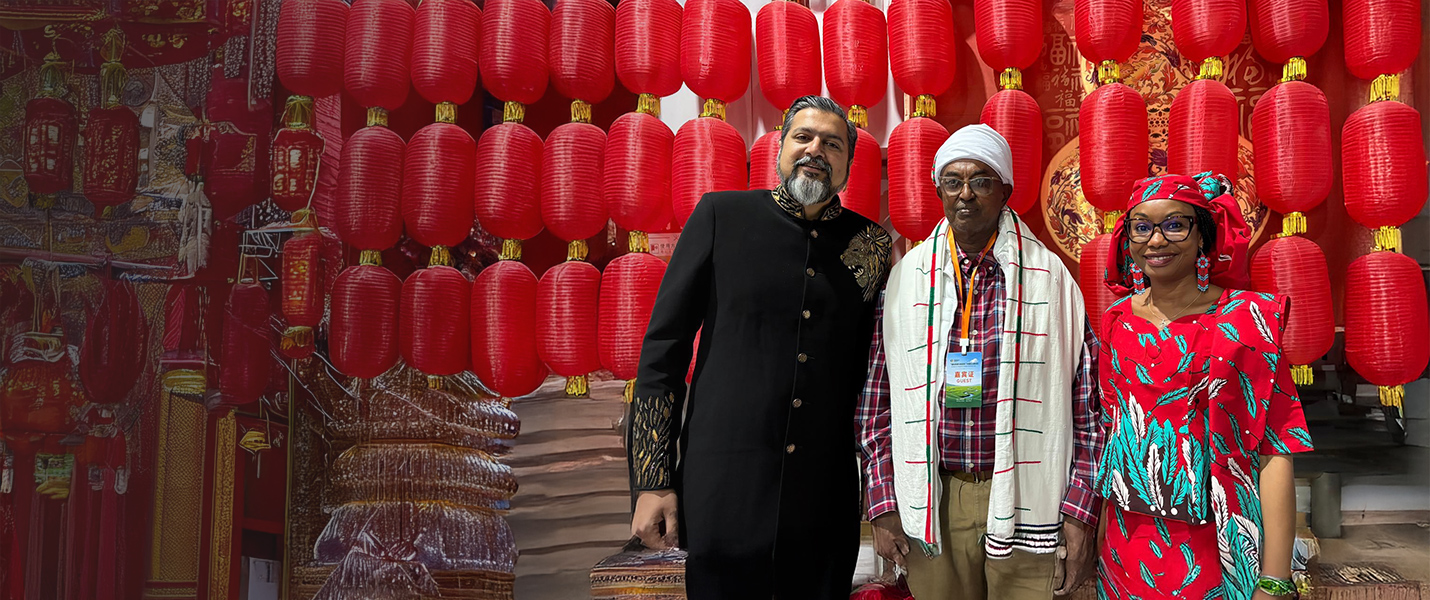
UNCCD has recently renewed its partnership with Baaba Maal who is one of the six UNCCD Land Ambassadors. Hailing from the region of the Senegal River which is home to millions of people living in four Western African countries: Senegal, Mali, Guinea and Mauritania, the music legend Baaba Maal has vowed to fight desertification and climate change in the Sahel, by planting trees and making it a land of green. A singer and guitarist who has released albums since 1989 in a music career lauded across the world, Baaba Maal lent his unique voice to the sound track of the international blockbuster Black Panther, a film that won an Oscar and a Grammy Award for its music score. Since 2003, the musician has been committed to fighting various development challenges in Africa. His popularity means that he can make global impact to help create a new narrative for the Sahel as a region of opportunities, where a Great Green Wall Initiative works to transform lives of humanity’s most vulnerable people by creating green jobs, harnessing the Sahel’s abundant solar energy and building and prosperous future on land. "My music and songs use many words to describe the beauty of the Sahel – but now the beauty is disappearing and people are moving away from their villages. I want my music to call people to fix things, again. The first step is planting trees." — Baaba Maal Photo (L to R): Baaba Maal with UNCCD Executive Secretary Ibrahim Thiaw Read more: Land Ambassadors Great Green Wall

As the COP26 closes with a call for more ambitious and measurable climate actions by governments, activists around the world are ramping up their efforts to continue work outside the conference halls. Our Land Ambassador, a Malian-French singer and songwriter Inna Modja, in her recent interview with CNN presented the CodeGreen, a new coalition of artists and coders who want to use non-fungible token (NFT) auctions to raise money for climate projects. Inna, who is a co-founder of CodeGreen, discussed its potential to mobilize funds for projects along the Great Green Wall. In the Sahel, where 80 per cent of the population rely on agriculture for their livelihood, the Great Green Wall goes beyond growing trees to create opportunities for vulnerable populations, especially, for youth and women. The first CodeGreen is planned for the World Economic Forum in Davos. Watch the interview here

Communities all over the world have suffered some of the most brutal effects of drought and flooding this year. Flash floods in western Europe, eastern and central Asia and southern African. And catastrophic drought in Australia, southern Africa, southern Asia, much of Latin America, western North America and Siberia are cases in point. The impacts extend well beyond the individual events. For example, the rise in food insecurity in the southern African region and unprecedented wildfires in North America, Europe and Central Asia. What is going on? This is much more than bad weather in some cases, and is increasingly so. The UNCCD organized an event at COP26, the Climate Change Conference taking place in Glasgow, United Kingdom, to focus attention on the land-water-climate nexus. The science and policy responses discussed make it clear that human decisions exacerbated by climate change are significantly – and arguably, catastrophically – amplifying the impact of drought and floods. The discussion encouraged more strategic land use decisions. Decisions that ensure what we do where, and in particular, what we plant where, mitigatesthe impacts of both extremes, be it too much or too little rainfall. It also shed light on how important it is to have healthy soils. Soils that are replete with organic matter will obtain “more crop per drop”, and reduce the risks associated with drought and flooding. Extreme events, including both droughts and floods are on the rise. With more land projected to be get drier and more and more people living in drylandsin the future, the discussions centered on the shift more than 60 countries are making from “reactive” response to droughts and floods to “proactive” planning and risk management designed to build resilience. Participants from Malawi, Pakistan, Honduras, Grenada and Burkina Faso provided concrete examples of policy alignment and cross-sectorial approaches to implementation. Here is a quick overview of the highlights. Read more: Land and drought

After a year of hard work, the UNCCD Performance Review and Implementation System (PRAIS) has undergone a major upgrade –from the 3rd (PRAIS 3) to 4th edition (PRAIS 4).

Enhancing knowledge on the differentiated impacts of land degradation, desertification and drought on women and men With a view to strengthening gender-related knowledge, the United Nations Convention to Combat Desertification (UNCCD) secretariat is currently conducting a "Study on the differentiated impacts of land degradation, desertification, and drought on women and men." The study aims to address the socio-economic dimensions of land degradation and desertification with a gender lens and document existing practices. In line with objective 4 of the UNCCD Gender Action Plan, this study will also contribute to developing a baseline on gender-related issues in land degradation and desertification. It builds on the efforts of the UNCCD Parties to produce gender-related knowledge and sex-disaggregated data on matters relevant to the Convention. The Secretariat seeks to collect cases studies and promising practices from Convention Parties, international organizations, civil society organizations (national and international), indigenous peoples’ organizations, academia, and other relevant actors on 5 different topics: Information and data on differentiated gender roles in the communities fighting land degradation, desertification, and drought. How women and men experience changes in environmental conditions, in particular land degradation, desertification, and drought. How land degradation affects women’s empowerment (including participation, economic empowerment, health, mobility, access to and use of resources, access to social services). How land degradation exacerbates the socio-economic vulnerability of specific groups of women. How gender is mainstreamed in national policies related to desertification and land degradation. Transformative actions taken by governments at the national level to ensure that women and men benefit equally from policies and programs addressing land degradation, desertification, and drought. Case studies submitted in English, French, or Spanish will be reviewed and collated, and the Secretariat may follow up to gather further information on individual projects or case studies. Case studies should be sent by 1 December 2021 to the following address: gender@unccd.int .You can also contact us at this address in case you have any questions. Download the questionnaire: PDF | WORD Read more: UNCCD Gender Action Plan Land tenure
