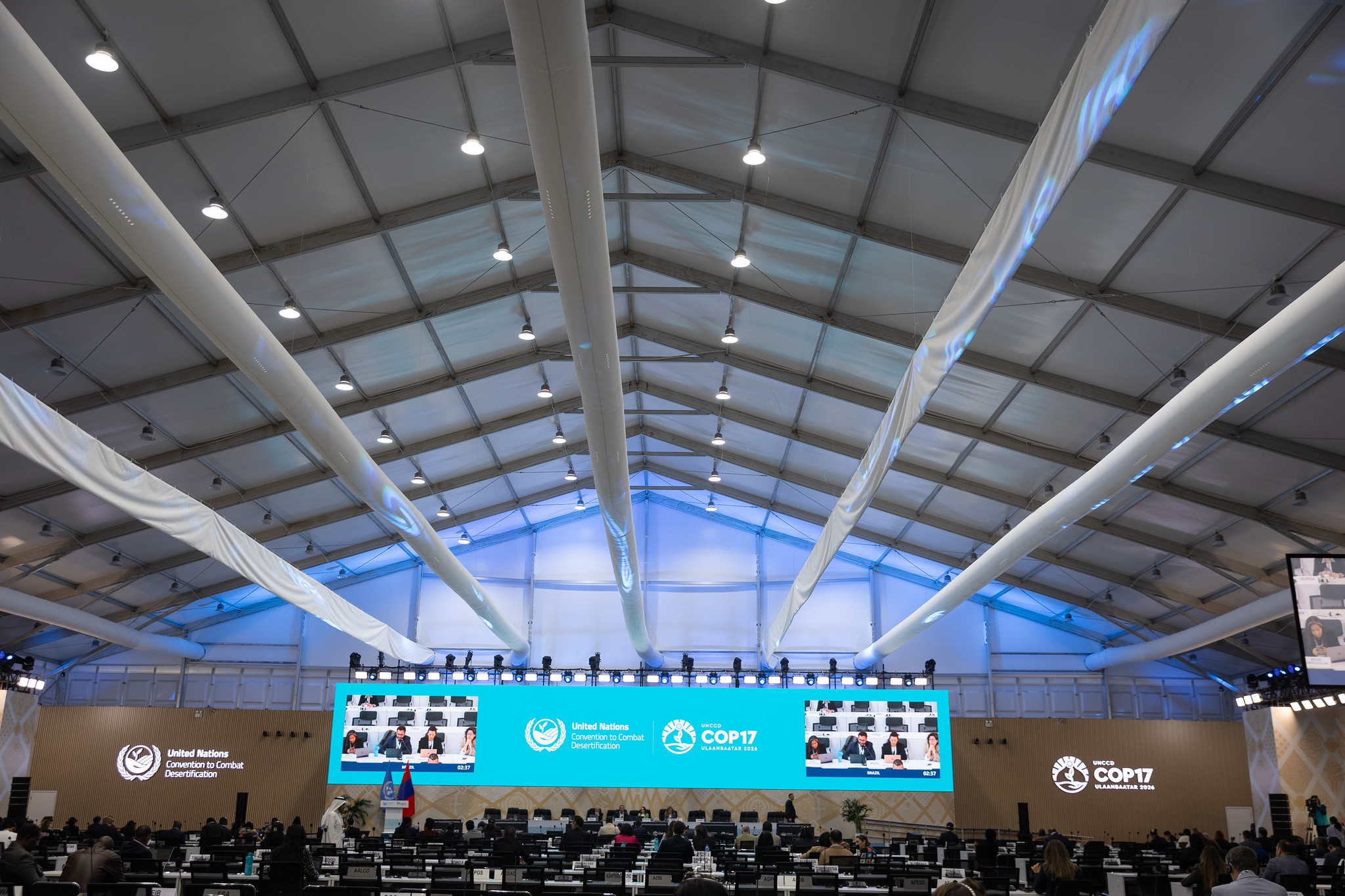

Ulaanbaatar, Mongolia, 21 August 2026 — About 30 mayors, governors and other local and regional leaders gathered this week at the UNCCD COP17 Mayors' Forum adopted the Ulaanbaatar Declaration, committing to advance local action on sustainable land management and drought resilience, and calling for a stronger, more permanent role for cities and regions in the United Nations Convention to Combat Desertification (UNCCD) process.The Forum, held from 20 to 22 August 2026 in Ulaanbaatar, Mongolia, was hosted by the Governor's Office of the Capital City of Ulaanbaatar and co-organized by the UNCCD Secretariat, the United Nations Human Settlements Programme (UN-Habitat), the Local2030 Coalition and ICLEI – Local Governments for Sustainability (ICLEI), with United Cities and Local Governments (UCLG), through the Global Taskforce of Local and Regional Governments (GTF), as key partner. It brought together over 200 participants from more than 30 countries, including local and regional leaders, international organizations, city networks, financial institutions, academic and research bodies, and private sector representatives.At the Forum, the Ulaanbaatar Initiative was also put forward. Led by the Capital City of Ulaanbaatar, this voluntary effort will test a practical way for cities to measure and report on land degradation, with results shared with the Convention by COP18.What the Ulaanbaatar Declaration commits toThe Ulaanbaatar Declaration builds on the commitments made by local and regional governments at UNCCD COP16 in Riyadh, Saudi Arabia. Ulaanbaatar carries this process forward, moving from political recognition towards sustained engagement and implementation between COPs.The Declaration, titled Local Leadership for Land Resilience: Advancing Implementation across the Rio Conventions, sets out five calls to action addressed to local and regional governments, UNCCD Parties, the UNCCD Secretariat and their partners:Advance integrated local action on sustainable land management, drought resilience, biodiversity, climate resilience, water security and sustainable urban development, while strengthening urban-rural linkages. These interconnected challenges demand integrated, locally led solutions.Strengthen the role of local and regional governments within the UNCCD process itself, including through more structured and regular engagement between sessions of the Conference of the Parties, building on the Riyadh Process.Strengthen coherence across the three Rio Conventions and the water agenda, encouraging more coordinated implementation at the local level and thereby advancing the 2030 Agenda.Support implementation through partnerships and finance, including calls for more direct, simplified and predictable access to finance for local and regional governments.Promote knowledge, innovation and cooperation, including peer learning and the exchange of practical experience such as nature-based solutions.By transitioning from advocacy to implementation alliances, the Declaration directly turns global commitments into concrete, on-the-ground action to advance SDG 6 worldwide — marking a key milestone on the Local2030 Coalition’s "Road to Abu Dhabi: The Local Way"— a dedicated stakeholder engagement journey to shape global agendas ahead of the 2026 UN Water Conference and the 2027 SDG Summit.Signatories commit to advancing local action on sustainable land management, land restoration and drought resilience, deepening cooperation between cities and regions, and promoting inclusive approaches that engage communities, youth, women and Indigenous Peoples. The Declaration also reaffirms the Riyadh Process as the continuing platform for structured dialogue between the UNCCD, its Parties and organized local and regional governments.QuotesB.Purevdagva, Governor of the Capital City and Mayor of Ulaanbaatar: “Land resilience is not an abstract global agenda. It is about whether our cities can provide safe water, clean air, green spaces, secure livelihoods and a healthy future for our children and our communities. Through the Ulaanbaatar Declaration and the Ulaanbaatar Initiative, we are advancing a people-centered, gender-sensitive and child-friendly approach to sustainable urban development, aligned with the Sustainable Development Goals. Ulaanbaatar is proud to help connect local and regional governments across dryland and extreme-climate regions, so that cities can share knowledge, measure land degradation more practically, and turn global commitments into action in our communities. This initiative is our contribution to a stronger regional and global network of cities working together for land, water, climate resilience and future generations.”Yasmine Fouad, Executive Secretary of the UNCCD: “National commitments set the direction, but implementation ultimately happens in cities, regions and communities. Local and regional governments make many decisions that shape how land and water are managed, how communities prepare for drought, extreme heat and other climate-related risks. And how resilient infrastructure and services are delivered. The Ulaanbaatar Declaration is an important step in moving from recognition of their role to sustained engagement and practical action. Their experience, knowledge and proximity to communities are essential if we are to turn global commitments into measurable results on the ground.”Ursula Sautter, Deputy Mayor of Bonn, Germany: "This process started in Bonn in 1999, and it means a great deal to see it reach this point almost thirty years later, with mayors from every region adopting a shared declaration. Bonn will continue to stand behind this work, as a founding partner of this dialogue and as home to the UNCCD Secretariat.”Ji Rimutu, Deputy Mayor of Ordos, China: “Participating in this Mayors' Forum, I deeply feel that local governments are the key implementers in desertification control. Ordos's practice of "holding back the desert with green growth" demonstrates that firm governance commitment and continuous innovative measures can rejuvenate deserts. We look forward to deepening cooperation with all cities, sharing sand-control technologies, jointly shouldering ecological responsibilities, and striving hand in hand to enhance the green well-being of all humanity.”Ingrid Cavalcanti Feitosa, State Secretary for Environment, Sustainability and Climate Action of Sergipe, Brazil: "The impacts of desertification are felt most directly at the local level, which is why subnational governments play a strategic role in developing effective solutions. For Sergipe, supporting the Ulaanbaatar Declaration is an opportunity not only to push for actions on land and drought, but also to share our experience in strengthening protected areas, restoring degraded lands and advancing climate adaptation policies, particularly in the Caatinga — an exclusively Brazilian biome that faces significant challenges related to desertification, many of which are interconnected with those experienced by other territories. Knowledge exchange and international cooperation are essential to strengthening our capacity to respond to a challenge that transcends borders."Oumar Ba, Mayor of Ndiob, President of the Association of Mayors of Senegal, President of UCLG Africa: “Local and regional governments are essential partners in turning global commitments on land restoration and drought resilience into action in our territories. Through UCLG and the Global Taskforce of Local and Regional Governments, we are bringing our collective experience and priorities into the UNCCD process. Building on the progress achieved in Riyadh, the Ulaanbaatar Mayors’ Forum must further strengthen the recognition and meaningful participation of local and regional governments in global land governance.”Anacláudia Rossbach, UN-Habitat Executive Director: “Urbanization, land and water are deeply interconnected challenges that require locally led solutions. The New Urban Agenda recognizes the social and ecological functions of land, while the right to adequate housing is at the heart of sustainable development and linked to access to water, public space and basic services. Following the reviews of SDG 11 and the New Urban Agenda, the Ulaanbaatar Declaration reinforces our commitment to move from global ambition to implementation. As co-chair of the Local2030 Coalition, UN-Habitat is committed to unlocking more direct and predictable finance for local governments. From Ulaanbaatar to Abu Dhabi, we must turn global commitments into tangible improvements, ensuring that no one and no place is left behind.”Prince Faisal bin Abdulaziz bin Ayyaf, Mayor of Riyadh, Saudi Arabia: "Cities are at the heart of sustainable development. They are platforms for advancing innovative solutions and translating ambition into tangible impact. This underscores the importance of empowering local action and strengthening cooperation among cities to address shared challenges. We aspire for the 11th World Water Forum, hosted in Riyadh in 2027, to serve as a global platform for strengthening the role of cities in exchanging experiences that contribute to shaping a more sustainable water future."Building on nearly three decades of city engagementThe Mayors' Forum builds on a process of municipal cooperation on desertification that dates back to the World Forum of Mayors on Cities and Desertification, held in Bonn, Germany, in 1999, and that has since continued through forums in Rome, Italy; Ordos, China; and Riyadh, Saudi Arabia. The 2024 Riyadh Mayors' Forum affirmed the essential role of local and regional governments in addressing land degradation, desertification and drought, a role that this year's Forum sought to deepen further.This year represents a historic junction for global policy, converging the World Urban Forum (WUF13), the global review of SDG11, the midterm review of the New Urban Agenda, and the three Rio Conventions COPs—with the UN Water Conference in Abu Dhabi serving as the crucial capstone. Forum participants highlighted this as a rare opportunity to strengthen coherence across the global agendas on land, biodiversity, climate and water, and to ensure local and regional governments are recognized as central actors in delivering on all three. They also emphasized that localization is the ultimate engine for systems change, turning global policy into local impact, building on lessons from a series of major UN gatherings over the past two years: the Fourth International Conference on Financing for Development in Seville, Spain; the Second World Summit for Social Development in Doha, Qatar; and the UNFCCC Conferences of the Parties in Baku, Azerbaijan, and Belém, Brazil.Over three days, the Forum combined high-level policy dialogue with technical exchange and peer-to-peer learning. Sessions addressed urban ecosystem restoration and sand and dust storms, water scarcity and drought resilience, sustainable urban growth and land use, and financing mechanisms to move commitments into implementation.Following the Forum, the UNCCD Secretariat and partners will work together to track voluntary progress on the Declaration's commitments, with findings to be presented at the next Mayors' Forum and at UNCCD COP18.About UlanbaatarUlaanbaatar is the capital city and economic, political and cultural centre of Mongolia, home to nearly half of the country’s population and serving as the main hub for government, business, education, innovation and international cooperation. Located in a high-altitude valley connected to wider rangeland, forest and river ecosystems, the city faces many challenges common to dryland and extreme-climate cities, including air pollution, water security, land degradation, rapid urban growth and climate-related risks. Guided by its long-term development vision, Ulaanbaatar is working to become a more people-centred, gender-sensitive, child-friendly, green and resilient city, while using the Ulaanbaatar Declaration and the Ulaanbaatar Initiative to strengthen global and regional cooperation and contribute practical solutions for sustainable land management, urban resilience and the localization of the Sustainable Development Goals.About UNCCDThe United Nations Convention to Combat Desertification (UNCCD) is the global vision and voice for land. We unite governments, scientists, policymakers, private sector and communities around a shared vision and global action to restore and manage the world’s land for the sustainability of humanity and the planet. Much more than an international treaty signed by 197 Parties, UNCCD is a multilateral commitment to mitigating today’s impacts of land degradation and advancing tomorrow’s land stewardship in order to provide food, water, shelter and economic opportunity to all people in an equitable and inclusive manner.About ICLEIICLEI – Local Governments for Sustainability (known as ICLEI) is a global network working with more than 2500 local and regional governments committed to sustainable urban development. Active in 125+ countries, we influence sustainability policy and drive local action for zero-emission, nature-based, equitable, resilient and circular development. Our Members and team of experts work together through peer exchange, partnerships and capacity building to create systemic change for urban sustainability.About UCLGUnited Cities and Local Governments (UCLG) is the world’s largest organization of local and regional governments and their associations, representing and advocating for their interests on the global stage. Headquartered in Barcelona and present across all world regions, UCLG brings together cities, metropolitan and regional governments, and national and subnational associations to promote democratic local self-government, strengthen cooperation among territories, and amplify the collective voice of local and regional governments in international decision-making. Through advocacy, policy dialogue, knowledge-sharing and decentralized cooperation, UCLG works to ensure that local and regional governments are recognized as essential partners in addressing global challenges and advancing sustainable development that leaves no one and no place behind.About Local2030 CoalitionThe Local 2030 Coalition is the United Nations System platform to accelerate the localization of the 2030 Agenda, enhancing coherence, efficiency, and the impact of UN action. 14 UN entities drive the Coalition, co-chaired by UN-Habitat and UNECE, ensuring that the UN system is equipped to articulate global goals and national policies with local contexts, needs, and priorities, while securing a single and powerful UN approach to localization.About UN-HabitatUN-Habitat is the United Nations entity responsible for sustainable urbanization. It has programmes in over 90 countries supporting policymakers and communities to create socially and environmentally sustainable cities and towns. UN-Habitat promotes transformative change in cities through knowledge, policy advice, technical assistance, and collaborative action. To know more, visit unhabitat.org or follow us on social media @UNHABITAT.Media contact:Matteo Bizzotto, Senior Officer, Global Communications, ICLEI - Local Governments for Sustainability. matteo.bizzotto@iclei.org
Land provides the food we eat, the water we drink and the raw materials that power industries and economies. Yet nearly 40 per cent of the world's land is already degraded, threatening ecosystems, livelihoods and businesses alike.Reversing this trend requires action far beyond governments alone, with the private sector playing an increasingly important role in driving innovation, investment and sustainable land management.This is the vision behind Business for Land (B4L), the UNCCD main vehicle for engaging the private sector in sustainable land and water management. Through partnerships, policy dialogue and sustainable finance, B4L works with companies and financial institutions to help manage the risks associated with land degradation and drought while creating opportunities to restore landscapes, strengthen value chains and build more resilient economies.Building on the record level of private sector participation at the sixteenth session of the Conference of the Parties (COP16) to the United Nations Convention to Combat Desertification (UNCCD) in Riyadh, Business for Land will deepen its engagement at UNCCD COP17 in Ulaanbaatar, Mongolia. The Business Land Forum will bring together governments, businesses, investors and development partners to strengthen public-private partnerships and identify practical ways to accelerate investment and action on regenerative landscapes.One of the Forum's key outcomes will be the presentation of a new set of policy recommendations developed by the World Business Council for Sustainable Development (WBCSD), a global, CEO-led organization working with businesses to accelerate the transition to a more sustainable future.At the request of the UNCCD Business for Land initiative, WBCSD led a global consultation involving more than 50 businesses, producers, civil society organizations and ecosystem partners to identify practical policy changes that can unlock investment in regenerative landscapes. Drawing on the experience of businesses across agriculture, forestry, finance, food and manufacturing, the recommendations call for more coherent policy frameworks, stronger public-private collaboration and investment conditions that enable regenerative landscapes to be scaled. The recommendations will be formally presented during the Business for Land Forum on 24 August.“We need a systemic shift in the incentives that drive land use decisions so that sustainable land management becomes the default rather than the exception. I think it is absolutely true that this is an economic necessity and not just an act for the environment,” saidDr. Claudia Hiepe, UNCCD National Focal Point Team, Germany.The recommendations build on months of dialogue between governments and the private sector, including the Public-Private Dialogue on Regenerative Landscapes, co-hosted by the Governments of Germany and Côte d'Ivoire in partnership with WBCSD on 16 July. The dialogue provided an opportunity for governments and businesses to exchange priorities ahead of COP17 and helped shape the recommendations. Through the Action Agenda on Regenerative Landscapes, participating organizations have already committed more than USD 9 billion across over 210 million hectares, demonstrating growing momentum behind private sector action. “Businesses and governments have a shared interest in scaling regenerative landscapes. But achieving this requires trust and collaboration between the public and private sector. Going forward, it’s important that both sectors continue to strengthen their collaboration to co-create country-specific solutions and unlock investment for sustainable land management,” said Emeline Fellus, Senior Director, World Business Council for Sustainable Development.Despite this progress, financing remains one of the greatest challenges. UNCCD estimates that approximately USD 355 billion is needed every year to meet global land restoration and drought resilience commitments, while current investment stands at around USD 77 billion annually. Closing this USD 278 billion gap will require stronger policy frameworks, innovative financial solutions and closer collaboration between governments, businesses and financial institutions. "Restoring land at scale requires more than finance—it requires partnership. Governments create the enabling environment, businesses bring innovation and investment and financial institutions help unlock capital. Business for Land is about bringing these actors together so that ambition is translated into practical action and lasting impact," said Louise Baker, Managing Director of the UNCCD Global Mechanism. Alongside the recommendations, WBCSD has launched a Statement of Support, inviting companies to endorse a shared commitment to regenerative landscapes and closer collaboration with governments. Businesses are encouraged to support the initiative and work with policymakers to adapt and apply the recommendations in ways that respond to national priorities and accelerate investment in sustainable land management. By bringing together governments, businesses and financial institutions, the Business4Land Forum aims to turn growing momentum into practical partnerships that accelerate investment and action on regenerative landscapes.
A new report shows progress in restoring land, creating jobs and building resilience across the Sahel—while highlighting the scale of the work still aheadIn Garaké, Niger, a pond once choked by invasive plants has become a source of food, income and hope. After restoration work cleared the water and opened the land for crops, Abdoulaye Aboubacar began growing rice, maize, sugar cane, potatoes and sweet potatoes. He now feeds his family, sells the surplus and invests the income in other small businesses.Stories like his bring to life a new report marking five years of the Great Green Wall Accelerator an effort launched to help turn one of Africa’s most ambitious environmental visions into tangible progress for communities on the ground.Led by African countries and supported by partners including the United Nations Convention to Combat Desertification (UNCCD), the Great Green Wall (GGW) initiative has evolved from a bold vision into a growing effort to deliver results on the ground and at scale.Senegal / Kaolack regionThe world's largest living structureOften described as the world’s largest living structure, it spans a vast mosaic of restored landscapes, farms, water systems and communities stretching across Africa’s drylands. Founded in 2007 by the African Union and UNCCD, the Great Green Wall extends across 156 million hectares — from the Senegal River Basin in the west to the Horn of Africa in the east. The 11 founding member countries are Burkina Faso, Chad, Djibouti, Eritrea, Ethiopia, Mali, Mauritania, Niger, Nigeria, Senegal and Sudan.Five years into the Accelerator, the story is evolving—from ambition and scale to a stronger focus on tracking impact, improving transparency and building systems that can show what is working. It is no longer just about planting trees, but about whether large-scale restoration can deliver real change, fast enough, in one of the world’s most vulnerable regions.The initiative has long been thought of as a wall of trees. It’s more. A continental effort to restore degraded land, strengthen food systems and create new economic opportunities, while expanding access to clean energy and building resilience in one of the regions most exposed to climate change, land degradation and drought.Fetching water in NigerThe GGW Accelerator: Turning pledges into results on the groundLaunched in 2021 after the One Planet Summit, where major technical and financial partners pledged more than $19 billion, the Accelerator was created to improve coordination, track funding and help countries measure results. Five years later, the picture that emerges is still taking shape—but it is beginning to show how this effort is changing the way the Great Green Wall is planned, financed and monitored.Central to the Accelerator's success is its close partnership with the Panafrican Agency of the Great Green Wall (PAGGW), the intergovernmental body that coordinates regional implementation across borders. Together, the GGW Accelerator and the PAGGW work to convert financial commitments into tangible, measurable results across Africa's drylands, building the institutional architecture required for reporting and monitoring progress. The Observatory now tracks over 389 projects. But the data also tells a more complex story. Fewer than 90 currently report data aligned with the initiative’s harmonized indicators, highlighting both early progress and significant gaps in reporting that are still being addressed. Stonewall construction in Ethiopia's Tigray regionEven with these limitations, the available data points to early but meaningful gains: 1.66 million hectares under restoration, 24 million tons of CO₂ equivalent sequestered or mitigated, 4.6 million jobs created, 46 million beneficiaries reached and 2,315 MWh of clean energy produced.These results should be understood in the context of long-term land restoration processes, which can take years—sometimes decades—to fully materialize at scale, especially since reporting on the totality of GGW projects remains an iterative process that remains undergoing.For partners already investing in the Great Green Wall, the report offers a clearer —though still evolving— sense of how support is translating into results on the ground. For those considering future engagement, it points to something equally important: a growing architecture for transparency, accountability and investment readiness.Employment, women's leadership and the human face of restorationThe jobs figure is among the strongest early indicators of momentum. Against a 2030 target of 10 million jobs, the reported total suggests that restoration is not only an environmental undertaking but also an economic one. Across the Sahel, the Great Green Wall is increasingly being framed as a platform for rural enterprise, women’s leadership, youth employment and locally led adaptation.Reversing land degradation in Burkina FasoThe report’s human stories bring that shift into focus. In Mali, a women’s cooperative received tools, training and a tricycle that transformed the daily work of transporting organic fertilizer. The cooperative later expanded into processing local crops into enriched flour and was granted four hectares of land by the municipality. "We are leaders, innovators, and providers. Our daughters now see a future. Our municipality recognized our progress by granting us four hectares of land to scale up production. This is proof that women's leadership can inspire trust and collective action." — Florence Banou, 55, leader of the AMAKENE women's cooperative, Bandiagara, Mali — supported through WFP's Integrated Resilience ProgrammeIn Chad, women trained to install and repair solar panels turned clean energy access into a new source of income and independence."Since solar panels have come to Chad, families have benefitted a lot and women's lives have been transformed. Before, I depended on my husband. But today, we make a profit from each installation. Ever since I learned this job, I've wanted my sisters to follow my example." — Adouia Brema, Chad — trained to install and repair solar panels through a World Bank-supported initiativeSuch examples help reframe the Great Green Wall for its next phase—one that places greater emphasis on systems, data, and investment readiness alongside on-the-ground impact. They also point to three areas shaping what comes next: communication, innovative finance and transboundary land and water management. Together, they aim to build a stronger narrative, unlock financing tools such as green bonds, carbon credits and blended finance and align land restoration with shared water governance across borders. The next generation of land stewardsOne framework, one platform: Building a common evidence baseA central achievement is the move toward a common evidence base. This responds directly to longstanding challenges around fragmented data, coordination, and visibility of results. The Harmonized Results Management Framework, developed and validated with ten of the 11 countries in close collaboration with the PAGGW, gives partners a shared language for measuring progress. The GGW Observatory — launched in Ouagadougou in 2024 and now endorsed by 10 countries — builds on that foundation, offering a single platform for tracking projects, finance, results and geospatial data. Its indicators feed directly into real-time dashboards used by the GGW governments, donors and local communities.The Accelerator also supported the establishment of National Coalitions in nine of the 11 countries — bringing together Finance, Planning, Environment and Forestry ministries alongside civil society, academia, the private sector and media into whole-of-society platforms for GGW governance.Planting the seeds of the next harvest in SudanThe report also places the Sahelian effort within a wider continental frame, noting that the updated African Union Great Green Wall Strategy expands the initiative’s reach while keeping the Sahel as its foundation.The work ahead: From commitment to lasting impactThe work ahead remains substantial. Challenges persist, particularly in data completeness, coordination across actors, and the time required to translate financial commitments into on-the-ground results. Stronger national validation, more complete reporting and sustained political leadership will be needed to turn commitments into lasting impact. National coalitions, already supported in nine of the 11 countries, are expected to play a growing role in aligning ministries, donors, civil society and local actors.The PAGGW and the Accelerator will continue to use the COPs and Ministerial Councils to sustain political visibility and accountability, driving a unified 'One Africa GGW' momentum toward Mission 2030.This progress is supported by a broad coalition of partners working across the region. The next five years will be critical in turning these systems into real impact on the ground. The Great Green Wall is beginning to move from ambition to more visible and coordinated results—grounded not only in restoration, but in jobs, resilience and opportunity across Africa’s drylands.


How much you know about rangelands and pastoralists?
Upcoming events
Publication

Region of ancient traditions and modern perspectives
Publication

Integrated solutions for a more resilient future