News & stories

Latest news & stories
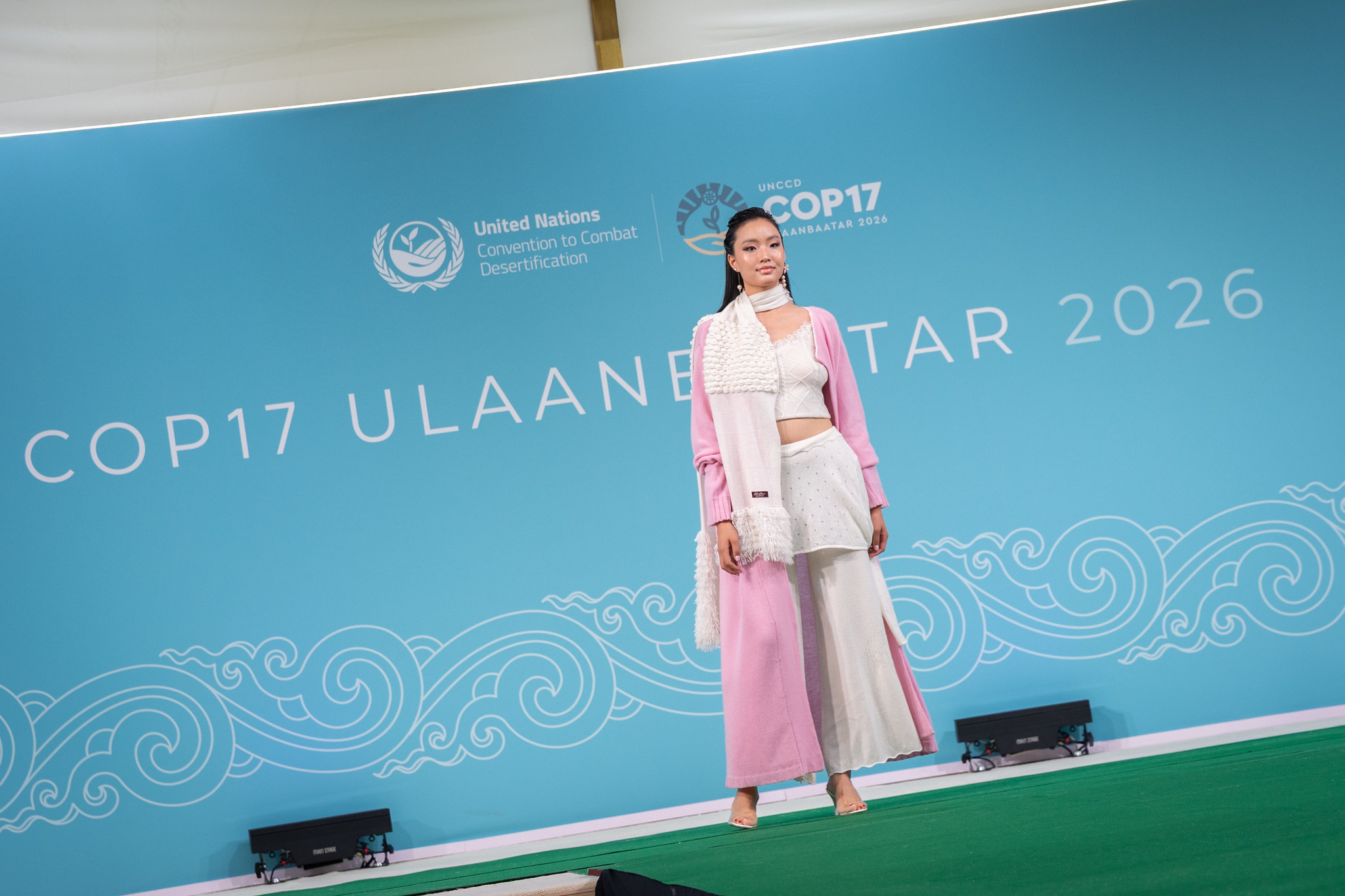
Cashmere can look weightless on a runway. Whether its footprint is equally light depends on the health of the rangelands that produce it. In Mongolia, around 190,000 herder households and 27 million goats are behind the fabled fiber that accounts for roughly 40 percent of the world’s raw cashmere. Its quality begins long before spinning or knitting, on vast rangelands that sustain animals and livelihoods but are also under growing pressure. Rangelands cover 54 per cent of the Earth’s terrestrial surface, and in Mongolia they make up more than 70 per cent of the country’s territory. Yet 81 per cent of Mongolia’s land is affected by degradation. This made Ulaanbaatar a fitting location for a new edition of Fashion4Land, which returned to UNCCD COP17 after its debut in Riyadh in 2024. What would it take to change the way clothes are designed, sourced, worn and regulated while retaining the talent, ingenuity and beauty that make people care about fashion in the first place? The forum brought together designers and manufacturers, global luxury brands and Mongolian producers, pastoralist advocates and policymakers around a simple premise: fashion begins on land. When discussing sustainable fashion, UNCCD Goodwill Ambassador Inna Modja sees an opportunity rather than a constraint. “Fashion has a unique ability to inspire, connect people and translate complex sustainability challenges into stories that everyone can understand,” she said. One such story is already famous. For Team Mongolia’s Milano Cortina 2026 Olympic wardrobe, GOYOL Cashmere’s Creative Director Munkhbayasgalan “Baysa” Delgerbat revisited clothing worn during the Mongol Empire, retaining details shaped by life on the steppe: a raised collar against the wind, an overlapping front for warmth and side slits designed for movement. “People don’t fall in love with a product because it is sustainable,” Baysa says. “People fall in love with story, with beauty, with craftsmanship.” A garment carrying cultural and material value, she argued, is more likely to be cared for, kept and eventually passed on. For Nan Hu of Nan Knits, the color of the fiber itself offers an exciting design opportunity. The brand leans toward the subtle shades of yak fiber — soft browns, dusky grays and creamy whites that become an irresistible palette rather than something to overwhelm with dye. For a designer known for experimental contemporary knitwear, the appeal lies in taking a well-known material somewhere unexpected. Sustainability, he argues, need not limit creativity – it can jump-start it. At LVMH, the raw material can mean something the industry has already made but was unable to sell. Alexandre Capelli described how designer Kevin Germanier gathers unsold products from the group’s boutiques, dismantles them and turns the material into new designs in which the initial object might be impossible to recognize. Other experiments with young designers involve regenerative flax, food-industry waste, discarded hotel linens and innovative materials for dyeing. The idea is not to make sustainability visible as an aesthetic. It is to make it part of how design happens. UNCCD Goodwill Ambassador Ricky Kej took that logic a step further. His #ReWear4Earth campaign began with a minor red-carpet heresy: wearing the same clothes to a next high-visibility event. Speaking at the COP17 Fashion4Land event, he challenged the disposable expectations encouraged by fast fashion and social media. “The Earth will not remember what we wore to our last party, but it will certainly remember how we treated it,” Kej said. “We do not need a different outfit for each Instagram photo.” But does a beautifully made garment worn for decades necessarily mean it is land-positive? Fashion4Land resists the convenient idea that “natural” automatically means sustainable. Cotton can place enormous demands on land and water. Wool and cashmere can contribute to overgrazing when production is poorly managed. Synthetic fibers depend heavily on fossil fuels and can shed microplastics. The question is: what is the impact of wearable beauty on the planet’s finite resources? For Battsetseg Batmunkh, Mongolia’s Minister of Foreign Affairs and COP17 President, that question reflects directly on livelihoods. New environmental requirements, she argued, should help producers improve rather than price herders and smaller businesses out of sustainable supply chains. “The future of sustainable fashion should be measured not only by the value of its products but also by how effectively it protects the land, ecosystem and communities upon which production depends,” she said. However, the more than 400 standards and certifications across textiles and fashion do not in themselves ensure that the industry’s environmental impacts are addressed. Mongolian producer Gantakhi Gantsetseg warned that repeated audits and certification fees can consume money without a cent reaching the rangelands they are intended to protect. The challenge is not weaker standards but smarter ones — compatible systems that reward measurable improvement in practice. UNCCD Executive Secretary Yasmine Fouad pointed to Mongolia’s ability to bring tradition into a modern industry while remaining “grounded at the land.” Fashion4Land’s next chapter, she said, should bring greater policy coherence, stronger partnerships and greater responsibility for “the people and the land together.” That evening, the COP17 Action Dome — a larger-than-life Mongolian ger — transformed into a runway. Each brand brought its own signature style to the catwalk: NOLUR spoke the language of quiet luxury in Mongolian cashmere; OYUNA wove nomadic heritage into contemporary design; Nan Knits took knitwear into new experimental territories; BODIOS brought the warmth, softness and comfort of Mongolian yak to the runway; TANGOLA traced yak fiber from high-altitude grasslands to the final stitch; GOYOL showcased the craftsmanship of a family-run Mongolian fashion house; GOBI celebrated cashmere’s natural colors and the traditional art of hand-combing; and Khanbogd turned Mongolian raw cashmere into finished fashion for the world, keeping the craftsmanship at home. Next time we are in the market for new clothes, let’s not forget: a stylish garment does not begin at the tailor’s table. Truly sustainable fashion helps keep the land healthy long after the runway season is over – and that is a pattern that never goes out of style. Photos : © UNCCD/Kiara Worth

At UNCCD COP17 in Ulaanbaatar, the Committee on Science and Technology examined how scientific evidence can help countries monitor land degradation, plan for drought and make informed choices about land management.

Drought resilience is not only about knowing when and where drought will occur. It is about understanding how well societies, economies, ecosystems and institutions can anticipate, prepare for and adapt to its impacts —and where action can make them better able to withstand the next shock.“We have become very good at observing drought. But we are still, in many ways, data-rich and decision-poor,” said UNCCD Chief Scientist Barron Orr at the launch. The challenge, he stressed, is to turn increasingly sophisticated drought information into actionable intelligence.”During the UNCCD COP17, the launch of Phase II (version Beta) of the International Drought Resilience Observatory (IDRO) brought together governments, scientists and international partners to address the challenge of how to turn growing knowledge about drought into stronger resilience.The launch introduced the Drought Resilience Index (DRI) to help countries assess their capacity to anticipate, prepare for and adapt to drought. By bringing together evidence across environmental, social, infrastructure and economic dimensions, the Index aims to show where resilience is weakest and where action and investment could make the greatest difference. The new tool has been developed under the International Drought Resilience Alliance (IDRA), with UNCCD and in collaboration with the Yale Center for Environment and Architecture and partner institutions from around the world. Now in beta, IDRO has been financed by Spain, which co-chairs IDRA with Senegal, and the European Union.From measuring drought to measuring resilience“As we are seeing from Europe to the Horn of Africa to the Panama Canal, drought does not stay where its starts,” said UNCCD Deputy Executive Secretary Andrea Meza, who noted that “its impacts cut across economies and ecosystems and persist over time. A drought affecting crops or water supplies in one place can disrupt energy, transport, supply chains and livelihoods far beyond where it began making it essential to manage drought risk in a cross-cutting manner and at all levels of governance”, she said.Meza added: “The same drought does not necessarily have the same impacts everywhere. Its consequences depend on the capacity of communities, economies and ecosystems to absorb the impact, adapt and recover. Resilience is about reducing that vulnerability, and IDRO can help us understand where it lies.”Meza placed IDRO within a broader global architecture for drought resilience, alongside IDRA, the Drought Resilience Investment Facility (DRIF) and the Riyadh Global Drought Resilience Partnership (RGDRP).Making resilience gaps visibleEdgar Gutiérrez, IDRO Senior Policy Advisor and former Minister of Environment and Energy of Costa Rica, described the Drought Resilience Index as “a practical decision compass —showing not only where drought risk exists, but where resilience is weakest, what dimension needs attention, and where action and investment can have the greatest preventive impact.”IDRO aids Users to explore how countries perform across three dimensions —Anticipate, Prepare and Adapt— and across four domains: the Natural Environment, Built Environment, People and Community, and Economy. Interactive maps, country profiles, underlying indicators and data sources, case studies and an AI-enabled function that helps interpret search results allow users to explore the evidence behind the Index.“A report is a snapshot, frozen at the time of publication”, said Anna Dyson, Founding Director of the Yale Center for Environment and Architecture (CEA). “IDRO turns the Drought Resilience Index into a practical tool, allowing users to go beyond a single score to understand what is driving resilience, identify priorities and support better-informed decisions.”María Jesús Rodríguez de Sancho, Director General for Forest Policy and Desertification Control at Spain’s Ministry for the Ecological Transition and the Demographic Challenge (MITECO), noted: “It is our hope that IDRO may contribute to bridge the gap between knowledge and action, by bringing together scientific evidence, local experience and policy-relevant information in a single platform.” Spain, which co-chairs IDRA with Senegal, has contributed one of IDRO’s in-depth case studies, alongside Australia, Brazil, Mongolia, Peru, Saudi Arabia, Senegal and the United States. Together, the case studies bring country experience into the platform, translating data and evidence into practical lessons that can be adapted to other contexts.Scientific and international partnersSenegal’s role as IDRA co-chair was also reflected in the launch, with Aliou Gory Diouf, Minister of Environment and Ecological Transition, highlighting the importance of international cooperation in strengthening drought resilience.The launch also brought together scientific and technical partners behind IDRO. Andrea Toreti, Senior Scientist and Head of the Copernicus EMS Drought Observatory at the European Commission’s Joint Research Centre,highlighted the need for drought intelligence to evolve alongside advances in science and technology. Valentin Aich, senior Water and Climate specialist with the Global Water Partnership and World Meteorological Organization, emphasized the importance of translating resilience assessments into practical support for decision-makers, while Hind Wildman, Co-founder of Yale CEA, highlighted the value of making complex information accessible to different audiences.Ina Marčiulionytė, Ambassador and Head of Delegation of the European Union to Mongolia, also underscored the importance of strengthening resilience through cooperation and better evidence. With Phase II, IDRO aims to support earlier, more targeted action, helping countries reduce the vulnerability for communities, economies and ecosystems.

Land is often discussed at global conferences in hectares, targets and indicators. For the people who live from the land, it is also home, livelihood, culture, memory and identity. At UNCCD COP17, held in Ulaanbaatar in August, that reality was evident in discussions on land tenure, rangelands, science and knowledge, finance and implementation. Across them, one practical issue kept surfacing: how to bring the knowledge of people who manage the land into decisions on its use, assessment and restoration. Throughout COP17, the role of Indigenous Peoples as well as local communities in restoring and sustainably managing land featured prominently in formal discussions. Parties and observers emphasized the value of bringing Indigenous knowledge together with science and of strengthening land rights and tenure security. Representative of civil society organizations and Indigenous Peoples also called for community-generated data to inform reporting and for communities to be engaged as partners in implementation and decision-making. Some of those priorities were reflected in the final decisions. On land tenure, Parties encouraged inclusive and participatory dialogue from local to national level, drawing on all forms of available knowledge, and recognized customary and communal rights of access to natural resources. The decision on rangelands recognized pastoralists as critical stewards, acknowledged mobility as an adaptation and resilience strategy and called for knowledge accumulated by pastoralists to inform efforts to close knowledge and data gaps. The specific agenda item on civil society participation, however, was not considered at COP17 and will return at COP18. Outside the negotiating rooms, practitioners and Indigenous participants brought these questions down to the level of everyday experience. Maedeh Salimi of Iran, a programme director at the Center for Sustainable Development and Environment (CENESTA), works with pastoralists, smallholder farmers and fishing communities. She described land as far more than a source of income. A community’s culture, food system, social structure and future are tied to its territory, she said. Indigenous Peoples as well as local communities therefore need a direct role in decisions affecting those territories as rights-holders. Several voices at COP17 stressed that useful evidence does not come from formal science alone. Ecologist Ermias Betemariam of the Nairobi-based Landscape Alliance says young scientists need to learn not only from books but also from communities, farmers and pastoralists — to “read landscapes and people” alongside scientific literature. Tai Pelli, a Borican Taíno from Puerto Rico with the United Confederation of Taíno Peoples, put the same point more directly. “We cannot make Indigenous knowledge secondary or inferior to what modern science has,” she said. “I think that if we work together, we can make a huge difference.” One example of that collaboration came from South Africa. At a DryNet event on community-driven rangeland management, participants presented restoration work where grazing plans are co-designed with communities rather than delivered to them. Farmers implement the plans with locally recruited eco-rangers, including young people and women, while restoration is linked to training, market access and livelihoods. The experience demonstrated that technical interventions are only part of the equation: restoration is more likely to last when communities have ownership, functioning local institutions and economic opportunities tied to the land. UNCCD Executive Secretary Yasmine Fouad speaks at the opening of the COP17 Indigenous Peoples' PavilionAt an event on Indigenous data and resilient territories, participants explored what people on the ground can add to information gathered from above. Satellite data can show that something has changed; communities can often explain what that change means and why it happened. Indigenous representatives and practitioners working in the Amazon, the Congo Basin and West Africa described monitoring systems that combine satellite imagery, GPS, drones and mapping with knowledge built up over generations. In the Peruvian Amazon, Indigenous monitors collect territorial data to identify threats and guide conservation and restoration. Pastoralist groups carried many of these priorities into a collective declaration. The Ulaanbaatar Declaration, adopted by pastoralist and Indigenous peoples at the Global Pastoralist Gathering ahead of COP17 and presented during the COP’s open dialogue, describes pastoralists as rights-holders, knowledge holders and solution providers. It calls for recognition of mobility and customary governance, free, prior and informed consent, meaningful participation, direct access to finance and the need to recognize pastoralist knowledge systems alongside scientific knowledge. For Erjen Khamaganova, a Buryat-Mongol representative of the World Union of Indigenous Spiritual Practitioners at COP17 and a founding member of its Elders Council, knowledge of the land is also inseparable from responsibility. Frameworks and finance cannot deliver implementation without real engagement at community level, she said. Her own vision of land is rooted in ancestral ideas of two-way responsibility between people and Mother Earth — a relationship in which caring for land is an obligation upheld across generations. The question of knowledge and stewardship ultimately leads to another: who has a voice in the work of the Convention. During COP17, the UNCCD Indigenous Peoples Caucus, the Local Communities Caucus, Civil Society Organizations Panel, Youth Caucus and Gender Caucus came together to call for meaningful participation in UNCCD decision-making and for their role to be fully reflected in the Convention’s work. “We are here to offer solutions that are born from our close relationship with nature and with the land,” said Jennifer Tauli Corpuz of the Indigenous Peoples' Caucus. While COP17 did not resolve every question around participation, it marked the first formal meetings of the Indigenous Peoples Caucus and Local Communities Caucus and brought together the largest representation of Indigenous Peoples in the history of a UNCCD COP. Parties took note with appreciation of the declarations of Indigenous Peoples, the youth the local communities and the Mayors and included them in the COP17 proceedings. They did the same with the declaration by civil society organizations and summaries of the two civil society open dialogues. The land tenure decision also asks the secretariat to support the convening of all four UNCCD caucuses as a way to enrich discussions on land tenure and implementation. The participation debate remains unfinished, but the programme for COP18 puts civil society participation back on the agenda and provides for the caucuses to convene again when Parties meet in Egypt in 2028. Photo : © UNCCD/Kiara Worth

Un portefeuille de 1,3 milliard de dollars consacré au financement de la restauration des terres et de la résilience à la sécheresse dans 23 pays, avec en son cœur un portefeuille de 1,2 milliard de dollars dédié aux parcours pastoraux et couvrant 45 projets Progrès vers la neutralité en matière de dégradation des terres (NDT), le Brésil ayant présenté un nouvel objectif volontaire de NDT à l’horizon 2030, décliné en 17 sous-objectifs, tandis que l’Asie centrale a déjà atteint la moitié de ses objectifs de NDT.Le Partenariat mondial de Riyad pour la résilience à la sécheresse, lancé par l’Arabie saoudite à la COP16, s’est rapproché de sa mise en œuvre opérationnelle à Oulan-Bator, avec des avancées sur un projet de fonds commun destiné à soutenir environ 70 pays vulnérables La CNULCD et le Luxembourg ont lancé la Facilité d’investissement pour la résilience à la sécheresse (DRIF), qui vise à mobiliser jusqu’à 400 millions de dollars de capitaux publics et privés en faveur de la résilience à la sécheresse OULAN-BATOR, MONGOLIE, 28 août 2026 — Après deux semaines de négociations consacrées aux moyens de lutter contre la dégradation des terres, la désertification et la sécheresse, la dix-septième session de la Conférence des Parties à la Convention des Nations Unies sur la lutte contre la désertification (COP17 de la CNULCD) s’est achevée aujourd’hui à Oulan-Bator, en Mongolie. À travers les négociations et le programme d’action, Oulan-Bator a réuni plusieurs éléments essentiels au passage à la mise en œuvre : orientations politiques, données scientifiques, financements, projets prêts à l’investissement, partenariats et participation accrue des populations qui gèrent les terres de la planète. La réunion biennale des 197 Parties à la CNULCD a placé les parcours pastoraux — qui couvrent 54 % des terres émergées de la planète, font vivre environ deux milliards de personnes et sont gérés par quelque 500 millions de éleveurs pastoraux — au cœur de l’agenda mondial sur les terres. Lancée à Oulan-Bator pendant l’Année internationale des parcours et des éleveurs pastoraux, l’Initiative phare sur les parcours rassemble 1,2 milliard de dollars à travers 45 projets, soit la plus importante mobilisation jamais consacrée aux parcours dans l’histoire de la Convention. Parallèlement aux négociations, la COP17 a donné lieu à une série d’initiatives et d’engagements financiers visant à accélérer la restauration des terres et le renforcement de la résilience à la sécheresse. Des gouvernements, banques de développement, fonds et entreprises ont annoncé un portefeuille de financements de 1,3 milliard de dollars dans 23 pays sur cinq continents, à différents stades de développement. Sur ce montant, 644,5 millions de dollars correspondent à de nouveaux financements identifiés, dont 216,4 millions sont déjà confirmés et en voie de mise en œuvre. La Secrétaire exécutive de la CNULCD, Yasmine Fouad, a déclaré : « Nous sommes arrivés à Oulan-Bator en affirmant que la COP17 devait être la COP de la mise en œuvre. Nous repartons avec une architecture plus solide pour y parvenir : des décisions politiques, une science renforcée, des mécanismes de financement innovants, des portefeuilles d’investissement et des partenariats capables de porter les solutions à plus grande échelle. Mais Oulan-Bator ne sera pas jugée à l’aune des annonces faites dans l’enceinte de cette conférence. Son héritage se mesurera à ce qui suivra : les pays seront-ils mieux préparés à la sécheresse ? Les terres dégradées et les parcours seront-ils restaurés ? Les financements parviendront-ils jusqu’à des projets viables ? Et les populations qui gèrent les terres verront-elles une réelle amélioration de leurs conditions de vie ? » S.E. Battsetseg Batmunkh, ministre des Affaires étrangères de Mongolie et Présidente de la COP17 de la CNULCD, a déclaré : « En tant que pays hôte et Présidente de la 17e session de la Conférence des Parties à la Convention des Nations Unies sur la lutte contre la désertification, la Mongolie s’est attachée à garantir un climat de discussion ouvert, transparent, inclusif et fondé sur le consensus, tout en œuvrant à rapprocher les positions des Parties afin d’obtenir des résultats concrets. Dans le cadre de l’Année internationale des parcours et des éleveurs pastoraux, la Mongolie a montré au monde que les parcours constituent un écosystème d’importance stratégique, au croisement de l’alimentation, de l’environnement, de l’économie, de la biodiversité et des moyens de subsistance des éleveurs. Dans l’exercice de la présidence de la 17e session de la Conférence des Parties à la Convention des Nations Unies sur la lutte contre la désertification, la Mongolie s’est guidée sur le principe suivant : “passer des promesses à la mise en œuvre et des discussions à l’action concrète”. S.E. Sandag-Ochir Tsend, ministre de l’Environnement et du Changement climatique de Mongolie et président du Comité national d’organisation de la COP17 de la CNULCD, a déclaré : « La Mongolie a accueilli avec succès la 17e session de la Conférence des Parties à la Convention des Nations Unies sur la lutte contre la désertification (COP17 de la CNULCD), réunissant des pays du monde entier afin de faire progresser des solutions concrètes face à la désertification, à la dégradation des terres et à la sécheresse. Pour la Mongolie, l’un des résultats les plus importants de la conférence a été d’obtenir le soutien des Parties, des organisations internationales, du secteur privé et de la société civile au “Plan pour les steppes”, l’un des principaux héritages politiques de la COP17. Dans le cadre de ce Plan, le gouvernement mongol a officiellement lancé trois initiatives internationales : l’Initiative phare sur les parcours, l’Initiative sur le nexus eau-terres et l’Initiative sur les solutions fondées sur la nature pour des infrastructures durables. Ces initiatives ouvrent de nouvelles possibilités pour développer des projets, renforcer la coopération internationale et mobiliser des investissements dans ces domaines prioritaires. Si la COP17 s’achève aujourd’hui, notre travail, lui, se poursuit. Notre prochaine priorité sera de traduire en actions concrètes les décisions adoptées, les partenariats noués et les engagements d’investissement pris lors de la conférence, et de veiller à ce que les initiatives lancées depuis les steppes mongoles produisent des résultats mesurables. » Des engagements à la mise en œuvre La conférence s’est tenue dans un contexte mondial préoccupant. Jusqu’à 40 % des terres de la planète sont dégradées, alors que les pays se sont engagés à restaurer plus d’un milliard d’hectares d’ici à 2030. Plus de 70 pays disposent aujourd’hui de plans nationaux de lutte contre la sécheresse, contre seulement trois en 2013, mais les financements et la mise en œuvre restent en deçà de l’ampleur et de l’urgence du défi. Dans ce contexte, les Parties ont appelé à mobiliser davantage de ressources financières, à renforcer les capacités et à développer la coopération technique afin de promouvoir une gestion proactive de la sécheresse, en particulier dans les pays africains, sans négliger les autres pays en développement touchés. Un important corpus de nouvelles données présenté à Oulan-Bator a mis en évidence à la fois le coût de l’inaction et les bénéfices d’un investissement dans des terres en bonne santé. De nouveaux rapports ont analysé l’économie de la restauration des parcours dans le monde, les conséquences humaines et économiques croissantes de la sécheresse, les défis particuliers auxquels sont confrontés les petits États insulaires en développement et l’Asie centrale, ainsi que les bénéfices d’investir dans la santé des sols. Les conclusions montrent que 18,8 millions d’hectares de terres sont dégradés dans les petits États insulaires en développement, tandis qu’en Asie centrale, plus de 80 millions d’hectares — soit plus d’un quart de la région — sont déjà dégradés, affectant 24 millions de personnes. Dans le même temps, les cinq pays d’Asie centrale ont adopté des objectifs volontaires de neutralité en matière de dégradation des terres, dont la moitié ont déjà été atteints. Pris ensemble, ces rapports montrent comment la dégradation des terres et la sécheresse affectent la sécurité alimentaire et hydrique, les moyens de subsistance et les économies dans des régions très diverses, tout en démontrant l’intérêt économique de la prévention, de la gestion durable des terres et de la restauration. Parallèlement à ces nouvelles données, le Brésil a présenté un engagement national majeur à travers son objectif volontaire de neutralité en matière de dégradation des terres (NDT) à l’horizon 2030, composé de 17 sous-objectifs liés aux politiques, plans et programmes nationaux. L’objectif prévoit la récupération ou la restauration de plus de 163 000 km², notamment par la régénération de la végétation indigène et des systèmes agroforestiers, tandis que 3,51 millions de km² supplémentaires sont couverts par des mesures visant à prévenir la dégradation grâce à la conservation et à la gestion durable des terres. Ensemble, les 17 sous-objectifs couvrent environ 3,67 millions de km². Cet engagement soutient les efforts du Brésil pour atteindre l’Objectif de développement durable 15.3, en évitant, réduisant et inversant la dégradation des terres, tout en renforçant la sécurité alimentaire et hydrique, la biodiversité et la résilience climatique. Une nouvelle architecture mondiale pour la résilience à la sécheresse À l’issue de négociations soutenues, les Parties ont décidé de poursuivre les discussions à la COP18, en s’appuyant sur les progrès accomplis lors des COP16 et COP17, en vue d’adopter une décision sur la gestion proactive de la sécheresse à tous les niveaux. Les Parties ont également décidé que la sécheresse resterait un point distinct de l’ordre du jour à la COP18 et à chacune des sessions ordinaires suivantes. Le Partenariat mondial de Riyad pour la résilience à la sécheresse, établi à la COP16, a progressé vers sa mise en œuvre à Oulan-Bator. Sa première Assemblée des partenaires a fait avancer les travaux sur un projet de fonds commun destiné à aider environ 70 pays à revenu faible ou intermédiaire de la tranche inférieure, grâce au renforcement des capacités, à des programmes prêts à l’investissement et au financement de la résilience à la sécheresse. La COP17 a également vu le lancement de la Facilité d’investissement pour la résilience à la sécheresse (DRIF), première plateforme mondiale de financement catalytique entièrement consacrée à la résilience à la sécheresse. Créée conjointement par la CNULCD et le Luxembourg, avec le soutien de l’Alliance internationale pour la résilience à la sécheresse, la Facilité vise à mobiliser jusqu’à 400 millions de dollars de capitaux publics et privés pour des investissements dans la sécurité hydrique, l’agriculture durable, les solutions fondées sur la nature et la restauration des terres. Son premier partenariat stratégique avec le Fonds pour l’environnement mondial étudiera les possibilités de mobiliser des financements privés et philanthropiques. La phase II de l’Observatoire international de la résilience à la sécheresse a également introduit le premier Indice de résilience à la sécheresse au monde, offrant aux pays un nouvel outil pour évaluer leur capacité à anticiper les sécheresses, à s’y préparer et à s’y adapter, et pour mieux cibler les politiques et les investissements. Le financement des terres gagne du terrain La COP17 s’est également attachée à réduire l’écart entre les engagements mondiaux en faveur des terres et les financements disponibles pour les concrétiser. Selon les estimations, 355 milliards de dollars par an sont nécessaires jusqu’en 2030 pour tenir les engagements mondiaux en matière de restauration des terres, contre environ 77 milliards actuellement investis, soit un déficit annuel de financement de 278 milliards de dollars. Les financements privés ne représentent qu’environ 6 % des investissements mondiaux dans la restauration des terres. Des gouvernements, banques de développement, fonds et entreprises ont annoncé un portefeuille de financements de 1,3 milliard de dollars pour la restauration des terres et la résilience à la sécheresse dans 23 pays sur cinq continents, à différents stades de développement. Sur ce montant, 644,5 millions de dollars correspondent à de nouveaux financements identifiés, dont 216,4 millions sont déjà confirmés et en voie de mise en œuvre. Le portefeuille couvre la restauration des parcours et des paysages, la résilience à la sécheresse et l’adaptation menée au niveau local. Les discussions à Oulan-Bator ont également porté sur les obstacles qui freinent les investissements dans les terres, notamment sur les moyens de mieux rendre visibles et mesurables les terres, la santé des sols et la résilience à la sécheresse dans les catégories existantes de financement de la nature. Les participants ont aussi examiné un recours accru aux garanties, aux capitaux de première perte, à l’assurance et aux mécanismes de préparation de projets afin de transformer les plans de restauration en projets prêts à l’investissement. Pays hôte, la Mongolie a lancé le premier hub national Business 4 Land (B4L), parallèlement à des principes de finance durable, une taxonomie verte nationale et un objectif de 10 % de prêts verts d’ici à 2030. La Russie a ensuite créé son propre hub national, tandis que le Luxembourg a engagé la création d’une Fondation B4L et que l’Allemagne a soutenu un groupe d’experts sur le financement B4L. Parcours pastoraux : d’écosystèmes négligés à actifs économiques Accueillie par la Mongolie pendant l’Année internationale des parcours et des éleveurs pastoraux des Nations Unies, la COP17 a accordé une place particulière aux parcours et aux populations qui les gèrent. Les Parties ont reconnu les éleveurs pastoraux comme des acteurs essentiels de la gestion des écosystèmes de parcours, soulignant l’importance de la mobilité transfrontalière ainsi que la valeur de leurs savoirs et de leur expérience. Malgré leur importance mondiale, les parcours restent largement négligés dans les politiques publiques et les investissements : ils abritent environ un tiers des principales zones mondiales de biodiversité, mais ne figurent dans les plans climatiques nationaux que de 24 pays, contre 181 pour les forêts. Une nouvelle analyse économique présentée à Oulan-Bator estime que les parcours génèrent chaque année entre 21 000 et 47 000 milliards de dollars de services écosystémiques — soit jusqu’à près de la moitié du PIB mondial — grâce notamment à la production alimentaire, à l’eau, au stockage du carbone et à la biodiversité. La restauration des parcours rapporte généralement entre 4 et 6 dollars pour chaque dollar investi, et jusqu’à 36 dollars lorsque des bénéfices publics plus larges, tels que l’approvisionnement en eau, sont pris en compte. L’Initiative phare sur les parcours annoncée à la COP17 vise à traduire cet argument économique en investissements, en réunissant des projets qui soutiennent la gestion durable des parcours, leur restauration et les moyens de subsistance des éleveurs pastoraux. Le Fonds pour l’environnement mondial soutient la coordination de l’initiative par un investissement de 3,3 millions de dollars dans le projet Héritage de la COP17 de la CNULCD. Au cours des quatre dernières années, le Fonds a également approuvé plus de 50 projets, d’une valeur totale supérieure à 300 millions de dollars, au bénéfice des parcours et des communautés pastorales. Les peuples autochtones et les communautés locales réunissent leurs nouveaux caucus à la COP17 La conférence a marqué les premières réunions officielles du Caucus des peuples autochtones et du Caucus des communautés locales de la CNULCD, à la suite de la décision prise par les Parties à la COP16 de Riyad de créer ces deux organes et de leur offrir des espaces dédiés afin que leurs perspectives et priorités soient prises en compte dans le cadre de la Convention. Elle a également réuni la plus importante représentation de peuples autochtones de l’histoire d’une Conférence des Parties à la CNULCD. Un événement spécial de haut niveau organisé lors de la Journée des terres et des populations a mis en avant les peuples autochtones en tant que détenteurs de droits, détenteurs de savoirs et partenaires de la mise en œuvre, autour notamment des systèmes de savoirs autochtones, de la gouvernance coutumière, du pastoralisme durable, de la gestion des terres et de l’accès direct au financement des actions menées par les peuples autochtones. Tout au long de la COP17, les peuples autochtones, les éleveurs pastoraux et les communautés locales ont appelé à renforcer les droits fonciers et les droits à la mobilité, à améliorer l’accès direct aux financements, à garantir une participation réelle à la prise de décision et à reconnaître les savoirs autochtones et traditionnels dans la restauration des terres et la résilience à la sécheresse. Les discussions ont également mis en lumière le leadership des femmes et des jeunes, notamment à travers des appels à investir dans la jeunesse en tant que force motrice de la restauration des terres et à renforcer sa participation aux actions menées sur les terres et contre la sécheresse. De la Mongolie à l’Égypte La prochaine session de la Conférence des Parties à la CNULCD, la COP18, devrait se tenir en Égypte en 2028, dans le prolongement de la dynamique engagée à Oulan-Bator. Dans la perspective de la COP18, l’Égypte a souligné l’importance de renforcer la coopération et de promouvoir des approches intégrées face à la dégradation des terres, au changement climatique et à la perte de biodiversité, afin de consolider la sécurité alimentaire et hydrique ainsi que la résilience. La COP18 constituera la prochaine grande étape pour permettre aux pays d’évaluer les progrès accomplis en matière de restauration des terres et de résilience à la sécheresse, et de s’appuyer sur les résultats obtenus à Oulan-Bator. Notes aux rédactions Pour toute demande des médias : Bureau de presse de la CNULCD : press@unccd.int Les décisions de la COP17 sont disponibles ici : https://www.unccd.int/cop17/official-documents À propos de la CNULCD La Convention des Nations Unies sur la lutte contre la désertification (CNULCD) porte une vision et une voix mondiales en faveur des terres. Elle rassemble gouvernements, scientifiques, décideurs, secteur privé et communautés autour d’une vision commune et d’une action mondiale visant à restaurer et à gérer durablement les terres de la planète, pour le bien-être de l’humanité et de la planète. Bien plus qu’un traité international réunissant 197 Parties, la CNULCD constitue un engagement multilatéral visant à atténuer les effets actuels de la dégradation des terres et à promouvoir une gestion responsable des terres pour l’avenir, afin de garantir à toutes et à tous, de manière équitable et inclusive, l’accès à la nourriture, à l’eau, au logement et aux perspectives économiques.

The proposed voluntary country-led Rio Synergies Group for Action would help countries translate climate, biodiversity and land priorities into more coherent planning, investment and implementation, while reducing duplication and reporting burdens.Ulaanbaatar, 27 August 2026 – In a push to transform political momentum into practical action, Ministers, current and incoming Rio Convention COP Presidencies, the Executive Secretaries of the three Rio Conventions, international organizations and financial institutions on 26 August at UNCCD COP17 held a High-Level Dialogue on strengthening cooperation across the climate, biodiversity and land degradation issues.The event launched the COP31 Presidency Process, led by Türkiye, towards a proposed Rio Synergies Group for Action. The proposed Action group is intended to support a voluntary, country led implementation by connecting existing national priorities across climate, biodiversity and land with existing partnerships, technical expertise, implementation, knowledge-sharing, capacity-building and financing opportunities.The aim is not to create another parallel structure, but to help countries connect the pieces they already have, national plans, science, projects, finance and partnerships, and make them work together more effectively on the ground.Several countries, including Australia, Ireland, Japan, Maldives and Sierra Leone, and the heads of the UN entities supported the idea, emphasizing the multiple benefits of such a group to countries. A coordinated and integrated approach brings efficiency, cost-savings, reduces the planning and reporting burdens on countries and will help countries to respond practically to environmental challenges that communities experience as multiple, not single crises.It can also help countries identify programmes and investments capable of delivering simultaneously for land restoration, climate resilience, biodiversity and development, rather than financing each agenda in isolation.The High-level Dialogue, “From Ambition to Action: Delivering Rio Convention Synergies across the Triple COP Year,” is the first high-level opportunity during the 2026 Triple COP Year to consider how political momentum for Rio Convention synergies can be translated into practical, country-led implementation.Convened by the Presidencies of UNCCD COP17, incoming CBD COP17 and incoming UNFCCC COP31, the Dialogue underscored the continuity of political leadership across the 2026 Triple COP Year, beginning with UNCCD COP17 in Ulaanbaatar, continuing in October to COP17 of the Biodiversity Convention under the Presidency of Armenia in Yerevan, and culminating with UNFCCC COP31 in November under the Presidency of Türkiye in Antalya.The process offers interested countries and partners an opportunity to contribute to the co-development of the proposed voluntary, country-led Group, with a view to its formal launch at UNFCCC COP31 in Antalya.Speakers explained why stronger synergy among the Convention’s matters now more than ever, proposed some guiding principles for such an Action Group and explained the multiple benefits to be gained through synergy. Dr. Yasmine Fouad, UNCCD Executive Secretary said: “Rio synergies need to deliver in three areas: stronger national policy coherence with less bureaucratic burden for countries, tangible action on the ground and greater engagement of the private sector to mobilize investment. The real test is whether we can connect national priorities to integrated programmes, programmes to finance, and finance to implementation that delivers multiple benefits for people and landscapes. We do not need another layer of process. We need the systems we already have to work together more effectively and at scale”Ms. Fatma Varank, Türkiye Deputy Minister of Environment, Urbanization and Climate Change of the Republic of Türkiye, who represented the incoming UNFCCC COP31 Presidency at the Dialogue, emphasized the need for coherence and efficiency in implementing agreements, and the importance of dialogue in building momentum for synergy towards COP31.Synergy, she said, does not equal merging mandates, rather, it achieves greater scale, coherence, efficiency, reduced duplication and yields multiple benefits.Mr. Andrew Berryman, Deputy Head of Mission, Embassy of Australia in Mongolia, representing UNFCCC COP31 Presidency of Negotiations said a voluntary, country-led and practical Rio Synergies Group for Action could strengthen coordination across institutions, including through leveraging existing mechanisms and delivering more with less.Mr. Andranik Grigoryan, Government of Armenia representing the incoming Presidency of CBD COP17, said one of the lessons emerging from the global report reviewing progress in the implementation of the Kunming Montreal global biodiversity framework is the need for cooperation, integrated and coordinated action among stakeholders. The draft report is currently undergoing peer review and will be launched at CBD COP17.Integrating action among the three Conventions at the national level, he said, can reduce institutional and regulatory burdens and enhance the process, for instance, by sharing science, capacity building on several agendas, and in finance, through shared solutions.Astrid Schomaker, Executive Secretary of the Convention on Biological Diversity, said the study shows 80 percent of biodiversity delivers for climate, but only 22 percent of climate finance delivers for biodiversity, and that a re-set is needed in how we approach the mandates to help countries to align plans, reduce the reporting burden and avoid leaving people behind.H.E. Mr. Shigeharu Aoyama, Japan’s State Minister of the Environment, said synergy should minimize trade-offs, while maximizing co-benefits, and highlighted the results of an Asia-Pacific synergies report: advancing synergistic solutions to the triple planetary crisis and the SDGs whose more than 104 case studies on synergy demonstrate the benefits of shared knowledge and tangible action on the ground.Citing the same study, Inger Andersen, United Nations Environment Program Executive Director, reported that significant financial savings of up to 24 percent, equivalent to 6.4 billion United States dollars could be achieved by 2050. Synergy would be especially useful in developing plans on the ground and in reporting by the Conventions, she said. H.E. Mr. Timmy Dooley, Ireland’s Minister of State at the Department of Agriculture, Food and the Marine and at the Department of Climate, Environment and Energy, said implementation should be interconnected, particularly with regards to national priorities, implementation partners, and connecting ambition with finance. H.E. Ali Shareef, Minister of Climate Change, Environment and Energy of the Republic of Maldives said integration is “not a convenience” but borne of “necessity” for Small Island States (SIDs), and called for a dialogue on synergy that can close the gap SIDs encounter, for instance in indicators that are calibrated individually, and in the case of UNCCD, action that is limited to arid, semi-arid and dry sub-humid zones. Simon Stiell, Executive Secretary of the United Nations Framework Convention on Climate Change, called for alignment between the politics and the realities and practicalities of the Conventions. He urged Parties to be very practical and to reduce the burden of reporting on countries. Supporting the idea of an Action Group, Samed Ağırbaş, Climate High-Level Champion of the COP31 Presidency said there is no need for another parallel system. Rather, implementation that connects solutions is what is needed.H.E. Ms. Ruth Davis OBE, United Kingdom Special Representative for Nature, stressed the need for practical progress – synergistic solutions – because people experience the land, biodiversity and climate change challenges as multiple crises, not as single crisis.The outgoing Presidencies of UNCCD COP16, the Kingdom of Saudi Arabia, and UNFCCC COP30, Brazil, highlighted their past contributions to the Belém process and statement on the Rio Conventions and praised the progress and momentum building up towards COP31 in Türkiye.Türkiye formally endorsed the Belém Joint Statement on the Rio Conventions, becoming the final incoming Rio Convention COP Presidency to join the shared political commitment.Media contact:Wagaki WischnewskiCommunications Officer/UNCCD G20 Global Land InitiativeM: +49 (0)173 268 7593/+976 99207536email: wwischnewski@unccd.int
