Science at the heart of policy and implementation at COP17
-
23 septembre 2026
-
Story
-
Land Degradation Neutrality
What makes scientific evidence actionable for decisions on land, drought and resilience?
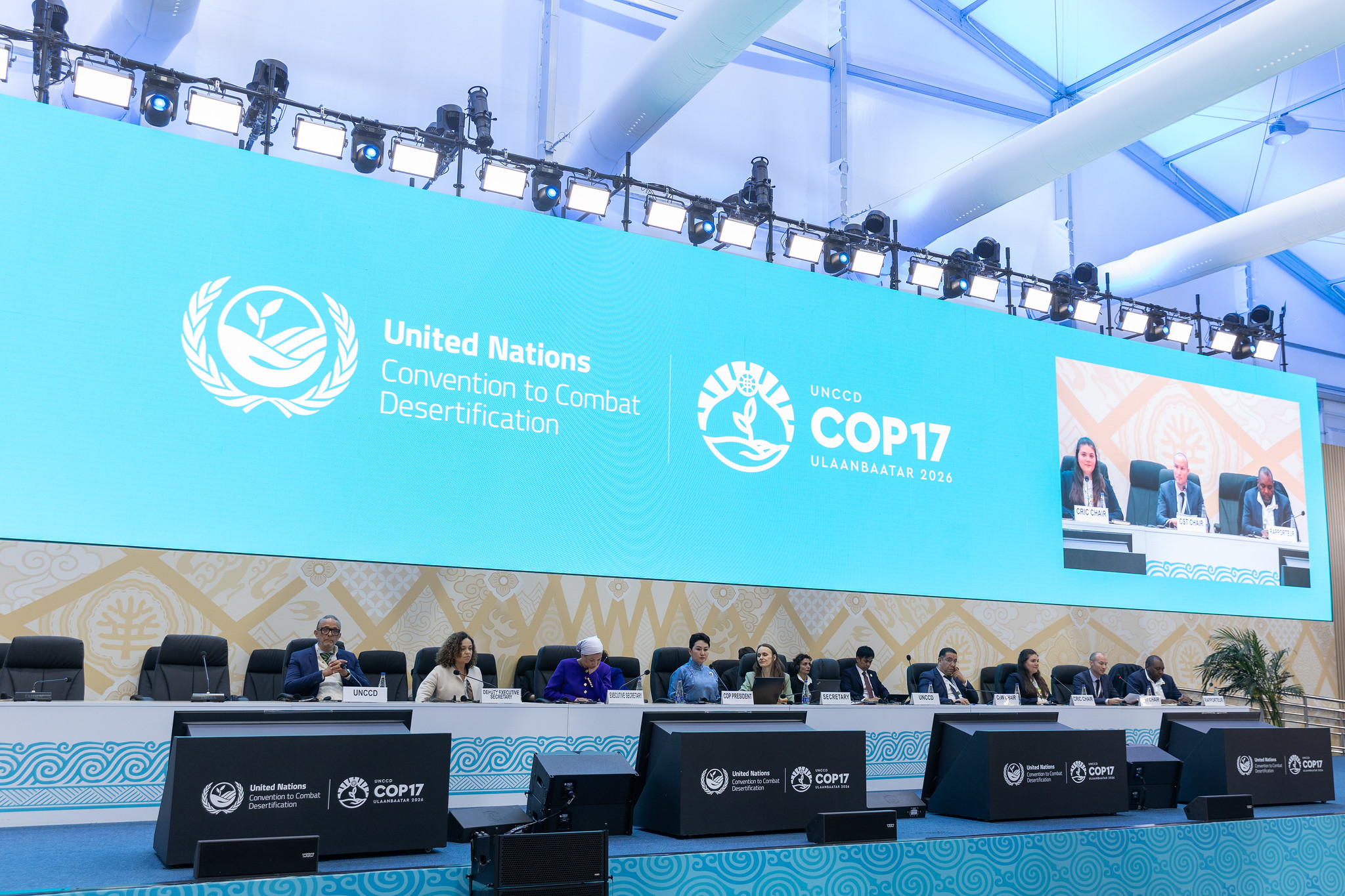
At UNCCD COP17 in Ulaanbaatar this August, the Committee on Science and Technology (CST) examined how scientific evidence can help countries monitor land degradation, plan for drought and make informed choices about land management.
As the COP’s scientific and technical advisory body, the CST brings government representatives together to consider evidence and develop recommendations. The UNCCD Science-Policy Interface (SPI) supports this work with assessments and policy-relevant advice, drawing on expertise across disciplines and regions.
On the CST’s recommendation, Parties adopted a decision on the SPI’s future functioning to strengthen evidence-based decision-making and support implementation of the Convention.
In the words of the UNCCD Executive Secretary Yasmine Fouad: “Science must help us continue to take better decisions today for more resilient landscapes tomorrow.”
Scientific advice shaped by country needs
Priorities on desertification, land degradation and drought identified by countries will guide the SPI’s work in 2027–2030. At COP17, considerable time has been spent examining the purposes, audiences and review processes of various scientific products.
A major assessment will bring together evidence across disciplines and regions, forming the basis for the fourth edition of the Global Land Outlook. This will update the public on trends and impact and inform policy under the Convention. Alongside this flagship report, fast-track assessments and information products can provide timely, targeted input on emerging issues and specific implementation questions.
Scientific review underpins both, with procedures adapted to their scope and purpose. Together, they give the SPI complementary ways to respond to the scientific needs identified by Parties.
The the development and formalization of these procedures will give countries channels to propose assessment priorities and raise requests for focused scientific work through the COP, CRIC and CST Bureaux, Secretariat and Global Mechanism. Regional groups can help identify shared priorities.
From global evidence to national action
“Scientific guidance must be rigorous without becoming detached from context. It must identify general principles while leaving room for locally adapted solutions,” said Nicholas Webb, Chair of CST17, in his opening statement.
National datasets, field observations and local knowledge enable countries to validate global data and interpret what global trends mean in the context of their own landscapes.
In joint CST discussions with the Committee for the Review of the Implementation of the Convention, delegates emphasized that national reporting should build lasting in-country capacity: stronger institutions, expertise and monitoring systems, rather than simply fulfilling an international obligation.
An advance copy of the Handbook on land degradation neutrality assessment in Central Asia, developed at the request of countries in the region and presented for discussion at COP17, offers practical approaches to interpreting land cover and land-condition changes. It demonstrates how long-term satellite observations, national data and field-based evidence can be used together to better understand long-term trends, account for short-term climate variability and support the identification of areas where targeted action may be appropriate.
The reporting decision adopted at COP17 enables this approach. Subject to available funding, it calls for technical cooperation to strengthen countries’ ability to generate and use national data, Earth observation and geospatial information. It also addresses gaps in data accessibility, quality, spatial resolution and coverage over time, with support responsive to national and regional circumstances.
Two Global Land Outlook thematic reports on Small Island Developing States (SIDS) and Central Asia, launched at COP17, illustrated the value of context-specific assessment. The SIDS report examines integrated land and water management in closely connected island ecosystems. The Central Asia report documents how land degradation neutrality is embedded in national strategies, agricultural planning and climate adaptation.
Healthy soils, productive lands, resilient futures
Agricultural land needs a central place in efforts to restore degraded land. Healthy soils underpin food production and help tackle climate change and biodiversity loss.
Jointly developed by FAO and UNCCD, Living soils, productive lands, resilient landscapes offers guidance on preventing, reducing and reversing agricultural land and soil degradation. It promotes better land-use planning, more diverse and resilient farming systems, and supportive policies.
A digital companion on the Agrifood Systems Technologies and Innovations Outlook (ATIO) Knowledge Base connects users with practical tools, resources and good practices. Users can explore these by their role, scale of action and whether they aim to prevent, reduce or reverse degradation.
Together, the guidance and digital companion help countries and communities tailor responses to local needs.
“The combination of traditional guidance and an AI-enabled platform to provide access to validated technologies, innovations and previously published guidance puts literally hundreds of past publications at the fingertips of end users in a platform that will grow and evolve as new evidence and innovations become available.” said Dr. Barron Joseph Orr, UNCCD Chief Scientist.
Building on this guidance and its digital companion, Parties at COP17 took a policy decision that emphasizes prevention is better than cure by agreeing to more rigorously apply the land degradation neutrality response (LDN) hierarchy: prioritizing the avoidance of degradation, followed by reducing ongoing degradation and reversing past degradation through restoration and rehabilitation.
The decision encourages them to promote policies and practices that protect soil health, alongside better access to finance and knowledge for smallholder farmers and other land users. It also encourages forward-looking analysis of environmental change and land suitability to anticipate production needs, identify adaptation pathways and guide investment. To realize this investment, they agreed to pursue public–private partnerships, improved monitoring and forward-looking planning to guide investment and help agriculture adapt to changing environmental conditions.
An advance copy of the Feasibility study on the prospects for carbon farming solutions in Greater Central Asia was also presented for discussion at COP17. The study examines how carbon farming can support sustainable land management and land restoration across Greater Central Asia while generating measurable climate benefits and mobilizing additional finance. It identifies robust carbon monitoring, clear land-use rights and fair benefit sharing as conditions for credible projects. The analysis also underlines the importance of combining carbon revenues with complementary sources of finance to cover implementation costs and support long-term sustainability.
Access, capacity and participation
Countries consistently linked the value of scientific guidance to the resources needed to put it to work. Earth observation, remote sensing, modelling and artificial intelligence offer opportunities for monitoring and analysis, but access to data, infrastructure and technical skills remains uneven.
Strengthening capacity also means widening the pool of people who can generate, interpret and apply evidence.
“Scientific knowledge must therefore become more accessible, actionable and closely connected to decision making,” said UNCCD Land Hero and young hydrologist Aliona Isac, speaking at the opening of CST17.
Calls for greater opportunities for young scientists in countries with fewer resources and stronger links between the SPI and universities reflected this concern. The SPI’s membership framework also takes account of regional, disciplinary and career-stage balance.
Scientific guidance fit for implementation
At UNCCD COP18 in Egypt, Parties will return to the topics of aridity and drought guidance and continue discussions on knowledge sharing, technology transfer and innovation.
Sustaining the Convention’s scientific work requires contributions of data, expertise, technical assistance and finance, alongside transparency and safeguards for scientific independence.
The value of that cooperation goes far beyond individual assessments: it lies in better-informed policy and investment and in national institutions with the capacity to sustain implementation.
Photo : © UNCCD/Kiara Worth
Read more

Region of ancient traditions and modern perspectives

Integrated solutions for a more resilient future


Agricultural land underpins food security, nutrition, rural livelihoods and essential ecosystem services, yet faces growing pressures from unsustainable land use and management,…