UNCCD and China deepen strategic cooperation on land restoration, drought resilience and sustainable…
-
16 July 2026
-
Press release
-
Sustainable land management & restoration

Beijing/Bonn, 16 July 2026 – As land degradation, drought and water scarcity intensify across regions, countries are increasingly looking for ways to restore ecosystems, strengthen food systems, safeguard livelihoods, and build resilience.
Today, up to 40 per cent of the Earth’s land is degraded, affecting nearly half of humanity, while droughts have increased by nearly 30 per cent since 2000 — making land restoration one of the most pressing environmental and economic and development challenges of our time.
In this context, cooperation between the United Nations Convention to Combat Desertification (UNCCD) and China continues to deepen across some of the Convention’s strategic priorities — from rangelands and sand and dust storms to sustainable finance, innovation and South-South cooperation.
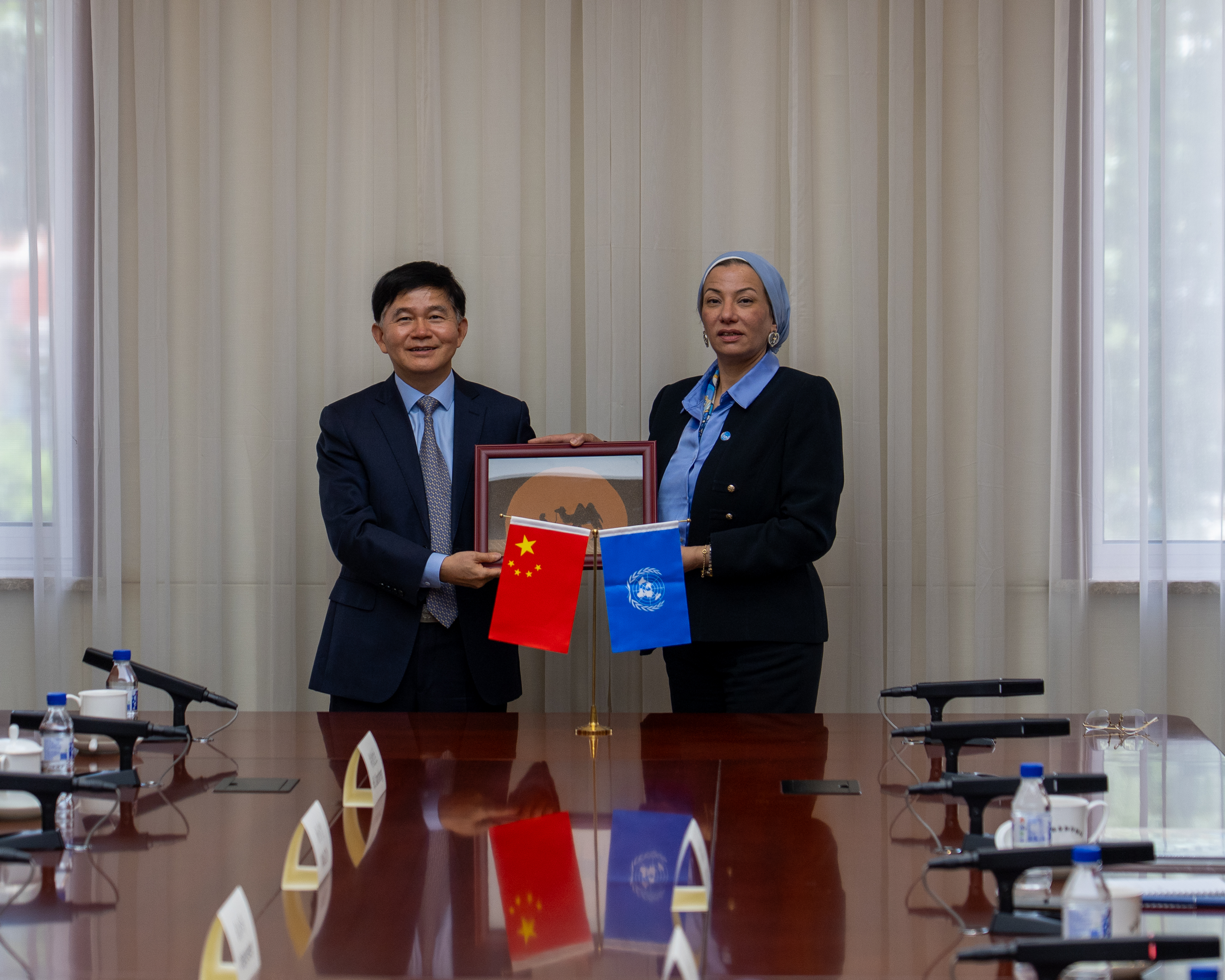
During her first official visit to China, Yasmine Fouad, Executive Secretary of the UNCCD, engaged with Chinese partners to strengthen cooperation on land restoration, drought resilience and sustainable investment ahead of the seventeenth session of the Conference of the Parties (UNCCD COP17) to the UNCCD, which will take place in Ulaanbaatar, Mongolia, from 17 to 28 August.
China has played an important role in the Convention’s history. In 2017, it hosted UNCCD COP13 in Ordos, where Parties adopted the Convention’s 2018–2030 Strategic Framework, a milestone in advancing Land Degradation Neutrality globally.
Over recent decades, China has also demonstrated how long-term policy continuity, scientific planning and sustained investment can help deliver large-scale land restoration, while generating tangible socio-economic benefits for communities, offering practical lessons for countries seeking to scale implementation under the Convention.
“China’s experience shows that restoring land at scale requires long-term vision, policy continuity, scientific innovation and sustained investment,” said Yasmine Fouad, Executive Secretary of the UNCCD.
“Equally important is ensuring that restoration delivers tangible benefits for people. Healthy land underpins food security, water security, livelihoods and economic resilience. China's experience demonstrates that when restoration is integrated into broader development planning, environmental action becomes an investment in people and prosperity. As we move toward COP17, the priority is to translate practical experience like this into stronger cooperation, greater investment and faster implementation, because the scale of land degradation and drought today requires stronger and more coordinated action.”
That spirit of cooperation was also reflected in the UNCCD Silk Road Caravan initiative — a multi-country effort connecting restoration experiences, pastoral systems and dryland cooperation across Eurasia.
Building on the momentum generated at COP16 in Riyadh, the initiative began in Türkiye and continued through Hohhot and Xilinhot in China before continuing to COP17 in Ulaanbaatar.
Along the way, it has created a platform for countries to exchange practical solutions, strengthen regional partnerships and showcase successful approaches to land restoration in regions facing common drought and land degradation challenges.
A key area of cooperation during the visit was the growing importance of rangelands and pastoral systems, which cover more than half of the Earth’s land surface, support around 2 billion people, and provide nearly 70 per cent of global livestock feed yet remain among the world’s most under-recognized and underfunded ecosystems.
As the International Year of Rangelands and Pastoralists (IYRP 2026) brings renewed global attention to these landscapes, their role in food security, biodiversity and resilience is becoming increasingly visible.
Rangelands also sit at the frontline of broader dryland challenges, including the increasing frequency and intensity of sand and dust storms — a transboundary phenomenon affecting around 330 million people in more than 150 countries, with major impacts on health, agriculture, transport and infrastructure. Strengthening land restoration and sustainable land management remains one of the most effective long-term responses to reducing these risks while helping communities become more resilient to future climate shocks.
Scaling these solutions will require significantly greater investment. UNCCD estimates that USD 355 billion is needed annually through 2030 to restore degraded land and strengthen drought resilience, while current annual investment flows remain far below that level.
Addressing this financing gap remains one of the major challenges for scaling land restoration. Public finance, private capital and multilateral institutions all have a role to play in improving the bankability of restoration and accelerating implementation. Private sector engagement is becoming increasingly important, not only because public resources alone are insufficient, but because businesses themselves face growing environmental risks affecting supply chains, water security, food production and long-term productivity.
Technology and innovation are also playing a growing role in supporting this shift. Remote sensing, geospatial systems and artificial intelligence are improving drought monitoring, land-use planning and early warning systems, helping countries move from reactive crisis response toward anticipatory resilience.
Within this evolving landscape, the UNCCD’s Performance Review and Assessment of Implementation System (PRAIS) continues to strengthen data collection, reporting and analysis, helping countries track progress toward Land Degradation Neutrality targets and support more evidence-based decision-making.
These efforts are also opening new opportunities for South-South cooperation, particularly through stronger knowledge exchange, technical collaboration and practical restoration solutions across Africa, Asia and other dryland regions. The launch of the Business4Land (B4L) China Hub during the visit also highlighted the role of the private sector in mobilizing investment, fostering innovation and scaling sustainable land management and restoration.
“Desertification and land degradation are major ecological challenges affecting human survival and development. China adheres to an integrated approach to protecting and systematically managing mountains, rivers, forests, farmlands, lakes, grasslands, and sandy lands, and has implemented a series of large-scale ecological conservation and restoration projects, including the Three-North Shelterbelt Forest Program. These efforts have systematically improved ecosystem quality, advanced green development and transformation in a coordinated manner, and forged a path of land restoration that aligns with natural laws as well as China’s national and local conditions.
China attaches great importance to its long-standing cooperation with the UNCCD and stands ready to share knowledge and best practices on land restoration with all parties to jointly address desertification and land degradation.
We look forward to working with all stakeholders at COP17 to explore pragmatic measures for scaling up financing for land restoration and advancing global desertification control, thereby contributing to the harmonious coexistence between humanity and nature,” said Liu Guohong, Administrator of the National Forestry and Grassland Administration.
These issues will shape discussions at COP17, where Parties will seek to accelerate implementation, strengthen drought preparedness, advance sustainable food systems, and mobilize greater investment in land restoration. At a time when the gap between commitments and delivery remains wide, the focus must shift from ambition to implementation. Stronger cooperation and practical partnerships will be essential to scale solutions that improve people's lives while restoring the land they depend on.