News & stories


Latest news & stories
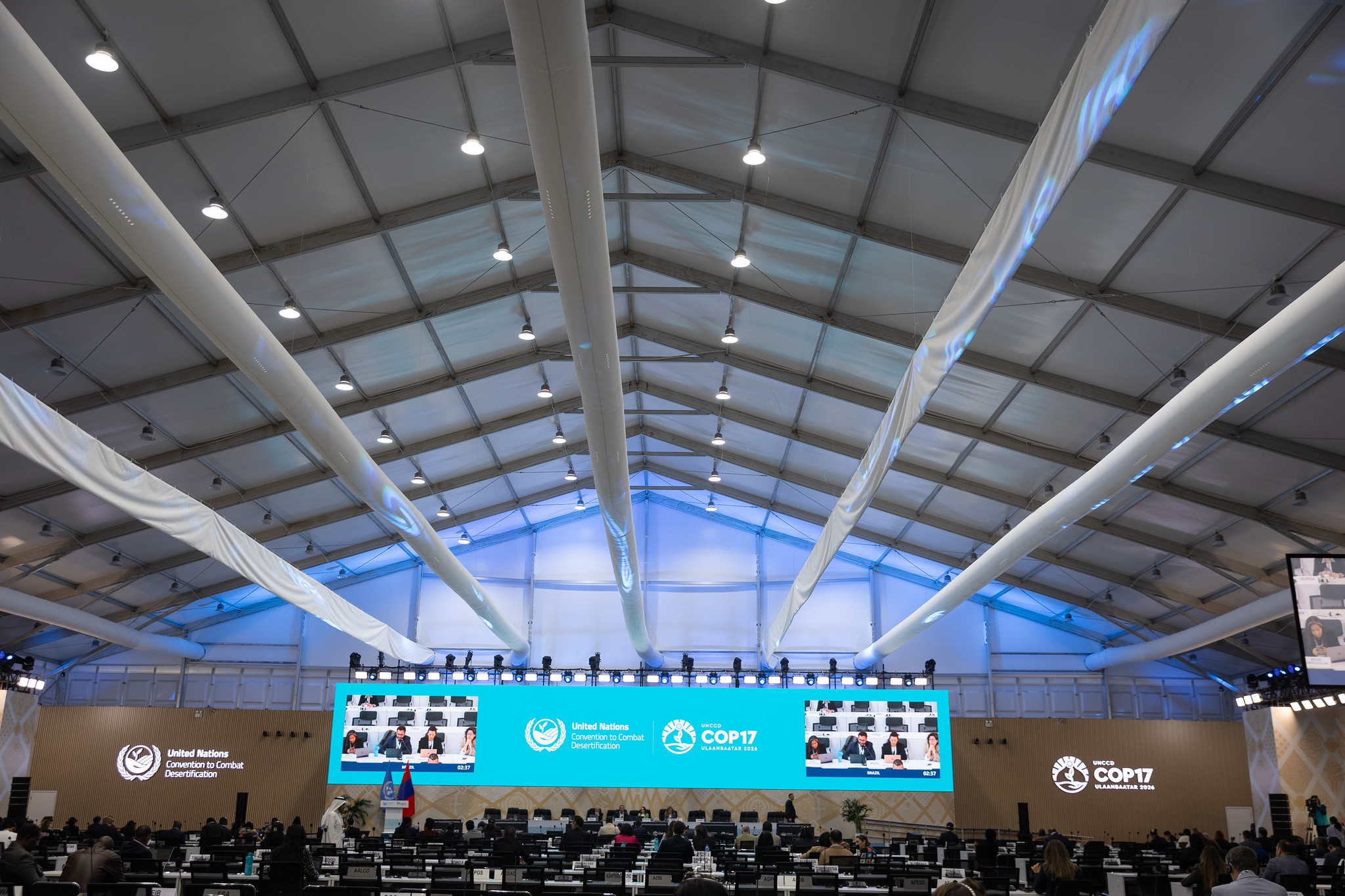
23个国家形成总额13亿美元的土地恢复和抗旱韧性融资组合,其中以草原为重点,45个项目共获得12亿美元融资支持。 在土地退化零增长(LDN)方面取得进展:巴西提出了由17项子目标构成的2030年自愿性土地退化零增长目标,与此同时,中亚地区已有一半的土地退化零增长目标得以实现。 沙特阿拉伯在COP16上发起的“利雅得全球抗旱韧性伙伴关系(The Riyadh Global Drought Resilience Partnership)”进一步迈向落实,在乌兰巴托推进建立资金池,以支持约70个脆弱国家。 联合国防治荒漠化公约(UNCCD)与卢森堡共同启动“抗旱韧性投资机制(the Drought Resilience Investment Facility)”,以撬动最高4亿美元的公共和私营资本,用于增强抗旱韧性。 蒙古乌兰巴托,2026年8月28日— 经过为期两周,围绕如何应对土地退化、荒漠化和干旱问题展开的谈判,《联合国防治荒漠化公约》第十七次缔约方大会(UNCCD COP17)今日在蒙古国乌兰巴托闭幕 在谈判进程和行动议程两条主线上,乌兰巴托大会汇聚了推动落实所需的关键要素,包括政治指引、科学依据、资金、具备投资条件的项目、伙伴关系,以及世界各地土地管理者更广泛的参与。 UNCCD 197个缔约方每两年举行一次缔约方大会,本次大会将全球草原置于土地议程的核心位置。草原覆盖地球陆地面积的54%,为约20亿人提供支持,并由约5亿名牧民守护和管理。 在“国际草原与牧民年”期间,“牧场旗舰倡议” 于乌兰巴托启动,汇集了45个项目、总额12亿美元的资金,是《联合国防治荒漠化公约》历史上针对草原领域规模最大的一次资金动员。 除谈判进程外,COP17还推出了一系列旨在加快土地恢复和增强抗旱韧性行动的倡议和资金承诺。 各国政府、开发银行、基金和企业宣布,在五大洲23个国家形成一个总额13亿美元的融资组合,涵盖处于不同发展阶段的项目。其中,6.445亿美元被确认为新增融资,2.164亿美元已经得到确认并正在迈向实施。 UNCCD执行秘书亚斯敏·福阿德表示: “我们来到乌兰巴托时就明确表示,COP17必须成为一次落实行动的缔约方大会。如今即将离开,我们已推动落实所需的架构更加完善:政治决策、更有力的科学支撑、创新融资机制、投资项目储备以及能够推动解决方案扩大规模的伙伴关系,这些都取得了进展。 但乌兰巴托大会的成效不是由会议期间宣布了什么来评判,而将由接下来发生什么来衡量:各国是否能够更好地应对干旱,退化土地和草原是否得到恢复,资金是否真正流向具有可行性的项目,以及土地管理者的生活是否因此发生切实改变。” 蒙古国外交部长、UNCCD COP17主席巴特蒙赫·巴特策策格阁下(H.E. Battsetseg Batmunkh)表示: “作为东道国以及《联合国防治荒漠化公约》第十七次缔约方大会主席国,蒙古国本着开放、透明、包容和协商一致的精神,为各方讨论营造良好氛围,并努力缩小各方立场差距,以实现切实成果。 在‘国际草原和牧民年’之际,蒙古国向世界展示了草原这一具有重要战略意义的生态系统,如何连接粮食、环境、经济、生物多样性以及牧民生计。 在履行第十七次缔约方大会主席职责过程中,蒙古国始终坚持‘从承诺走向落实,从讨论走向实干’的原则。” 蒙古国环境与气候变化部长、UNCCD COP17国家组委会主席桑达格-奥奇尔·曾德阁下(H.E. Sandag-Ochir Tsend)表示: “蒙古国成功主办《联合国防治荒漠化公约》第十七次缔约方大会(UNCCD COP17),汇聚世界各国,共同推动荒漠化、土地退化和干旱问题的务实解决方案。对蒙古国而言,本次大会最重要的成果之一,是获得缔约方、国际组织、私营部门和民间社会对‘草原计划(Steppe Plan)’的支持,使其成为COP17的重要政策遗产。 在‘草原计划’框架下,蒙古国政府正式启动三项国际倡议:‘草原旗舰倡议’、‘水—土地纽带倡议’以及‘可持续基础设施自然解决方案倡议’。这些倡议为开发项目、加强国际合作以及在这些重点领域动员投资创造了新的机遇。 尽管COP17今天闭幕,但我们的工作并未就此结束。下一步的重点,是将大会通过的决定、建立的伙伴关系以及投资承诺转化为切实行动,并确保从蒙古草原发起的各项倡议取得可衡量的成果。” 从承诺走向落实 本次大会是在严峻的全球背景下举行的。目前全球多达40%的土地处于退化状态,而各国已承诺到2030年恢复超过10亿公顷土地。如今已有70多个国家制定了国家干旱计划,而2013年这一数字仅为3个。然而,资金和行动落实仍落后于这一挑战的规模和速度。在此背景下,缔约方呼吁进一步动员财政资源、加强能力建设和技术合作,以强化主动型干旱管理,特别是在非洲国家,同时也不能忽视其他受到影响的发展中国家。 乌兰巴托大会期间公布的大量新证据,进一步凸显了不采取行动的代价,以及投资于健康土地所能带来的收益。新报告分别研究了恢复全球草原的经济效益、日益加剧的干旱对人类和经济的影响、小岛屿发展中国家和中亚面临的特殊挑战,以及投资于土壤健康的价值。 研究显示,小岛屿发展中国家共有1880万公顷土地发生退化;与此同时,中亚地区已有超过8000万公顷土地退化,占该地区土地面积的四分之一以上,并已影响2400万人。与此同时,中亚五国均已制定自愿性土地退化零增长目标,其中一半目标已经实现。 这些报告共同表明,土地退化和干旱正在不同地区影响粮食和水安全、生计以及经济,同时也进一步说明了开展预防、可持续土地管理和土地恢复的经济必要性。 在这些新证据的基础上,巴西提出了一项重要的国家承诺,即制定2030年自愿性土地退化零增长(LDN)目标,包含17项与国家政策、规划和项目相衔接的子目标。 该目标包括恢复或修复超过16.3万平方公里土地,其中包括恢复原生植被和发展农林复合经营系统;另有351万平方公里土地将通过保护和可持续土地管理措施得到覆盖,以防止土地退化。17项子目标合计覆盖约367万平方公里土地。 这一承诺将支持巴西通过避免、减少和逆转土地退化,实现可持续发展目标15.3,同时加强粮食和水安全、生物多样性以及气候韧性。 构建全球抗旱韧性新架构 经过持续谈判,缔约方决定在COP18继续相关讨论,在COP16和COP17取得进展的基础上,来推动就各层级主动型干旱管理作出决定。缔约方还决定,干旱问题将在COP18以及此后的每届常会中继续作为独立议程项目。“利雅得全球抗旱韧性伙伴关系(The Riyadh Global Drought Resilience Partnership)”于COP16期间建立,并在乌兰巴托进一步迈向落实。其首次伙伴大会推进了拟议资金池的相关工作,该资金池旨在通过能力建设、具备投资条件的项目以及抗旱韧性融资,帮助约70个低收入和中低收入国家。 COP17期间还启动了 “抗旱韧性投资机制(Drought Resilience Investment Facility, DRIF)”,这是全球首个专门致力于抗旱韧性的催化型融资平台。该机制由UNCCD与卢森堡共同创建,并得到“国际抗旱韧性联盟(theInternational Drought Resilience Alliance)”的支持,旨在为水安全、可持续农业、自然解决方案和土地恢复领域的投资,撬动高达4亿美元的公共和私人资本。该机制与全球环境基金建立的首个战略伙伴关系,将探索释放私营和慈善资金的机遇。 “国际干旱韧性观测站(International Drought Resilience Observatory)”第二阶段也推出了全球首个“干旱韧性指数”,为各国提供新的工具,用于评估自身预测、准备和适应干旱的能力,并更有针对性地制定政策和配置投资。 土地融资进一步提升议程地位 COP17还致力于缩小全球土地承诺与落实这些承诺所需资金之间的差距。 预计到2030年,为实现全球土地恢复承诺,每年需要约3550亿美元,而目前每年实际投入约770亿美元,由此形成每年约2780亿美元的融资缺口。私人融资目前仅占全球土地恢复投资的约6%。 各国政府、开发银行、基金和企业宣布,在五大洲23个国家形成一个总额13亿美元、用于土地恢复和抗旱韧性的融资组合,涵盖处于不同发展阶段的项目。其中,6.445亿美元为新增融资,2.164亿美元已经确认并正在迈向实施。该融资组合涵盖草原和景观恢复、抗旱韧性以及地方主导的适应行动。 乌兰巴托的讨论还聚焦于如何解决长期制约土地投资的障碍,包括如何让土地、土壤健康和抗旱韧性在现有自然融资分类体系中得到更加明确和可追踪的体现。与会者还探讨了进一步利用担保、优先损失资本、保险以及项目准备机制,将土地恢复计划转化为具备投资条件的项目。 东道国蒙古国启动了首个国家级“企业促土地(Business 4 Land,B4L)”中心,同时推出可持续金融原则、国家绿色分类目录,并提出到2030年实现绿色贷款占比10%的目标。俄罗斯随后启动了本国B4L中心,卢森堡则推进建立B4L基金会,德国支持成立B4L金融专家组。 草原:从被忽视的生态系统走向经济资产 在联合国“国际草原与牧民年”期间,蒙古国作为东道国,通过COP17特别强调了草原以及管理和守护这些土地的人们的重要作用。缔约方承认牧民是草原生态系统不可或缺的守护者,强调跨地区迁徙的重要性,以及牧民知识和经验的价值。尽管草原具有全球重要性,但其在政策和投资中仍长期被忽视:全球约三分之一的重要生物多样性区域位于草原,而目前仅有24个国家在其国家气候计划中纳入草原,相比之下,将森林纳入国家气候计划的国家达到181个。 乌兰巴托发布的新经济分析估算,草原每年产生价值21万亿至47万亿美元的生态系统服务,最高相当于全球GDP的近一半。这些生态系统服务包括粮食生产、水资源、碳储存和生物多样性等方面的收益。草原恢复通常可以实现每投入1美元获得4至6美元回报;如果将供水等更广泛的公共收益计算在内,回报最高可达到36美元。 COP17宣布的“草原旗舰倡议”旨在将这一经济论证转化为投资行动,汇集支持可持续草原管理、草原恢复和牧民生计的项目。 全球环境基金将通过向UNCCD COP17后续项目投资330万美元,支持该倡议的协调工作。在过去四年中,该基金还批准了50多个项目,总价值超过3亿美元,惠及草原和牧民社区。 土著人民和地方社区在COP17成立新的核心小组 本次大会举行了UNCCD土著人民核心小组和地方社区核心小组的首次正式会议。这是继COP16在利雅得作出决定、建立这两个机制,并在《公约》框架内为其观点和优先事项提供专门参与空间之后取得的重要进展。 COP17还迎来了UNCCD缔约方大会历史上规模最大的土著人民代表参与。“土地与人民日”期间举行的高级别特别活动强调,土著人民既是权利主体、知识持有者,也是行动落实伙伴。活动重点讨论了土著人民知识体系、传统治理、可持续牧业、土地守护,以及土著人民主导行动直接获得融资等问题。 在COP17期间,土著人民、牧民和地方社区呼吁进一步加强土地权利和流动迁徙权,扩大直接获得资金的渠道,确保其有意义地参与决策,并在土地恢复和抗旱韧性行动中认可土著人民和传统知识的价值。 会议还强调了妇女和青年发挥领导作用的重要性,包括呼吁投资青年群体,使其成为土地恢复行动的领导者,并提升他们在土地和干旱行动领域的参与度。 从蒙古走向埃及 下一次《联合国防治荒漠化公约》缔约方大会,即COP18,预计将于2028年在埃及举行,继续推进乌兰巴托大会形成的成果。 展望未来,埃及强调加强合作的重要性,并推动采取整合路径应对土地退化、气候变化和生物多样性丧失,以增强粮食和水安全以及韧性。 COP18将成为各国评估土地恢复和抗旱韧性进展、并在乌兰巴托大会成果基础上进一步推进的重要节点。 编者按 媒体垂询及采访请求: UNCCD 新闻办公室:press@unccd.int COP17 决议可在此查询: https://www.unccd.int/cop17/official-documents 关于《联合国防治荒漠化公约》 《联合国防治荒漠化公约》(UNCCD)是全球土地的共同愿景与声音。我们联合各国政府、科学家、政策制定者、私营部门和社区,共同推动全球行动,恢复和管理地球土地,以实现人类与地球的可持续发展。UNCCD不仅仅是一份由197个缔约方签署的国际条约,更是减缓当今土地退化影响、推进未来土地治理的多边承诺,旨在为所有人公平和包容地提供食物、水、住所和生计机会。

Closing DayOn Friday, 28 August, delegates gather as the seventeenth session of the Conference of the Parties (COP17) to the United Nations Convention to Combat Desertification concludes with the adoption of final decisions and reports, bringing the two-week conference to a close.KEY EVENTS FOR MEDIACOP17 Closing Press ConferenceWhen: 17:00Where: Press Conference RoomSpeakers:Yasmine Fouad (UNCCD Executive Secretary)Battsetseg Batmunkh (COP17 President and Minister of Foreign Affairs of Mongolia)Journalists are invited to attend the final press conference, where leadership present the main outcomes and reflections on COP17, outlining key decisions adopted by the Parties at the close of the session.Side EventsSide events throughout the day will cover rangelands and pastoralism, finance, drought resilience, land tenure, healthy soils and the land-water nexus.Journalists are encouraged to consult the official COP17 programme for the full schedule and latest updates : https://www.unccd.int/cop17/programmeMEDIA RESOURCESCOP17 programmeUNCCD COP17 websiteHost country websiteUNCCD Action Dome websiteUN WebTV – Live broadcast of key plenary sessions with live interpretation in all six UN languagesUNCCD COP17 Visual Assets and Branding ResourcesEarth Negotiations Bulletin – daily coverage, photographs and analysisFor media enquiries and interview requests: UNCCD Press Office: press@unccd.int

The proposed voluntary country-led Rio Synergies Group for Action would help countries translate climate, biodiversity and land priorities into more coherent planning, investment and implementation, while reducing duplication and reporting burdens.Ulaanbaatar, 27 August 2026 – In a push to transform political momentum into practical action, Ministers, current and incoming Rio Convention COP Presidencies, the Executive Secretaries of the three Rio Conventions, international organizations and financial institutions on 26 August at UNCCD COP17 held a High-Level Dialogue on strengthening cooperation across the climate, biodiversity and land degradation issues.The event launched the COP31 Presidency Process, led by Türkiye, towards a proposed Rio Synergies Group for Action. The proposed Action group is intended to support a voluntary, country led implementation by connecting existing national priorities across climate, biodiversity and land with existing partnerships, technical expertise, implementation, knowledge-sharing, capacity-building and financing opportunities.The aim is not to create another parallel structure, but to help countries connect the pieces they already have, national plans, science, projects, finance and partnerships, and make them work together more effectively on the ground.Several countries, including Australia, Ireland, Japan, Maldives and Sierra Leone, and the heads of the UN entities supported the idea, emphasizing the multiple benefits of such a group to countries. A coordinated and integrated approach brings efficiency, cost-savings, reduces the planning and reporting burdens on countries and will help countries to respond practically to environmental challenges that communities experience as multiple, not single crises.It can also help countries identify programmes and investments capable of delivering simultaneously for land restoration, climate resilience, biodiversity and development, rather than financing each agenda in isolation.The High-level Dialogue, “From Ambition to Action: Delivering Rio Convention Synergies across the Triple COP Year,” is the first high-level opportunity during the 2026 Triple COP Year to consider how political momentum for Rio Convention synergies can be translated into practical, country-led implementation.Convened by the Presidencies of UNCCD COP17, incoming CBD COP17 and incoming UNFCCC COP31, the Dialogue underscored the continuity of political leadership across the 2026 Triple COP Year, beginning with UNCCD COP17 in Ulaanbaatar, continuing in October to COP17 of the Biodiversity Convention under the Presidency of Armenia in Yerevan, and culminating with UNFCCC COP31 in November under the Presidency of Türkiye in Antalya.The process offers interested countries and partners an opportunity to contribute to the co-development of the proposed voluntary, country-led Group, with a view to its formal launch at UNFCCC COP31 in Antalya.Speakers explained why stronger synergy among the Convention’s matters now more than ever, proposed some guiding principles for such an Action Group and explained the multiple benefits to be gained through synergy. Dr. Yasmine Fouad, UNCCD Executive Secretary said: “Rio synergies need to deliver in three areas: stronger national policy coherence with less bureaucratic burden for countries, tangible action on the ground and greater engagement of the private sector to mobilize investment. The real test is whether we can connect national priorities to integrated programmes, programmes to finance, and finance to implementation that delivers multiple benefits for people and landscapes. We do not need another layer of process. We need the systems we already have to work together more effectively and at scale”Ms. Fatma Varank, Türkiye Deputy Minister of Environment, Urbanization and Climate Change of the Republic of Türkiye, who represented the incoming UNFCCC COP31 Presidency at the Dialogue, emphasized the need for coherence and efficiency in implementing agreements, and the importance of dialogue in building momentum for synergy towards COP31.Synergy, she said, does not equal merging mandates, rather, it achieves greater scale, coherence, efficiency, reduced duplication and yields multiple benefits.Mr. Andrew Berryman, Deputy Head of Mission, Embassy of Australia in Mongolia, representing UNFCCC COP31 Presidency of Negotiations said a voluntary, country-led and practical Rio Synergies Group for Action could strengthen coordination across institutions, including through leveraging existing mechanisms and delivering more with less.Mr. Andranik Grigoryan, Government of Armenia representing the incoming Presidency of CBD COP17, said one of the lessons emerging from the global report reviewing progress in the implementation of the Kunming Montreal global biodiversity framework is the need for cooperation, integrated and coordinated action among stakeholders. The draft report is currently undergoing peer review and will be launched at CBD COP17.Integrating action among the three Conventions at the national level, he said, can reduce institutional and regulatory burdens and enhance the process, for instance, by sharing science, capacity building on several agendas, and in finance, through shared solutions.Astrid Schomaker, Executive Secretary of the Convention on Biological Diversity, said the study shows 80 percent of biodiversity delivers for climate, but only 22 percent of climate finance delivers for biodiversity, and that a re-set is needed in how we approach the mandates to help countries to align plans, reduce the reporting burden and avoid leaving people behind.H.E. Mr. Shigeharu Aoyama, Japan’s State Minister of the Environment, said synergy should minimize trade-offs, while maximizing co-benefits, and highlighted the results of an Asia-Pacific synergies report: advancing synergistic solutions to the triple planetary crisis and the SDGs whose more than 104 case studies on synergy demonstrate the benefits of shared knowledge and tangible action on the ground.Citing the same study, Inger Andersen, United Nations Environment Program Executive Director, reported that significant financial savings of up to 24 percent, equivalent to 6.4 billion United States dollars could be achieved by 2050. Synergy would be especially useful in developing plans on the ground and in reporting by the Conventions, she said. H.E. Mr. Timmy Dooley, Ireland’s Minister of State at the Department of Agriculture, Food and the Marine and at the Department of Climate, Environment and Energy, said implementation should be interconnected, particularly with regards to national priorities, implementation partners, and connecting ambition with finance. H.E. Ali Shareef, Minister of Climate Change, Environment and Energy of the Republic of Maldives said integration is “not a convenience” but borne of “necessity” for Small Island States (SIDs), and called for a dialogue on synergy that can close the gap SIDs encounter, for instance in indicators that are calibrated individually, and in the case of UNCCD, action that is limited to arid, semi-arid and dry sub-humid zones. Simon Stiell, Executive Secretary of the United Nations Framework Convention on Climate Change, called for alignment between the politics and the realities and practicalities of the Conventions. He urged Parties to be very practical and to reduce the burden of reporting on countries. Supporting the idea of an Action Group, Samed Ağırbaş, Climate High-Level Champion of the COP31 Presidency said there is no need for another parallel system. Rather, implementation that connects solutions is what is needed.H.E. Ms. Ruth Davis OBE, United Kingdom Special Representative for Nature, stressed the need for practical progress – synergistic solutions – because people experience the land, biodiversity and climate change challenges as multiple crises, not as single crisis.The outgoing Presidencies of UNCCD COP16, the Kingdom of Saudi Arabia, and UNFCCC COP30, Brazil, highlighted their past contributions to the Belém process and statement on the Rio Conventions and praised the progress and momentum building up towards COP31 in Türkiye.Türkiye formally endorsed the Belém Joint Statement on the Rio Conventions, becoming the final incoming Rio Convention COP Presidency to join the shared political commitment.Media contact:Wagaki WischnewskiCommunications Officer/UNCCD G20 Global Land InitiativeM: +49 (0)173 268 7593/+976 99207536email: wwischnewski@unccd.int

Ulaanbaatar, Mongolia, 26 August 2026 (UNCCD) - From remote islands to large steppes, land resources are under increasing pressure from poor management, overexploitation and drought exacerbated by climate change, UN experts warn. The Global Land Outlook (GLO) reports on Small Island Developing States (SIDS) and on Central Asia, launched today by the United Nations Convention to Combat Desertification (UNCCD), document a serious decline in the health and productivity of land and water resources across more than 50 countries and territories, undermining their long-term sustainable development and in some cases threatening their very survival. More importantly, both reports offer a transformative vision for reversing this decline and boosting the resilience of communities living in these unique geographic contexts.SIDS offer scalable solutions for managing their most precious asset—landComprising 39 states and 18 territories, SIDS are home to around 74 million people in the Caribbean, Pacific, Atlantic and Indian Oceans, as well as the South China Sea. These diverse nations and territories also boast some of the world’s most extraordinary natural assets, cultural heritage and traditional ecological knowledge. Some18.8 million hectares of land — equivalent to 16.5% of SIDS’ total land area — is degraded to varying extents, slightly above the global average, intensifying competition over scarce natural resources.The inherent attributes of SIDS — their small size, geographic isolation, tight ecological connectivity and community stewardship — make them ideal incubators of innovation for the implementation of integrated land and water management approaches that account for the close linkages between terrestrial and marine ecosystems. These approaches also have the potential to generate nature-positive, economic development models that can be scaled up from islands to continents.Central Asia, an epicentre of degradation, is halfway towards meeting 2030 land targetsCentral Asia, a region once celebrated for its sweeping steppes and fertile oases, is now one of the world’s epicentres of land degradation. Over 80 million hectares – more than a quarter of the region – are already degraded, affecting nearly 30% of the population – 24 million people living across five Central Asian nations of Kazakhstan, Kyrgyzstan, Tajikistan, Turkmenistan and Uzbekistan.The GLO Central Asia Thematic Report takes stock of the current situation. “All five Central Asian states have embraced National Voluntary Land Degradation Neutrality (LDN) Targets under Sustainable Development Goal (SDG) 15.3, and half of these targets are already met. This is not a moment of triumph – it is the end of denial. LDN has moved from theory into practice, now embedded in national green economy strategies, agricultural development plans, and climate adaptation policies”, states the report.The countries of Central Asia maintain broad international partnerships, with regional and interregional cooperation, strongly supported by the Convention, serving as an important platform for collaboration with governments, international organizations, development finance institutions, and private-sector investors to advance sustainable land management and strengthen climate resilience. “Despite very different geographies and challenges, both SIDS and Central Asian countries show that vulnerability does not have to mean inevitability. SIDS can become laboratories for integrated land and water solutions that connect ecosystems, communities and development, while Central Asia is demonstrating how land degradation neutrality can move from targets into national policy and practice. The priority now is to accelerate that progress — by investing in land stewardship, strengthening regional and international cooperation, and ensuring that people and ecosystems remain at the centre of development decisions,” says UNCCD Executive Secretary Yasmine Fouad.These two GLO reports were released during the seventeenth session of the Conference of the Parties (COP17) to the UNCCD underway in Ulaanbaatar, Mongolia. Representatives of 196 countries and the European Union are gathered for negotiations on future policy directions for land restoration and drought resilience. UNCCD is the first of the three Rio Conventions COPs convening this year, ahead of the biodiversity COP in Armenia in October and the climate COP in Türkiye in November.For more information:UNCCD Press Office: press@unccd.intNotes to EditorsThe full reports can be accessed online at: GLO Small Island Developing States thematic reportGLO Central Asia thematic reportReports by the numbers:SIDSDespite covering less than 0.5 per cent of the world's total surface area, SIDS are home to over 20% of the world’s biodiversity, with 9.5 times more endemic species richness than mainland areas.18.8 million hectares — or 16.5% of the total land area of all SIDS — were reported as degraded.43% of the total land area of SIDS, were affected by drought, of which 3% experienced severe drought and 6% extreme drought. The total area affected by extreme drought rose by 30% across all SIDS.Over 70% of SIDS face a risk of water shortages, a figure which rises to 91% in low-lying SIDS.An estimated 16.3 million people face severe food insecurity across SIDS, with 11.5 million being undernourished.SIDS receive only around USD 2 billion in public adaptation finance per year — approximately 0.2% of total global climate finance. They will require at least USD 11.7 billion annually for adaptation purposes — nearly six times the current level of funding.Between 2016 and 2023, an average of around USD 487 million per year in development finance to SIDS targeted efforts to combat desertification, land degradation and drought.Central AsiaOver 80 million hectares – more than a quarter of the region, an area approximately four times the size of Kyrgyzstan – are already degraded.Every year, Central Asia loses between USD 2 and 6 billion to land degradation.Central Asia is heating at twice the global average. The glaciers – once the “water towers” of the region – have shrunk by 30% in just fifty years. About UNCCD The United Nations Convention to Combat Desertification (UNCCD) is the global vision and voice for land. We unite governments, scientists, policymakers, private sector and communities around a shared vision and global action to restore and manage the world’s land for the sustainability of humanity and the planet. Much more than an international treaty signed by 197 Parties, UNCCD is a multilateral commitment to mitigating today’s impacts of land degradation and advancing tomorrow’s land stewardship in order to provide food, water, shelter and economic opportunity to all people in an equitable and inclusive manner.

The Drought Resilience Investment Facility (DRIF), the first global catalytic financing platform aims to mobilize up to USD 400 million in public and private capital for drought resilience.The world's first Drought Resilience Index will provide a new basis for targeting policies and investments to reduce drought risk. COP17 advances work towards a new global pooled fund to help around 70 low- and lower-middle-income countries strengthen drought resilience Ulaanbaatar, Mongolia, 26 August 2026 --- By 2050, three out of four people worldwide could face drought. Responding to that challenge, the seventeenth session of the Conference of the Parties to the United Nations Convention to Combat Desertification (UNCCD COP17) marked a significant step towards shifting the global response to drought from crisis management to proactive resilience.A series of announcements and launches at COP17 are strengthening the way countries finance, measure and implement drought resilience. Three distinct initiatives mark this progress: the launch by Luxembourg and UNCCD of the Drought Resilience Investment Facility (DRIF), a new catalytic finance platform aiming to mobilize up to USD 400 million in public and private capital; progress towards a global pooled fund to support drought resilience in low- and lower-middle-income countries; and the unveiling of the world’s first Drought Resilience Index.Taken together, these initiatives reflect growing recognition that drought can no longer be managed as an isolated environmental challenge. It is a systemic risk requiring stronger governance, investment in preparedness, and coordinated action before its impacts cascade into wider social and economic crises. UNCCD Executive Secretary Yasmine Fouad said: "COP17 is about turning commitments into implementation. We now have stronger financing mechanisms, better tools and practical guidance to help countries prepare for drought before it becomes a crisis. The task now is to connect these pieces and put them to work at scale, through governments, development partners, financial institutions and the private sector.” Mobilizing investment in drought resilienceWater Day at COP17 marked the launch of the Drought Resilience Investment Facility (DRIF), the first global catalytic finance platform dedicated to drought resilience. Co-created by the Government of Luxembourg and the UNCCD, with the support from the International Drought Resilience Alliance (IDRA), DRIF is designed to use public and catalytic capital to reduce investment risks and unlock much larger flows of institutional and private finance. With an ambition to mobilize up to USD 400 million in public and private capital, DRIF will invest in commercially viable projects and businesses that strengthen drought resilience while generating measurable environmental, social and financial returns.Rather than approaching water security, sustainable agriculture, land restoration and nature-based solutions as separate investment themes, DRIF brings them together through a single lens: their contribution to drought resilience.Its ambition also extends beyond the capital mobilized by the Facility itself. DRIF aims to demonstrate that investments in drought resilience can be commercially viable, build a track record for the sector and help establish resilience as an investable proposition capable of attracting much larger flows of private capital over time.Gilles Roth, Minister of Finance of Luxembourg said: “Luxembourg’s EUR 5 million commitment to the Facility reflects a simple idea: public money can help bring much more private investment into areas where it is urgently needed. Together with the UNCCD, we want the Drought Resilience Investment Facility to turn promising ideas into investable projects and help bring them to scale. The aim is to make investment in drought resilience possible where the market alone would not get us there.” The Ministry of Foreign Affairs of Luxembourg provided an initial contribution of USD 2 million to support the design, structuring and establishment of DRIF.Minister Xavier Bettel said: “As a founding partner of DRIF, Luxembourg is proud to help advance innovative solutions to drought, one of the most pressing challenges facing vulnerable communities worldwide. By bringing together public and private partners, DRIF will help channel investment towards solutions that reduce vulnerability and strengthen the resilience of communities, economies and ecosystems, while delivering environmental, social and financial returns. This initiative reflects our commitment to building resilience before drought becomes a crisis.” At COP17, the Facility also announced its first strategic partnership with the Global Environment Facility(GEF), with the objective of exploring opportunities to unlock private and philanthropic finance through the GEF’s Blended Finance Program. Expanding finance for countriesAlongside DRIF, work is advancing on a proposed pooled fund under the Riyadh Global Drought Resilience Partnership (RGDRP) to help around 70 low- and lower-middle-income countries strengthen drought resilience.The proposed fund would support capacity-building, the development of investment-ready programmes and financing for drought-resilience investments. The Partnership's first Assembly of Partners during COP17 advanced discussions on the Fund and the transition from institutional set-up towards operational delivery. Saudi Arabia, the RGDRP’s founding donor, pledged USD 150 million to the pooled Fund at COP16. The Fund will be open to additional contributions from governments and donors, including through grants and official development assistance. It will complement separate financing from development banks and other partners, including USD 2 billion pledged by the Islamic Development Bank and the OPEC Fund at COP16. Dr. Osama Ibrahim Faqeeha, Deputy Minister of Environment of Saudi Arabia, said: “Drought resilience is an urgent necessity; every dollar invested in drought preparedness pays off many times over when drought strikes. Saudi Arabia is proud to have established the Riyadh Global Drought Resilience Partnership during COP16 as an umbrella for international collaboration to strengthen drought resilience in vulnerable low- and lower-middle-income countries, with voluntary contributions from governments and the private sector. RGDRP will help countries develop and implement drought resilience plans by strengthening partnerships and leveraging innovation, knowledge-sharing and capacity-building.” Assessing drought resilience Another milestone was the unveiling of Phase II of the International Drought Resilience Observatory (IDRO), the first global observatory dedicated to drought resilience.Developed by UNCCD with Yale Center for Ecosystems and Architecture (Yale CEA) and partners under the International Drought Resilience Alliance (IDRA), the launch marks IDRO's transition from the pilot version unveiled at COP16 to an online platform that can help countries move beyond monitoring drought hazards to strengthening their resilience. At its core is the world's first Drought Resilience Index (DRI), enabling countries to assess their capacity to anticipate, prepare for and adapt to drought while identifying vulnerabilities and informing more effective policies and investments. New AI-powered features can help policy-makers, technical experts and the public interpret complex data and turn it into practical insights. Featuring eight in-depth country case studies across five continents, the platform is now open for review to users worldwide, whose feedback will help further refine the tool. Moving forward, the focus will be on working with IDRA member countries to assess how the tool can inform and enhance their decision-making processes. María Jesús Rodríguez de Sancho, Director General for Biodiversity, Forests and Desertification, which co-chairs IDRA with Senegal, said: “As a Mediterranean country, Spain knows first-hand the economic, social and environmental costs of drought. Our experience has shown us that resilience cannot be built through isolated efforts. That is why Spain has invested in the development of IDRO and the Drought Resilience Index as part of the drive to proactively manage drought risk.” COP17 as an opportunity The initiatives advanced at COP17 address different parts of the same challenge: helping countries anticipate drought, understand where resilience needs to be strengthened, develop investable solutions and mobilize the public and private capital needed to implement them.Speaking at the opening of the Ministerial Dialogue on Drought Resilience, UNCCD Executive Secretary Yasmine Fouad said: “We cannot continue to wait for drought to become a crisis before we act. We have the tools, partnerships and financial mechanisms to invest in preparedness, reduce losses and protect people and communities. COP17 must deliver a strong outcome on drought, backed by the means of implementation needed to turn ambition into action at national and local level, where drought resilience is ultimately built.” For Mongolia, the host of COP17, the conference carries particular significance. Prime Minister Nyam-Osor Uchral said: “The biggest change we want to see from COP17 is a shift from words to action, from targets to implementation, and from commitments to measurable results. Let us make drought resilience not only an environmental priority, but a core part of development policy.” For media enquiries UNCCD Press Office: press@unccd.intAbout UNCCD The United Nations Convention to Combat Desertification (UNCCD) is the global vision and voice for land and the only binding global treaty on land. We unite governments, scientists, policymakers, private sector and communities around a shared vision and global action to restore and manage the world’s land for the sustainability of humanity and the planet. Much more than an international treaty signed by 197 Parties, UNCCD is a multilateral commitment to mitigating today’s impacts of land degradation and advancing tomorrow’s land stewardship to provide food, water, shelter and economic opportunity to all people in an equitable and inclusive manner. About UNCCD COP17 The seventeenth session of the Conference of the Parties (COP17) to the United Nations Convention to Combat Desertification (UNCCD) is taking place in Ulaanbaatar, Mongolia, from 17 to 28 August 2026 under the theme "Restoring Land, Restoring Hope." Bringing together the Convention's 197 Parties, alongside international organizations, financial institutions, scientists, Indigenous Peoples, the private sector and civil society, COP17 focuses on accelerating global action on land restoration and drought resilience through stronger finance, partnerships and science. About IDRA About IDRA The International Drought Resilience Alliance (IDRA) is the first global coalition creating political momentum and mobilizing financial and technical resources for a drought-resilient future. As a growing platform of more than 70 countries and institutions, IDRA draws on the collective strengths of its members to advance policies, actions, and capacity-building for drought preparedness, acknowledging we are only as resilient to drought and climate change as our land is. The work of IDRA is aligned with, and supportive of, the mandate of the United Nations Convention to Combat Desertification (UNCCD), which hosts the IDRA Secretariat. For more information: https://idralliance.global.

Mongolia launches a national Business4Land Hub and sets a 10 per cent green lending target New finance backs rangelands and drought resilience across 23 countries on five continents Ulaanbaatar, Mongolia, 24 August 2026 — Governments, development banks, funds and companies meeting at the seventeenth session of the Conference of the Parties to the UN Convention to Combat Desertification (UNCCD COP17) have announced US$1.3 billion in new and pipeline finance for land restoration and drought resilience, spanning commitments in 23 countries across five continents. At the centre of the new finance is a major push on rangelands — an issue of particular importance to host country Mongolia. The Rangelands Flagship Initiative, currently valued at US$1.2 billion across 45 named projects, was launched in Ulaanbaatar during the United Nations International Year of Rangelands and Pastoralists in 2026, a designation championed by Mongolia. It is the largest single mobilisation for rangelands in the Convention's history. Of the finance announced at COP17, US$644.5 million is currently identified as new finance, with US$216.4 million already confirmed and moving towards implementation. Mongolia's domestic finance agenda Mongolia came to COP17 with a series of measures aimed at bringing more domestic finance into land restoration. These include sector-wide sustainable finance principles, a national green taxonomy, and a target of 10 per cent green lending by 2030. Mongolia also launched a national Business4Land (B4L) Hub, bringing the Convention's private-sector platform to the country level for the first time. Russia followed with a hub of its own, while Luxembourg moved to establish a Business4Land Foundation and Germany funded the B4L Finance Expert Group. Rangelands: a flagship that arrived with a portfolio Rangelands cover more than half of the world's land surface and support the livelihoods of around two billion people, including some 500 million pastoralists. Yet up to half of these ecosystems are degraded or at risk, making investment in their restoration critical for food security, livelihoods and drought resilience. The economic case for that investment is significant. Rangelands generate benefits estimated at US$21–47 trillion a year, including through food production, water, carbon storage and biodiversity. Restoring rangelands typically returns US$4–6 for every dollar invested — and, when wider public benefits such as water supply are included, returns can reach as high as US$36 for every dollar invested. The Global Environment Facility (GEF) supports coordination of the Rangelands Flagship Initiative through a US$3.3 million investment in the UNCCD COP17 Legacy Project. Over the past four years, GEF has also approved more than 50 projects worth over US$300 million supporting sustainable rangeland management and restoration, as well as pastoralist livelihoods. The Asian Development Bank put US$113 million behind the Green Inclusive Regional Agribusiness Fund, while the Green Climate Fund backed two projects in Botswana and Mongolia and TWENDE in Kenya with the International Union for Conservation of Nature (IUCN).The Adaptation Fund committed US$9.1 million to locally led adaptation with Indigenous Peoples and local communities across Africa, while the German Agency for International Cooperation (GIZ) and the German Federal Ministry for Economic Cooperation and Development (BMZ) backed Forests4Future (US$76 million) and three further programmes across Southern Africa. Peace Parks Foundation and Conservation International brought Herding for Health (US$35 million), while the International Livestock Research Institute (ILRI) brought the STELARR Investment Hub (US$22 million). Twelve of the projects are delivered with the United Nations Development Programme (UNDP), six with the United Nations Environment Programme (UNEP) and three with the Food and Agriculture Organization of the United Nations (FAO) — showing how the UN system and development partners are beginning to converge around a common implementation agenda for rangelands. The significance of the Flagship is therefore not only its financial value. It is the emergence of an investment pipeline around ecosystems that have historically been under-recognized and underinvested, despite their importance to food systems, livelihoodsand resilience. “Land is not simply an environmental issue — it is economic infrastructure. It underpins food, water, jobs and stability, and when land fails, the costs are felt across economies and communities. What we are seeing in Ulaanbaatar is a shift from talking about the financing gap to building the pathways that can move investment into implementation, from stronger project pipelines and de-risking instruments to public-private partnerships. Ultimately, this finance will be judged by whether it reaches the people and landscapes that need it.” — Yasmine Fouad, Executive Secretary of the UNCCD “Rangelands are vital ecosystems, yet they have long been underfunded. Through the new UNCCD COP17 Legacy Project and other projects that are joining the Rangeland Flagship Initiative, the GEF is supporting the implementation of successful rangelands management and restoration at scale by combining our investments with strong partnerships.” — Chizuru Aoki, Head of the Multilateral Environmental Conventions and Funds Division of the Global Environmental Facility Development banks step up — and land moves towards its own investment category The Ministerial Dialogue on innovative financial mechanisms brought together high-level representatives of the World Bank Group, African Development Bank, Asian Development Bank, European Investment Bank, Islamic Development Bank, GEF and Green Climate Fund to advance finance for land restoration and drought resilience. Country Parties and development banks highlighted the need to make investment in land, soil health and drought resilience more visible and trackable within existing nature finance categories — based on a simple principle: what is measured is more likely to attract investment. There was broad support for scaling guarantees, first-loss capital and index-based insurance. The need is particularly acute in Africa, where only 3 per cent of smallholders have agricultural insurance, compared with 20 per cent elsewhere in the developing world. Participants also backed project preparation facilities to build a pipeline of investment-ready projects, particularly in least developed countries and fragile contexts, and called for simpler access to multilateral funds. Other options discussed included debt-for-nature swaps, nature-performance bonds, sustainability-linked bonds and country platforms. The discussions were backed by concrete financial commitments. At the African Union High-Level Event, the African Development Bank committed US$100 million to the Zambezi River Basin programme, spanning eight countries, alongside the Southern Africa Great Green Wall Accelerator — both confirmed, with board approval pathways already defined. Further finance commitments Luxembourg committed €5 million in catalytic first-loss capital to the Drought Resilience Investment Facility, Spain €5 million to the second phase of the International Drought Resilience Alliance (IDRA), and Germany a further €11 million to CompensActions. The Korea Forest Service, UNDP and the Global Mechanism opened the Greening Drylands Partnership call for proposals, channeling US$2.4 million in small grants directly to community implementers. Business: from concept to country presence Private sector finance currently accounts for only around 6 per cent of global investment in land restoration. The B4L Hubs launched in Ulaanbaatar aims to help close that gap at national level, complementing global efforts to mobilize private investment. The challenge is not simply to ask businesses to invest more. It is to create the conditions that allow investment to move into land restoration at scale, including stronger project pipelines, credible data, clearer policy signals, and mechanisms that help manage early-stage risk. The launch of national Business4Land Hubs marks an important step in bringing that architecture closer to where investment decisions are made. Mongolia established the first national B4L Hub, followed by Russia, while Luxembourg moved to establish a Business4Land Foundation and Germany supported the B4L Finance Expert Group. Together, these initiatives are designed to connect national priorities, companies, financial institutions, and investment opportunities more directly. “Six per cent is not a rounding error; it is a verdict on how regenerative landscapes have been packaged for investors. Business does not lack appetite for resilient supply chains, secure water and productive soil – it lacks bankable projects, credible data and a fair share of the early risk. That's why businesses are calling for more coherent policy frameworks, stronger public-private collaboration and investment conditions that enable regenerative landscapes to be scaled. First-loss capital, national Business for Land Hubs and a Business4Land Foundation will start to fix this. This is not charity – it is balance-sheet risk that business has every reason to tackle.” — Peter Bakker, President and CEO of the World Business Council for Sustainable Development (WBCSD) The investment case Ministers agreed that the scale of the financing challenge cannot be met through grants alone, particularly at a time when official development assistance contracted by 23.1 per cent in 2025 and roughly half of low-income countries are in or at high risk of debt distress. The scale of the gap remains enormous. The UNCCD financial needs assessment estimates that US$355 billion a year is needed through 2030 to meet global land restoration commitments, compared with current investment of US$77 billion — an annual shortfall of US$278 billion. The cost of inaction is estimated at US$878 billion a year, while investing in healthy land could generate benefits of up to US$1.8 trillion annually. Closing that gap will also require governments to look beyond traditional development finance, including through tax relief for restoration, payments for ecosystem services and the repurposing of environmentally harmful subsidies, of which some US$2.4 trillion is public. Separately, the FIELD facility set out an intention to catalyse a further US$2 billion in land restoration finance across Asia and the Pacific. As this is a financing ambition rather than committed funding, it is not included in the totals above. Notes to editors For media enquiries and interview requests UNCCD Press Office: press@unccd.int For more information about the GEF announcement: New GEF initiative will support UNCCD to strengthen drylands and drought resilience . Media resources COP17 programme UNCCD COP17 website Host country website UN WebTV – Live broadcast of key plenary sessions with live interpretation in all six UN languages Audiovisual material will be available for download here: https://www.flickr.com/photos/94683648@N07/albums/ UNCCD COP17 Visual Assets and Branding Resources Earth Negotiations Bulletin (daily coverage, photographs and analysis) Follow @UNCCD on X, Instagram, LinkedIn and Facebook. Primary hashtag: #COP17Mongolia Additional hashtags: #UNCCDCOP17, #UNited4Land About UNCCD The United Nations Convention to Combat Desertification (UNCCD) is the global vision and voice for land. We unite governments, scientists, policymakers, private sector and communities around a shared vision and global action to restore and manage the world’s land for the sustainability of humanity and the planet. Much more than an international treaty signed by 197 Parties, UNCCD is a multilateral commitment to mitigating today’s impacts of land degradation and advancing tomorrow’s land stewardship in order to provide food, water, shelter and economic opportunity to all people in an equitable and inclusive manner.
