News & stories


Latest news & stories
The Government of Türkiye, under the umbrella of the G20 Global Land Initiative at the United Nations Convention to Combat Desertification (UNCCD), convened G20 members, current and incoming COP presidencies, partner agencies, relevant initiatives and UN entities for the Antalya Dialogue.

部长们呼吁加强土地恢复、抗旱韧性与投资行动 《联合国防治荒漠化公约》(UNCCD)执行秘书呼吁加大投资,将承诺转化为行动 巴黎/波恩,2026年4月25日——在4月23日至24日于巴黎举行的七国集团(G7)环境部长会议上,各国部长正式表明荒漠化、土地退化和干旱是全球挑战及安全系统性风险的“倍增器”,并承诺加强在土地恢复、抗旱韧性和可持续土地管理方面的行动。 这些相互关联的危机已经对生态系统、生计以及粮食和水安全产生影响,并对经济稳定与和平带来日益加剧的冲击,尤其是在脆弱和受冲突影响的地区。 在其联合宣言中,各国部长强调应对“土地退化—安全关联”的战略重要性,指出环境压力正加剧资源竞争,导致人口流离失所,并加重不稳定风险。 在过去六十年中,超过40%的国内冲突与自然资源争端有关,尤其是土地和水资源,这凸显了土地退化和干旱所带来的日益突出的安全影响。 土地退化已影响全球相当大比例的土地——高达40%,并造成每年约9000亿美元的损失,对粮食系统、水资源可获得性、经济和民生产生连锁影响。 《联合国防治荒漠化公约》(UNCCD)执行秘书亚斯敏·福阿德对该宣言表示欢迎,并指出这一政治层面的认可必须转化为实际行动,同时强调承诺与落实之间仍存在差距。 “土地退化和干旱已不再是边缘问题。它们正在影响数以百万计人口的日常生活,决定着他们能够种什么、能够吃什么以及是否能够继续留在自己的土地上。” 福阿德表示。 “因此,恢复土地就是对和平、韧性和长期稳定的投资。当前亟需的是,将政治关注与实现成果所需的资金和伙伴关系相匹配。” “我们面临的并非知识差距,而是执行差距。”她补充道。“各国已经确定了各自的优先事项和目标,现在的挑战是在实地取得进展。” 挑战的规模之大凸显了其紧迫性。据估计,已有32亿人生活在受土地退化影响的地区,这对粮食系统、生计和社会稳定造成日益递增的压力。各国部长指出,对土地恢复和抗旱韧性的投资仍然不足且分散,因此呼吁加强协调公共和私营资金,以及国际金融机构之间更紧密的协作。 为支持这些承诺,法国作为主席国宣布了一系列举措,例如“自然与人类金融联盟”,旨在扩大公共和私营部门对自然和生态系统的投资规模。 这些努力已纳入该宣言之中。宣言重申了《联合国防治荒漠化公约》(UNCCD)在全球应对荒漠化、土地退化和干旱方面的核心作用,并将于2026年8月在蒙古国举行的UNCCD第十七次缔约方大会(COP17)确定为取得具体成果的关键契机。 展望未来,执行秘书福阿德强调,COP17必须在土地恢复和抗旱韧性方面取得切实进展。 她表示:“COP17必须成为将土地恢复和抗旱韧性承诺转化为可见进展的重要时刻,尤其是在最脆弱地区。” “这是一个将土地问题置于全球经济和安全讨论核心,并确保将其视为战略优先事项的机会。” 编者按: 七国集团环境部长通过了一项宣言,认为荒漠化、土地退化和干旱是全球挑战和安全系统性风险“倍增器”,并重申《联合国防治荒漠化公约》(UNCCD)在推动全球土地恢复和抗旱韧性方面的核心作用。 更多信息,包括七国集团关于荒漠化、土地退化和干旱的宣言,请参阅: https://www.ecologie.gouv.fr/en/press/g7-environment-ministers-meeting-progress-6-areas-boosting-collective-action 更多信息请联系: UNCCD新闻办公室:press@unccd.int 关于《联合国防治荒漠化公约》 《联合国防治荒漠化公约》(UNCCD)是全球土地的共同愿景与声音。我们联合各国政府、科学家、政策制定者、私营部门和社区,共同推动全球行动,恢复和管理地球土地,以实现人类与地球的可持续发展。UNCCD不仅仅是一份由197个缔约方签署的国际条约,更是减缓当今土地退化影响、推进未来土地治理的多边承诺,旨在为所有人公平和包容地提供食物、水、住所和经济机会。

内罗毕/波恩,2026年4月21日——两个月后,肯尼亚将于6月17日主办今年的“防治荒漠化和干旱世界日”纪念活动。当前,全球干旱与土地退化问题持续加剧,草原及依赖这些生态系统生存的社区面临的压力也日益增大。 本次活动以“草原:认识、尊重、修复”为主题,将汇聚国家和地方领导人、社区和国际合作伙伴,重点讨论草原在维持生计、增强抗旱能力和支持粮食系统方面的作用。 各项活动将于6月17日前一周内陆续展开,最终在基里菲郡(Kilifi County)的维平戈中心小学(Vipingo Central Primary School)举行主要纪念活动。当天,高级官员、社区领袖、青年、牧民及合作伙伴将齐聚一堂,活动将以植树仪式拉开序幕,随后参观展示土地修复项目的展览,并由当地学校和社区团体带来文化表演。 作为东道主,肯尼亚将重点放在旱地社区面临的现实挑战以及已经在当地形成的解决方案上。在肯尼亚,草原覆盖了该国约80%的面积,主要依靠游牧和牲畜养殖支撑着数百万人口的生计。然而,气候的多变性和土地退化正日益影响着牧场的生产力。 肯尼亚环境、气候变化与林业部部长德博拉·穆戈隆·巴拉萨(Deborah M. Barasa)表示:“肯尼亚非常荣幸能够主办2026年防治荒漠化和干旱世界日纪念活动。这将是一个让世界关注旱地社区面临的现实,以及当地正在逐步形成的解决方案的机会。我们期待着迎来世界各地的合作伙伴,推进土地恢复和抗旱能力建设方面的共同议程。” 联合国防治荒漠化公约(UNCCD)执行秘书亚斯敏·福阿德(Yasmine Fouad)补充道,这一活动反映了人们在应对土地和干旱问题上更广泛的转变: “草原往往被视为边缘土地,但它们对于经济、粮食系统和社区在压力下的运转都至关重要。它们对全球稳定至关重要,然而在一些地区,其退化速度甚至超过热带雨林。今年,我们正转向以落地实践为导向的解决方案,将草原置于土地、生物多样性和气候议题的核心,同时引入‘为人民投资、由人民投资’这一全新视角。” 为何草原如此重要? 草原覆盖了地球陆地面积的一半以上,支撑着全球约20亿人口的生计。它们还提供了全球近70%的牲畜饲料,因此对粮食系统至关重要。 在全球范围内,多达一半的草原已经退化或面临退化风险,这对粮食安全、水资源供应和生计都造成了直接影响。 经济影响已经相当巨大。土地退化每年给全球经济造成近9000亿美元的损失。而干旱越来越频繁,造成的损失也越来越大,每年造成至少3000亿美元的损失。 然而,切实可行的途径已经存在。投资土地修复和抗旱能力建设可以降低长期风险并带来丰厚回报,使其成为支持可持续发展最有效的方式之一。 今年的防治荒漠化和干旱世界日将草原置于提升韧性和保障生计的核心位置,强调了其在推动基层方案规模化方面的作用。 此次纪念活动恰逢国际草原与牧民年,还将重点介绍牧民社区和地方知识在管理和恢复这些景观方面的作用。 这些优先事项将在2026年8月17日至28日在乌兰巴托举行的第十七次缔约方大会(COP17)上继续推进,届时各国政府和合作伙伴将共同推进防治荒漠化、土地退化和干旱的行动。 更多信息请联系: UNCCD新闻办公室 press@unccd.int https://www.unccd.int/events/desertification-drought-day/2026 关于防治荒漠化和干旱世界日 联合国大会于1994年通过第A/RES/49/115号决议,将6月17日定为“防治荒漠化和干旱世界日”。这是一个独特的契机,用以强调防治荒漠化、土地退化和干旱的切实解决方案。全球各国正动员起来,通过一系列教育、文化和体育活动来纪念这一日子。 关于《联合国防治荒漠化公约》 《联合国防治荒漠化公约》(UNCCD)是全球土地的共同愿景与声音。我们联合各国政府、科学家、政策制定者、私营部门和社区,共同推动全球行动,恢复和管理地球土地,以实现人类与地球的可持续发展。UNCCD不仅仅是一份由197个缔约方签署的国际条约,更是减缓当今土地退化影响、推进未来土地治理的多边承诺,旨在为所有人公平和包容地提供食物、水、住所和经济机会。

Drought does not arrive with sirens. It builds quietly—through drying soils, shrinking water supplies and wilting crops—until its impacts ripple across farms, cities and entire economies. By the time it is fully visible, the damage is often already widespread and costly, affecting everything from food and energy production to transportation and health.With droughts projected to affect three in four people worldwide by 2050, and three quarters of the world’s land already permanently drier due to unsustainable land management and climate change, how should countries act to prevent drought from escalating into crisis?Much like the Human Development Index reshaped how countries understand progress, the new Drought Resilience Index aims to provide a clear, shared benchmark to help governments manage drought risk and prevent irreversible impacts—including lost lives and shattered livelihoods.Now under development through the United Nations Convention to Combat Desertification (UNCCD), the International Drought Resilience Alliance (IDRA) and partners, the index is designed to give decision-makers a clearer picture of where vulnerabilities lie —helping them assess preparedness, create policies and act before drought turns into disaster.A three-day workshop recently hosted by the European Commission Joint Research Centre in Italy brought together a wide range of international partners—spanning multilateral, scientific, academic, technical, and government institutions—to fine-tune the tool, which is expected to launch as part of a broader AI-powered data visualization platform.We spoke with Edgar Gutiérrez-Espeleta, senior policy consultant at UNCCD advising on the development of the tool, to understand how the Drought Resilience Index works—and why it could reshape how countries prepare for a new drought era. From data overload to clarityThe Drought Resilience Index, part of the broader International Drought Resilience Observatory (IDRO), is designed to turn complex and fragmented data into simple scores that policymakers can use to make decisions. “Drought is one thing. Resilience to drought is another,” says Gutiérrez-Espeleta. “The aim is to help countries assess their capacity to anticipate, prepare for and adapt to drought, and to highlight where action is most needed so they can use limited resources effectively.”To capture this, the Drought Resilience Index is built around three dimensions: anticipation, preparation and adaptation. These reflect the full lifecycle of drought risk. Each dimension is assessed across four areas that shape resilience: the built environment; the natural environment, including soils, forests and wetlands; communities; and the economy —together offering a multidimensional picture of how well countries manage drought risk.Across each of these areas, experts identify one or two indicators to capture the most critical aspects of resilience, drawing on available, UN-vetted global datasets. These indicators are then standardised and combined into a composite score, enabling countries to assess their capacity to manage drought risk.For example, in anticipation, the health of ecosystems—such as forest cover or watershed integrity—can indicate how well the natural environment buffers drought impacts. In preparation, the efficiency and reach of water supply systems reflect the capacity of the built environment to conserve and distribute scarce resources. In adaptation, the share of livelihoods diversified beyond water-intensive activities shows how well the economy can withstand recurring drought conditions.“Low scores act as warning signals, pointing decision-makers to areas that require urgent attention,” explains Gutiérrez-Espeleta.Built through collaborationThe index is not being developed in isolation. It builds on years of work within the UNCCD’s Science-Policy Interface and has been shaped through consultations with top drought resilience experts from different regions, including the European Union’s Joint Research Centre, the US National Drought Monitor, the World Meteorological Organization and Yale Center for Ecosystems and Architecture.In the lead up to the 17th session of the Conference of the Parties to the UNCCD (UNCCD COP17), specialists are refining the selection of indicators, assessing available datasets and ensuring that the index is both scientifically robust and practical for policymakers.One of the key challenges is data availability. Not all countries have the same level of information, and some indicators may only exist for some parts of the world.“We are starting with the best data currently available and building from there,” Gutiérrez-Espeleta says. “As the index evolves, it will also help drive stronger and more comprehensive data collection, as has been the case with the Human Development Index.”A tool shaped by experienceThe idea for the Drought Resilience Index is rooted in experience. In 2015, as Costa Rica’s Minister of Environment, Gutiérrez-Espeleta faced a severe drought that demanded urgent, cross-sector decisions—but without a clear overview, it was difficult to prioritize action. That gap is what the Index is designed to fill. By bringing diverse data into a single framework that everybody can understand, it helps policymakers identify where systems are weakest and where action is most needed—offering, in his words, “a way to quickly see the big picture.”Rather than prescribing solutions, the Index works as a signal, highlighting where problems are most acute and pointing decision-makers towards the areas that require attention.The ambition is simple. When ministers see it at COP17, Gutiérrez-Espeleta hopes their reaction will be immediate: “This is what we needed.” From there, governments can mobilize resources and act—because while drought cannot be prevented, the vulnerability of people, economies and ecosystems can be greatly reduced.Photo : Participants at the IDRO Drought Resilience Index workshop hosted in Italy by the European Commission Joint Research Centre, including representatives of: Yale Center for Ecosystems and Architecture, National Center for Meteorology of the Kingdom of Saudi Arabia, World Meteorological Organization, United Nations Environment Programme, United Nations University Institute for Water, Environment and Health, Global Water Partnership, US National Drought Mitigation Center, NASA Goddard Space Flight Center, CIMA Research Foundation, Sahara and Sahel Observatory, CSIC-CEBAS, Ministry of Ecological Transition and Demographic Challenge of Spain, Ministry of Environment and Sustainable Development of Senegal, Center for Hydrometeorology and Remote Sensing, UK Centre for Ecology & Hydrology, Deltares, International Rice Research Institute, IGAD Climate Prediction and Applications Centre, University of Southern Queensland, UNEP-DHI Partnership, Tree Aid.

随着全球土地、粮食系统和水资源所面临的压力日益加剧,联合国防治荒漠化公约(UNCCD)第十七次缔约方大会(COP17)的筹备工作正进入关键阶段。 在对乌兰巴托进行为期两天的访问期间,UNCCD执行秘书亚斯敏·福阿德会见了蒙古领导人,以推进COP17的筹备工作。该大会将于2026年8月17日至28日在蒙古首都举行,主题为 “恢复土地,重燃希望”。 本次访问正值全球土地和自然资源压力不断加剧之际。全球高达40%的土地已经退化,严重影响粮食生产、水资源供应和人们的生计。与此同时,自2000年以来,干旱事件增加了近三分之一,这给当地社区带来了更大的压力,尤其是在旱地区域,那里的人们直接依赖健康的土地生存。 仅干旱一项每年就给全球经济造成至少3000亿美元的损失,其影响波及粮食系统、供应链和生计等各个方面。 从全球挑战到国家现实 在蒙古,这些挑战并非抽象概念。近77%的土地受到退化影响,而日益频繁的干旱和随之而来的严冬,给牧民的生计带来了越来越大的压力。牧民是蒙古经济的基石,也是其全国约三分之一人口的生活方式。 这些压力反映了更广泛的全球趋势。草原覆盖了地球陆地面积的一半以上,养育着约20亿人口,但气候变化和不可持续的土地利用正日益加剧草原的压力,其中多达一半的草原已经退化或面临退化风险。 土壤肥力下降、保水能力减弱和生态系统退化已经影响到粮食生产、收入和韧性。与此同时,各方正在努力应对。国家层面的土地恢复、牧场管理和可持续畜牧系统等举措正在帮助应对这些挑战,同时也展现了环境可持续性和经济韧性如何能够齐头并进。 聚焦落实的大会 访问期间的讨论不仅集中在 COP17 的组织安排上,也聚焦于确保大会取得具体且可衡量的成果。 这包括加大对土地恢复和抗旱能力建设的投资,加强可持续粮食系统,以及支持处于土地退化前线的社区。 “健康的土地是粮食安全、生计和稳定的基础,”UNCCD执行秘书亚斯敏·福阿德博士表示。“第十七次缔约方大会的筹备工作正进入关键阶段。我们正与蒙古国携手努力,确保大会取得切实成果,包括加大对土地恢复和抗旱能力建设的投资,加强粮食系统,以及暴露于高风险的社区。” 蒙古当局还强调了他们致力于推进绿色发展,并会将COP17 作为加强国家层面和全球行动的机会。 “荒漠化已成为影响我国每一位公民生活环境的问题。因此,蒙古国政府将绿色发展列为国家优先事项。我们将向国家大呼拉尔(议会)提交《气候变化法》。我们将向全球推广绿色发展政策,吸引投资,创造新的机遇。我们还将加快基础设施和项目开发工作。”蒙古国总理尼亚木-奥索尔·乌其日勒表示。 为何当下至关重要 土地退化和干旱日益被视为系统性的风险放大器。它们加剧了对土地和水资源的竞争,破坏了人们的生计,并可能导致流离失所和局势动荡。 在世界许多地区,这些压力已经与日益严重的粮食不安全问题以及不断加剧的社会和经济压力密切相关。当土地无法再维持社区的生存时,其影响将波及整个系统,从当地居民的生计到国家的稳定都将受到影响。 它们的影响远远超出环境范畴,塑造着粮食系统、经济韧性和社会凝聚力,尤其是在已经面临压力的地区。 因此,应对这些挑战不仅是环境方面的优先事项,在发展和经济方面也是如此。同时,这也是对稳定的投资,有助于减轻稀缺资源的压力,增强民生,并支持更具韧性的社区。 展望COP17 COP17 将汇聚各国政府、金融机构、科学家、民间社会和私营部门,以加快土地恢复和抗旱能力建设方面的行动。 重点优先事项包括扩大融资规模、加强抗旱准备、推进可持续土地管理以及提升对草原和牧民社区的关注,尤其是在 2026 年国际草原和牧民年的背景下。 作为2026年里约三公约中首个召开的缔约方大会, COP17正值重要时刻,此时挑战的规模之大以及不作为的代价之高都已显而易见。当前重点是将承诺转化为成果,并确保解决方案真正落地。 在蒙古国,挑战已然显现,这一雄心壮志并非抽象愿景。这关乎接下来的行动议程,以及COP17将带来的改变。 媒体联系 UNCCD 新闻办公室: press@unccd.int 关于《联合国防治荒漠化公约》 《联合国防治荒漠化公约》(UNCCD)是全球土地的共同愿景与声音。我们联合各国政府、科学家、政策制定者、私营部门和社区,共同推动全球行动,恢复和管理地球土地,以实现人类与地球的可持续发展。UNCCD 不仅仅是一份由197个缔约方签署的国际条约,更是减缓当今土地退化影响、推进未来土地治理的多边承诺,旨在为所有人公平和包容地提供食物、水、住所和经济机会。

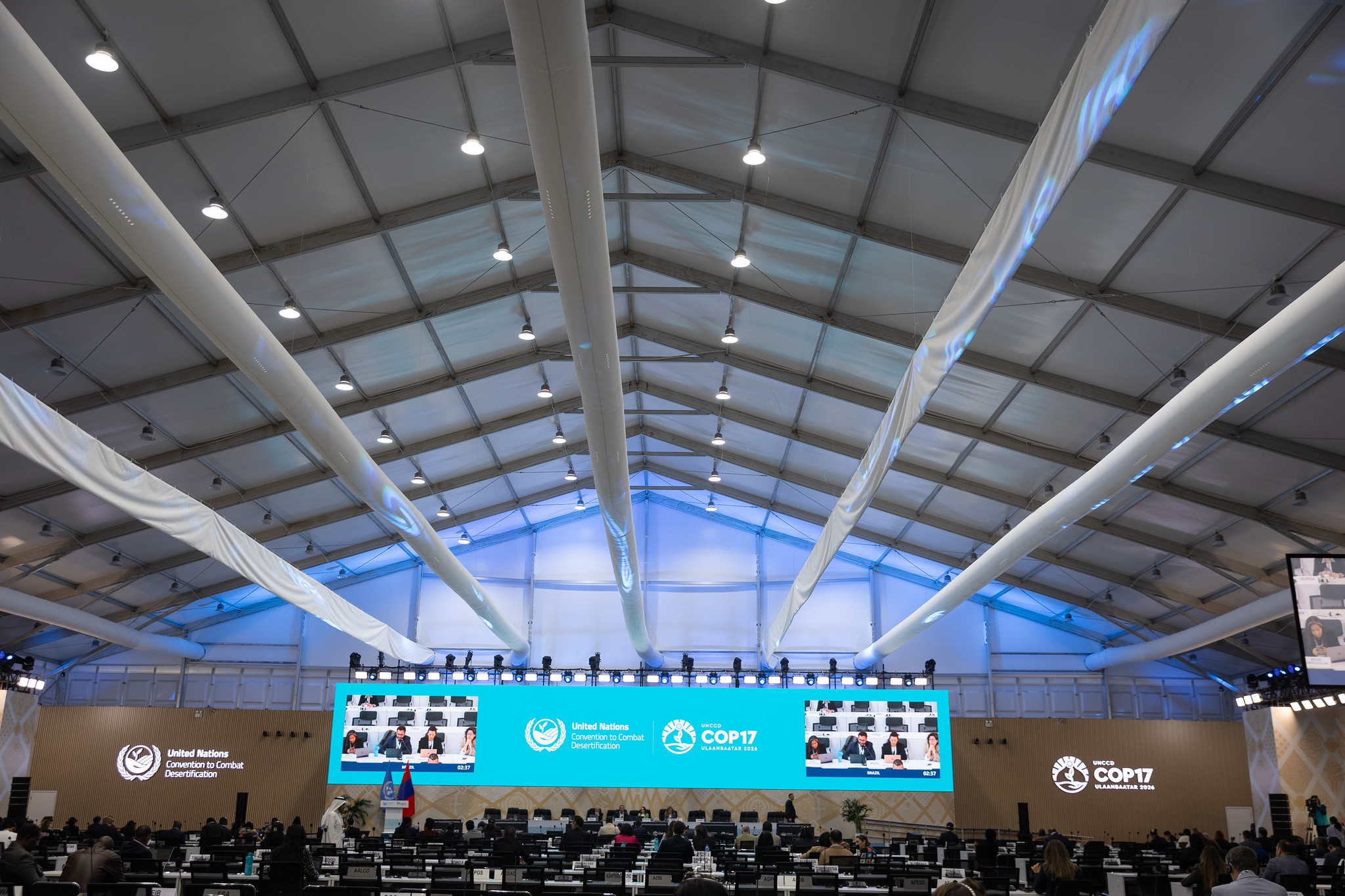
Distribution: To United Nations Secretariat units and bodies, specialized agencies and related organizations and intergovernmental organizations accredited as observers to the Conference of the Parties. The secretariat of the United Nations Convention to Combat Desertification (UNCCD) would like to inform that the seventeenth session of the Conference of the Parties (COP17), the twenty-fourth session of the Committee for the Review of the Implementation of the Convention (CRIC24) and the seventeenth session of the Committee on Science and Technology (CST17) to the UNCCD will take place in Ulaanbaatar, Mongolia, from 17 to 28 August 2026. The secretariat of the UNCCD has the honour to invite the representatives of your organization to participate in COP17 under the overarching theme “Restoring Land, Restoring Hope”. Regional in person consultations of affected country Parties of the Convention’s regional implementation annexes for Africa, Asia, Latin America and the Caribbean, Northern Mediterranean and Central and Eastern European country Parties in preparation to COP17 will be convened in Ulaanbaatar prior to the session from 15 to 16 August 2026, at the COP17 venue. Regional virtual consultations meetings will be implemented from 26 March until 9 July 2026. During the initial segment, from 17 to 21 August, in addition to the CST17 and CRIC24 sessions, the Committee of the Whole (COW) would initiate its work. In order to ensure the effectiveness of the civil society input in the deliberations of the COP, two half-days of open dialogue sessions have been planned on 20 August in the morning and 24 August in the afternoon. Also, in line with decision 36/COP.16 paragraph 2 and further to the request in decision 25/COP.16 paragraph 8, the convening of the Gender Caucus and other mandated events are included in programme of work. The High-Level Segment will take place during the second week of the COP, starting with a Heads of States Summit that will be organized by the Government of Mongolia on 23 August. The ministerial segment will follow, including ministerial dialogues and high-level special events that will be organized under thematic days, starting on August Monday 24 with Finance Day, Tuesday 25 with Water Day, Wednesday 26 Land and People Day, Thursday 27 Food Systems and Soil Health Day. During these days the agenda includes among others the following official events: on Monday (a) Ministerial Dialogue on innovative financial mechanisms for healthy land and drought resilience, and (b) the Business for Land Forum; on Tuesday (c) Ministerial Dialogue on accelerating drought resilience, (d) Special High Level event on Sand and Dust Storms; on Wednesday (e) Ministerial Dialogue on the Restoration of Rangelands and the well-being of Pastoralists’ Communities, (f) Youth Forum, (g) Gender Caucus, (h) Special Event on Indigenous Peoples and Local Communities Caucuses; on Thursday (i) Special Ministerial and High-Level event on Food Systems and Soil Health. During the thematic days, other high-level meetings, forums and side events will take place as part of an ambitious Riyadh-Ulaanbaatar Action Agenda for COP17, which is conceived as a platform to accelerate action and showcase solutions, innovations on finance, policy, coalitions, partnerships, technologies, operations in value chains to restore degraded land, manage and protect water, proactively manage drought, support food security, and build resilience economies and societies. The events will include the participation of political leaders, country delegates, representatives of financial institutions, CEO’s, mayors, academia, civil society organizations, parliamentarians, indigenous and local communities. Specific information about the thematic days and the events will be uploaded at https://www.unccd.int/cop17. During the concluding segment, the COP will consider all decisions not previously adopted. It will decide inter alia on the programme of work and date and venue of the eighteenth session of the COP and of the twenty-fifth session of the CRIC and any further decision on the matter taken during the current session. In order to assist delegations in preparing for the conference, a provisional agenda and relevant documents for the session will be made available on the UNCCD website. All relevant information for participation at COP17 will be made available on the UNCCD COP17 webpage at the following link: https://www.unccd.int/cop17/participate and on the host country COP17 website: https://unccdcop17.org. Please also note that COP17 will be a paperless session. Accordingly, official pre-session documents for COP17/CRIC24/CST17 sessions will be made available on the UNCCD website and the UNCCD Conference app. Official documents prepared in session will also be posted on the website and the Conference app. Limited quantities may be printed on site on demand only. Online registration will be available from 1 May 2026 on this link: https://indico.un.org/e/unccd-cop17. All participants are required to upload an official nomination letter confirming their capacity to attend the COP17 session. For more information on the online registration, please refer to the UNCCD COP17 webpage. The secretariat would like to draw your attention that participants are responsible for getting their own visas, hotel reservations and any type of health or other insurance they may need. Participants requiring visas must therefore obtain these from the Embassies or Consulates of Mongolia in their country or through electronic means, before their departure to Ulaanbaatar. Additional information on the session will be communicated in due course. Sincerely yours, Yasmine Fouad Executive Secretary
