News & stories

Latest news & stories
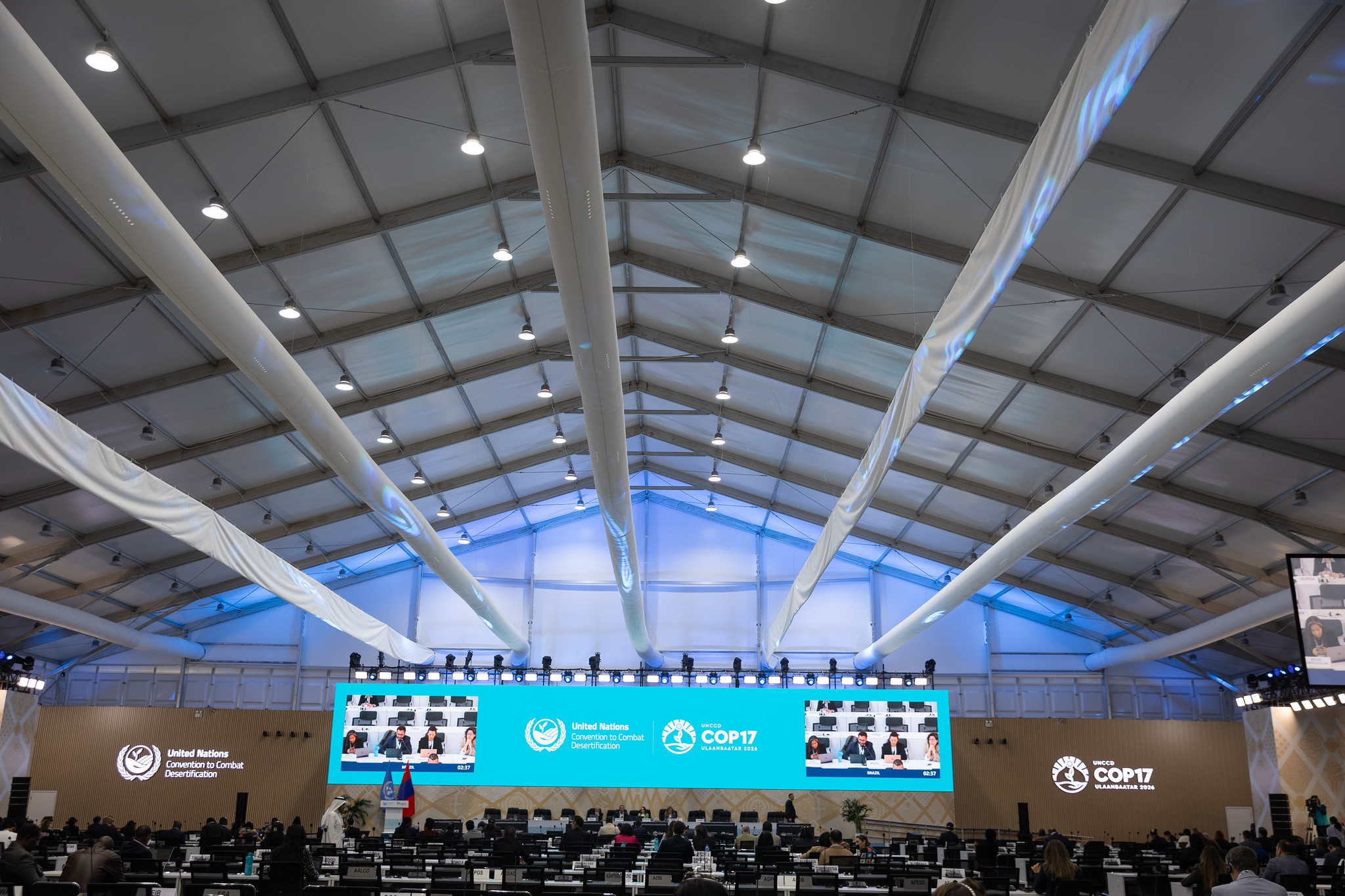
《联合国防治荒漠化公约》第十七届缔约方会议(UNCCD COP17)将于2026年8月17日至28日在蒙古国乌兰巴托举行乌兰巴托 / 波恩,2026年2月5日 - 蒙古国与《联合国防治荒漠化公约》(UNCCD)于今日正式宣布,《联合国防治荒漠化公约》第十七届缔约方会议(COP17)的主题为“恢复土地,重燃希望”。 随着这场具有里程碑意义的全球会议筹备工作不断推进,该主题于UNCCD与蒙古国领导层举行的高级别会议期间宣布,旨在推进UNCCD COP17的筹备工作。COP17将于2026年8月17日至28日在蒙古国乌兰巴托举行,重点聚焦荒漠化、土地退化和干旱问题。《联合国防治荒漠化公约》执行秘书亚斯敏·福阿德表示:“土地是我们最关键的基础设施,是粮食安全、水资源、生计和社会稳定的根基。一旦土地退化,风险便随之上升——生计丧失、被迫迁移以及对稀缺资源的竞争都会加剧。通过举办UNCCD COP17,蒙古国向世界传递了一个强有力的信息:‘恢复土地,重燃希望’不仅是一项环境议程,更是发展与韧性的核心优先事项。在干旱不断加剧、土地退化持续加速的背景下,本届会议必须推动切实可行、具有投资价值的解决方案——从修复退化的土地与土壤,到强化土地与水资源之间的协同关系——以支持社区实现可持续繁荣。”蒙古国总理贡布扎布·赞丹沙塔尔先生指出:“蒙古国充分认识到主办《联合国防治荒漠化公约》第十七次缔约方大会(UNCCD COP17)所肩负的责任,并致力于确保大会取得具体的、以行动为导向且具有长期影响的成果。作为一个发展、民生和文化遗产均与土地密切相连的国家,我们坚信土地恢复是实现和平、可持续发展和包容性社会经济增长的根本支柱。2026年恰逢‘国际牧场与牧民年’,在这一年主办COP17为我们提供了一个独特契机:将对牧场和牧民生计的关注从理念与认知层面提升到落实执行与实际投资,并进一步加强全球在应对荒漠化、土地退化和干旱问题方面的合作。”作为2026年举行的里约三公约(土地、生物多样性与气候变化)缔约方会议中的首场会议,UNCCD COP17旨在通过以人为本的方式推动集体行动,保护依赖土地的生计体系并增强社会韧性。本届会议预计将汇聚来自UNCCD 197个缔约方的代表,同时吸引政府、企业和民间社会领袖,以及科学界、青年、土著人民、牧民和小农代表,共同制定应对荒漠化、土地退化与干旱等相互关联的解决方案。会议将强调,恢复土地对于减少不稳定因素、防止被迫迁移以及增强脆弱地区的人类安全与国家安全都至关重要。目前,土地退化已影响全球多达40%的陆地面积,对粮食生产、水资源供给、生计保障和经济稳定造成深远的影响。COP17为各国和合作伙伴提供了一个关键契机,以加强公约执行力度,并动员更多投资用于抗旱韧性建设和可持续土地管理。蒙古国国土面积达156万平方公里,是全球受荒漠化和土地退化影响最为严重的国家之一,约77% 的土地已出现不同程度的退化。在乌兰巴托举办UNCCD COP17,将把国际社会的关注聚焦于土地恢复的优先事项,特别是兼顾干旱地区生计保障、粮食安全与生态系统保护的综合路径。COP17恰逢国际牧场与牧民年。该国际年由联合国大会宣布,并由蒙古国积极倡导。这为加快推进牧场的可持续管理、恢复与保护提供了重要契机,同时也将凸显直接依赖这些生态系统以维持生计的牧民群体的需求。牧场覆盖了全球一半以上的陆地面积,直接支撑着约5亿人口的生计,并提供全球六分之一的营养供给。然而,这一关键生态系统长期以来被忽视,且正面临日益严重的退化风险。在为期两周的会议期间,与会代表将参与高级别会议环节,包括部长级对话,以及多利益相关方论坛和专题讨论,重点涵盖科学与政策融合、创新与解决方案、工具与技术以及融资机制等议题。除正式谈判外,COP17还预计将推动围绕牧场、韧性与水资源、粮食系统及土壤健康的集体行动。为筹备COP17,蒙古国已启动多项将土地恢复与生计、乡村发展相结合的国家级行动。其中包括由总统牵头、于2021年启动的“十亿棵树”国家行动计划,目标是在2030年前种植十亿棵树。蒙古国还通过全国性对话和公众外联活动,加强公众互动和青年参与,例如举办“Youth4Land(青年为土地)”全国论坛。此外,COP17主席国还通过蒙古商业理事会,积极动员私营部门参与UNCCD 的 “Business 4 Land(企业为土地)”倡议,以加速私营部门在可持续土地管理领域的行动。UNCCD执行秘书总结指出:“蒙古国的相关举措正是UNCCD COP17希望推动的综合性土地恢复与韧性建设路径的生动体现。本届会议旨在释放更强有力的政治动能,并促成切实成果,帮助各国动员资源、强化伙伴关系,在最迫切需要的地区扩大土地恢复规模并提升抗风险能力。”媒体联系UNCCD 新闻办公室: press@unccd.int关于《联合国防治荒漠化公约》《联合国防治荒漠化公约》(UNCCD)是全球土地的共同愿景与声音。我们联合各国政府、科学家、政策制定者、私营部门和社区,共同推动全球行动,恢复和管理地球土地,以实现人类与地球的可持续发展。UNCCD 不仅仅是一份由197个缔约方签署的国际条约,更是减缓当今土地退化影响、推进未来土地治理的多边承诺,旨在为所有人公平和包容地提供食物、水、住所和经济机会。

The shift to renewable energy is picking up momentum, and with it comes a practical question: how do we scale clean power without putting more pressure on land that supports food, nature and livelihoods? A recent report from the International Institute for Sustainable Development (IISD) looks at how renewable energy and sustainable land management can work together when projects are planned with land and people in mind. During the webinar on the report findings, UNCCD Deputy Executive Secretary Andrea Meza noted, “There are ways in which we can deploy these technologies in different landscapes while ensuring food and water security and protecting biodiversity. It is possible to reduce negative impacts and have positive ones if we start putting in place integrated land use plans as part of the strategy for deploying these technologies.” To avoid catastrophic climate change impacts, the world must rapidly transition away from fossil fuels toward renewable energy sources. The share of renewable energy in the power mix is likely to continue growing rapidly, as countries strive to fulfil their emission reduction commitments and the cost of renewable energy technologies continues to shrink. “The starting point was: how can we make sure that the expansion of renewable energy does not come at the expense of sustainable land management and our efforts to halt land degradation globally? What are the main strategies to make sure that new renewable energy installations do not lead to land degradation?” explained IISD Indicator Lead and report co-author Stefan Jungcurt. Today, renewables account for around 30 per cent of global electricity mix, with solar power growing most rapidly, doubling capacity every three years. That momentum has a land dimension. Renewable energy technologies interact with land systems in complex ways, influencing land health and productivity, the provision of ecosystem services and local socio-economic outcomes. Many renewables require more land than fossil fuels when you factor in energy farms, spacing and enabling infrastructure. The report mentions that solar power needs about twice the land footprint of coal-fired electricity and wind energy can require up to 12 times more largely because of spacing between panels and turbines. However, the land between these components can often be put to good use and a larger footprint does not have to translate into degraded land or land use conflicts. Risks arise when renewable energy expansion is driven only by energy objectives, and land considerations arrive late. “The report is a joint response to overlapping challenges of climate change, land degradation and desertification and energy poverty. Clean energy and sustainable land management do not need to compete for space or resources. A well-designed renewable energy system can work with land rather than against it,” said the Interim Head of the Pan-African Cooperation and Educational Technologies Division at the United Nations University Vice-Rectorate in Europe Emmanuel Cheo. One of the most attractive options is dual land use: placing energy infrastructure alongside other productive uses on the same land. Dual-land-use systems can help align land-energy planning, finance and implementation and unlock synergies to advance climate action, biodiversity goals and land restoration together rather than on parallel tracks. The report points to the Land Degradation Neutrality response hierarchy as a practical way to structure action: Countries can avoid land degradation by siting renewable energy systems on land or freshwater systems that have already been degraded or modified by human activities. Solar, wind and bioenergy farms on low-impact sites can be explicitly designed to reduce reliance on wood and charcoal for fuel, helping avoid further deforestation and land degradation. Countries can reduce land degradation by designing and implementing dual-use approaches such as agrivoltaics which pairs solar with crops or grazing, eco-voltaics which combines solar with restoration or conservation goals and wind farms on rangelands where most of the surrounding land can still be used. Integrating renewables with sustainable land and water management through regenerative agriculture, agroforestry and silvo-pastoralism can increase food production, enhance drought resilience, conserve biodiversity and reduce post-harvest losses. “There have been a lot of methodologies developed to avoid and minimize the negative impacts. Integrating these considerations into the early planning stage is very important. We also found that the operation of solar photovoltaic plants can improve soil conditions and the micro-environment but an integrated and aligned policy framework is critical,” said International Renewable Energy Agency's Programme Officer Jinlei Feng. Countries can reverse land degradation through carefully chosen locations for solar and wind, or through bioenergy approaches such as harvesting invasive species or cultivating feedstock on marginal or degraded land. For example, solar energy systems can support land restoration through shading or wind protection, providing clean energy while promoting soil health and vegetation growth under the solar panels. “Countries are trying to decarbonize their economies, meet rising energy demands and at the same time deliver on the commitments under all three Rio Conventions. The good news is that renewable energy and sustainable land management are not in competition by default. We can avoid, reduce and reverse land degradation as we deploy renewables,” said UNCCD Chief Scientist Dr. Barron J. Orr. A key takeaway from the report is that dual-land-use systems will only deliver results if the right conditions are in place: coordination across sectors, clear governance and regulatory frameworks, finance and incentives. Community engagement and capacity building help ensure that people who work the land can influence siting and project design, take part in implementation and share fairly in jobs, energy access and other benefits. When done right, the renewable energy transition can support sustainable land management while strengthening food security and livelihoods. With UNCCD COP17 set to spotlight the world’s rangelands the message is timely: land that sustains rural and pastoralist communities can also accommodate well-designed renewable energy systems that support resilience without adding pressure. The report titled “A Natural Fit: Renewable energy and sustainable land management” was prepared by IISD in collaboration with UNCCD and UNU and with funding support from the European Union. You can watch the recording of the webinar on report findings below:

High-level meeting in Bonn highlights land degradation and drought as rising drivers of instability and security risks.

At the World Economic Forum in Davos, the United Nations Convention to Combat Desertification officially launched the Business4Land (B4L) Champions’ Council, a high-level coalition of global business leaders committed to restoring land and building drought resilience at scale. The launch, co-hosted with InTent, brought together Champions and partners for a dynamic discussion on accelerating private sector action for sustainable land management.Bringing together 10 visionary leaders across diverse regions and industries, including food, fashion and insurance, the B4L Champions’ Council will serve as a high-profile advocacy platform under UNCCD’s flagship B4L Initiative. Its mission is to mobilize corporate action to restore 1.5 billion hectares of degraded land by 2030, while inspiring other companies to adopt land-positive and regenerative business models that deliver both environmental and economic impact. The inaugural B4L Champions are:Bayanjargal Byambasaikhan, Vice Chair, Business Council of MongoliaBenedikt Bösel, Founder, Gut & BöselBirgit Cameron, Co-Founder, Patagonia Provisions and CEO, B. Cameron ConsultingDavid Canassa, Executive Director, Reservas VotorantimAlexandre Capelli, Group Environmental Deputy Director, LVMHMathieu Dondain, Managing Director, NexiraLorenzo Fattibene, Global Business Transformation Leader & Global Sustainable Insurance Leader, EYJulie Greene, Chief Sustainability Officer, Olam AgriAdrienne de Malleray, Co-Founder, Genesis Soil HealthMaria Luiza de Oliveira Pinto e Paiva, Executive Vice-President of Sustainability, Communication and Brand, Suzano“The B4L Champions’ Council reflects a pivotal shift in how we address land degradation: by placing the private sector at the forefront of sustainable land management and people at the heart of the process. Restoring land is not just a government priority, it is a global economic necessity,” said Dr. Yasmine Fouad, Executive Secretary of UNCCD at the launch event in Davos.The Kingdom of Saudi Arabia, represented at the launch by Deputy Minister of Environment and Advisor to the COP16 Presidency, Dr. Osama Ibrahim Faqeeha, serves as the inaugural Chair of the B4L Champions’ Council. “Land restoration is a smart investment in our collective future. With the launch of the Business4Land Champions’ Council, we are creating a platform where private sector leaders can commit, collaborate, and catalyze real-world impact,” he said. “Every business is a land champion.” The Chair role will integrate the Council’s work into UNCCD COP processes and align business leadership with national and global commitments on land restoration and drought resilience. The COP17 Presidency of Mongolia, represented by the Deputy Minister of Environment Mr. Munkhtamir Batbayar, will assume the Chair in August 2026, continuing this leadership through the next year and beyond.“The Champions’ Council is not symbolic, it is designed to lead private-sector action on land restoration and drought resilience. From Mongolia’s perspective, we want business engagement to shift in three ways: from commitments to measurable land outcomes, from isolated pilots to investable pipelines, and from ‘do no harm’ to land-positive value creation. Engaging with our Steppe Action Agenda, the Council can drive collective leadership that moves markets, influences peers, and creates a race to the top on land stewardship,” stated Deputy Minister Batbayar.“We want to bring companies the finance and technology needed to speed up land restoration and sustain livelihoods for people,” said Mr. Bayanjargal Byambasaikhan, Vice Chair, Business Council of Mongolia.As the world looks toward UNCCD COP17 in Mongolia, the B4L Champions’ Council marks a key milestone in placing land at the center of business strategies. With resources and priorities stretched across multiple global challenges, it is more essential than ever that companies invest in regenerative, land-positive solutions to secure a sustainable future for people, nature, and economies.

Restoring land is no longer a question of knowing what to do. Countries across regions and income levels have identified interventions where land is degrading and how drought risks can be reduced. What now determines whether these plans deliver real impact is their financing. “We have reached a point where the challenge is not a lack of commitment or solutions,” said Yasmine Fouad, Executive Secretary of the United Nations Convention to Combat Desertification (UNCCD). “The challenge is whether our financial systems are able to support the scale of transformation that land restoration and drought resilience require.” Meeting global land restoration and drought resilience targets will require around USD 355 billion per year between 2025 and 2030 – far more than is currently being invested. As long as land is not considered a strategic asset, rather than treated as a secondary environmental concern, this gap will persist. Why existing financing approaches fall short Today’s financial systems are not designed for the scale, timeframes, or risk profiles that land restoration demands. Public budgets in many countries are under pressure, shaped by competing development priorities and raising sovereign debt levels that result in limited fiscal space. Responsibilities for land, water, agriculture and climate are often split across institutions, complicating coordinated investment. Private investment has so far played a limited role. While interest in sustainability is growing, land restoration often involves longer time horizons and higher perceived risks. Without mechanisms to share risk, capital continues to flow elsewhere – even as UNCCD works to mobilize companies and investors through its Business4Land (B4L) platform, including the launch of the B4L Champions’ Council in 2026. The result is a persistent mismatch: the economic costs of land degradation continue to accumulate across food systems, water security and national economies, while investment remains far below what is required. Closing this gap requires a shift in investment logic – recognizing land restoration as core economic activity, not a side project. “Investing in land is one of the smartest investments available today,” Fouad said. “It reduces risk, strengthens resilience and delivers returns that far exceed the cost.” For development banks and public financiers, this means positioning land restoration not as a niche environmental issue, but as a strategic asset class – one that underpins food security, climate resilience and long-term stability. Turning finance into delivery In many countries, fiscal policies continue to favour land-degrading activities, while restoration remains underfunded. Redirecting incentives – by reforming subsidies and aligning taxation and public spending with sustainable land management – can change the economics of land use, making restoration financially viable rather than marginal. Aligning agriculture, water, climate and economic strategies is critical to making financing more effective and durable. When policies pull in different directions, investment fails to deliver lasting results. Mobilizing private investment at scale will also depend on reducing risk. Strategic use of public and concessional finance can absorb early risks, unlocking private capital at a scale that public budgets alone cannot reach. International cooperation remains essential, particularly for countries facing the largest restoration and drought resilience needs. When used strategically, public finance can mobilize additional resources while delivering benefits that extend beyond national borders. The cost of inaction The economic consequences of inaction are already visible. Land degradation, desertification and drought already cost the global economy close to USD 900 billion each year, through lost productivity, soil depletion, drought damage and carbon emissions. By contrast, scaling up investment in land restoration and drought resilience could generate USD 1.8 trillion in annual benefits- an estimated eight-to-one return on investment. These gains go beyond economics, strengthening food security, reducing vulnerability and supporting more resilient societies. Every year of delay increases the economic, social and environmental costs. From COP16 momentum to COP17 delivery Financing was central to discussions at the sixteenth session of the Conference of the Parties to the UNCCD (COP16), which mobilized political attention, launched new partnerships and secured more than USD 12 billion in pledges for drought resilience. COP16 showed that political momentum exists. The challenge now is whether financing systems can convert that momentum into delivery. Attention is now shifting to COP17 in Ulaanbaatar, Mongolia. With the International Year of Rangelands and Pastoralists in 2026 approaching, the focus will increasingly turn to implementation. Rangelands alone cover more than half of the Earth’s land surface and support the livelihoods of over one billion people, yet remain among the most underfinanced ecosystems globally. For the UNCCD, the road to COP17 is about ensuring that financing frameworks are designed to deliver -capable of translating ambition into measurable impact on the ground. A defining moment The plans are in place. The solutions are known. The ambition is clear. What will define the coming decade is whether financial systems evolve to match that ambition – recognizing land as a strategic investment and financing it accordingly. “If we align finance with the value of land,” Fouad said, “we can restore ecosystems, strengthen resilience and secure a future that delivers for both people and planet.”

The UNCCD Youth Caucus has announced the selection of Rico Rau and Tiffany Marcelle as its new Global Focal Points (GFPs), following an open and competitive nomination process. The call for nominations was launched on 15 October and closed on 29 October, receiving a total of 45 nominations from youth representatives across all regions. Candidates were assessed against eligibility criteria outlined in the call, including age requirements, demonstrated engagement within the UNCCD process, alignment with the Convention’s mandate, and affiliation with UNCCD-accredited organizations. Following this assessment, a short list of candidates who fully met the criteria was identified. In line with the Youth Caucus’ commitment to balanced geographical representation, and considering that the previous Global Focal Points, Ms. Juliet Grace Luwedde represented the Africa region, and Ms. Esha Mitra represented the Asia region — the selection team agreed to appoint: Tiffany Marcelle (Dominica, Caribbean Youth Environment Network – CYEN), representing the Latin America and Caribbean (LAC) region Rico Rau (Germany, Isha Foundation), representing the Europe / WEOG region Both selected candidates demonstrated strong alignment with the UNCCD mandate, active engagement within the UNCCD Youth Caucus, and solid experience working with accredited organizations and international youth processes. As Global Focal Points, Tiffany Marcelle and Rico Rau will provide overall coordination and strategic guidance for the Youth Caucus, supporting youth representation, strengthening regional coordination, and advancing collective action on land restoration, land degradation, and drought resilience. Global Focal Points are elected by Youth Caucus members and are accountable for ensuring that the mandate of their role is effectively implemented. The UNCCD Youth Caucus and the UNCCD Secretariat also expressed its appreciation to the outgoing leadership, Ms. Juliet Grace Luwedde, for her dedicated service and contributions to strengthening the visibility and impact of youth engagement within the UNCCD process. Learn more about the UNCCD Youth Caucus.
