News & stories


Latest news & stories
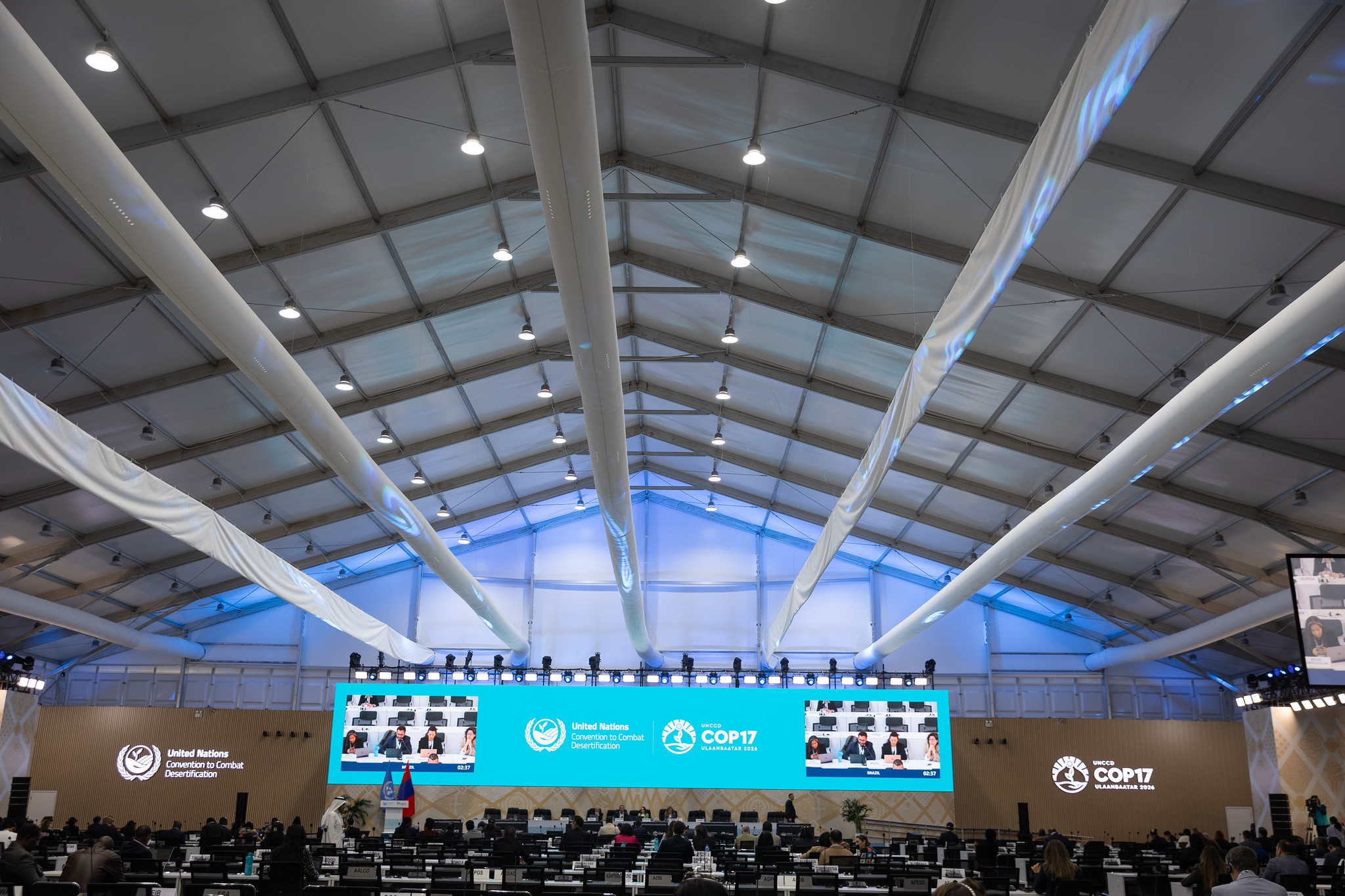
US$1.3 billion portfolio of finance for land restoration and drought resilience across 23 countries, with rangelands at its centre through a US$1.2 billion portfolio spanning 45 projects Progress toward Land Degradation Neutrality (LDN), with Brazil presenting a new voluntary 2030 LDN target comprising 17 sub-targets, while Central Asia has already achieved half of its LDN targets.The Riyadh Global Drought Resilience Partnership, launched by Saudi Arabia at COP16, moved closer to operational delivery in Ulaanbaatar, advancing work on a proposed pooled fund to support around 70 vulnerable countries. UNCCD and Luxembourg launched the Drought Resilience Investment Facility, which aims to mobilize up to US$400 million in public and private capital for drought resilience. ULAANBAATAR, MONGOLIA, 28 August 2026 — After two weeks of negotiations on how to tackle land degradation, desertification and drought, the seventeenth session of the Conference of the Parties to the United Nations Convention to Combat Desertification (UNCCD COP17) concluded today in Ulaanbaatar, Mongolia. Across the negotiated and Action Agenda tracks, Ulaanbaatar brought together key elements of implementation: political direction, science, finance, investment-ready projects, partnerships and stronger participation by the people who manage the world’s land. The biannual meeting of the UNCCD's 197 Parties put the world’s rangelands — which cover 54 per cent of the Earth's land surface, support around two billion people and are stewarded by some 500 million pastoralists — at the centre of the global land agenda. Launched in Ulaanbaatar during the International Year of Rangelands and Pastoralists, the Rangelands Flagship Initiative brings together US$1.2 billion across 45 projects, the largest single mobilization for rangelands in the Convention’s history. Alongside the negotiations, COP17 delivered a series of initiatives and financial commitments aimed at accelerating action on land restoration and drought resilience. Governments, development banks, funds and companies announced a US$1.3 billion portfolio of finance across 23 countries on five continents, at different stages of development. This includes US$644.5 million identified as new finance, of which US$216.4 million is already confirmed and moving towards implementation. UNCCD Executive Secretary Yasmine Fouad said: “We came to Ulaanbaatar saying that COP17 must be a COP of implementation. We leave with more of the architecture needed to make that possible. - political decisions, stronger science, innovative financing mechanisms, investment pipelines and partnerships that can move solutions to scale. But Ulaanbaatar will not be judged by what was announced inside this conference. Its legacy will be measured by what happens next: whether countries are better prepared for drought, whether degraded land and rangelands are restored, whether finance reaches viable projects, and whether the people who manage the land see a real difference in their lives.” H.E. Battsetseg Batmunkh, Minister for Foreign Affairs of Mongolia and UNCCD COP17 President, said: "As the Host Country and President of the 17th Session of the Conference of the Parties to the United Nations Convention to Combat Desertification, Mongolia has worked in the spirit of ensuring open, transparent, inclusive and consensus-driven atmosphere for the discussions and striving to bring Parties’ positions closer in order to achieve tangible results. Within the International Year of Rangelands and Pastoralists, Mongolia has demonstrated to the world that pastures form a strategically important ecosystem which connects food, environment, economy, biodiversity and herdcers’ livelihoods. In exercizing the Presidency of the 17th Session of the Conference of the Parties to the United Nations Convention to Combat Desertification, Mongolia was guided by the principle of “from promises to implementation and from discussions to real work”. H.E. Sandag-Ochir Tsend, Minister of Environment and Climate Change of Mongolia and Chair of the National Committee for the Organization of UNCCD COP17, said: "Mongolia successfully hosted the 17th session of the Conference of the Parties to the United Nations Convention to Combat Desertification (UNCCD COP17), bringing countries from around the world together to advance practical solutions to desertification, land degradation, and drought. One of the conference’s most significant outcomes for Mongolia was securing support from Parties, international organizations, the private sector, and civil society for the “Steppe Plan”a key policy legacy of COP17. Under the Steppe Plan, the Government of Mongolia officially launched three international initiatives: the Rangelands Flagship Initiative, the Water–Land Nexus Initiative, and the Nature-based Solutions for Sustainable Infrastructure Initiative. These initiatives have created new opportunities to develop projects, strengthen international cooperation, and mobilize investment in these priority areas. Although COP17 concludes today, our work does not end here. Our next priority is to translate the decisions adopted, partnerships established, and investment commitments secured at the conference into tangible action and to ensure that the initiatives launched from Mongolia’s steppes deliver measurable results." From commitments to implementation The conference took place against a stark global backdrop. Up to 40 per cent of the world’s land is degraded, while countries have committed to restoring more than one billion hectares by 2030. More than 70 countries now have national drought plans, compared with only three in 2013, but financing and implementation continue to lag behind the scale and speed of the challenge. Against this backdrop, Parties called for greater mobilization of financial resources, capacity-building and technical cooperation to strengthen proactive drought management, particularly in African countries, without neglecting other affected developing countries. A significant body of new evidence presented in Ulaanbaatar highlighted both the costs of inaction and the benefits of investing in healthy land. New reports examined the economics of restoring the world’s rangelands, the growing human and economic impacts of drought, the particular challenges facing Small Island Developing States and Central Asia, and the value of investing in soil health. The findings showed that 18.8 million hectares of land are degraded across SIDS, while in Central Asia more than 80 million hectares — over a quarter of the region — are already degraded, affecting 24 million people. At the same time, all five Central Asian countries have adopted voluntary Land Degradation Neutrality targets, half of which have already been met. Together, the reports showed how land degradation and drought are affecting food and water security, livelihoods and economies across diverse regions, while making the economic case for prevention, sustainable land management and restoration. Alongside this new evidence, Brazil presented a major national commitment through its voluntary Land Degradation Neutrality (LDN) target for 2030, comprising 17 sub-targets linked to national policies, plans and programmes. The target includes the recovery or restoration of more than 163,000 km², including through native vegetation recovery and agroforestry systems, while a further 3.51 million km² are covered by measures aimed at preventing degradation through conservation and sustainable land management. Together, the 17 sub-targets cover approximately 3.67 million km². This commitment supports Brazil’s efforts to achieve Sustainable Development Goal 15.3 by avoiding, reducing and reversing land degradation, while strengthening food and water security, biodiversity and climate resilience. A new global architecture for drought resilience Following sustained negotiations, Parties decided to continue discussions at COP18, building on progress made at COP16 and COP17, with a view to adopting a decision on the proactive management of drought at all levels. Parties also decided that drought will remain a stand-alone agenda item at COP18 and at each ordinary session thereafter. The Riyadh Global Drought Resilience Partnership, established at COP16, moved towards implementation in Ulaanbaatar. Its first Assembly of Partners advanced work on a proposed pooled fund intended to help around 70 low- and lower-middle-income countries through capacity-building, investment-ready programmes and financing for drought resilience. COP17 also saw the launch of the Drought Resilience Investment Facility (DRIF), the first global catalytic financing platform dedicated to drought resilience. Co-created by UNCCD and Luxembourg with support from the International Drought Resilience Alliance, the Facility aims to mobilize up to US$400 million in public and private capital for investments in water security, sustainable agriculture, nature-based solutions and land restoration. Its first strategic partnership with the Global Environment Facility will explore opportunities to unlock private and philanthropic finance. Phase II of the International Drought Resilience Observatory also introduced the world’s first Drought Resilience Index, providing countries with a new tool to assess their capacity to anticipate, prepare for and adapt to drought and to better target policies and investment. Finance for land moves up the agenda COP17 also sought to narrow the gap between global land commitments and the finance available to deliver them. z zzzz An estimated US$355 billion a year is needed through 2030 to meet global land restoration commitments, compared with around US$77 billion currently invested, leaving an annual financing gap of US$278 billion. Private finance accounts for only around six per cent of global investment in land restoration. Governments, development banks, funds and companies announced a US$1.3 billion portfolio of finance for land restoration and drought resilience across 23 countries on five continents, at different stages of development. Of this, US$644.5 million is identified as new finance, with US$216.4 million already confirmed and moving towards implementation. The portfolio spans rangeland and landscape restoration, drought resilience and locally led adaptation. Discussions in Ulaanbaatar also focused on addressing barriers that have kept investment in land low, including how to make land, soil health and drought resilience more visible and trackable within existing nature-finance categories. Participants also explored greater use of guarantees, first-loss capital, insurance and project-preparation facilities to turn restoration plans into investment-ready projects. Host country Mongolia launched the first national Business 4 Land (B4L) Hub, alongside sustainable finance principles, a national green taxonomy and a target for 10 per cent green lending by 2030. Russia followed with its own national hub, while Luxembourg moved to establish a B4L Foundation and Germany supported a B4L Finance Expert Group. Rangelands: from overlooked ecosystems to economic assets Hosted by Mongolia during the United Nations International Year of Rangelands and Pastoralists, COP17 gave particular prominence to rangelands and the people who manage them. Parties recognized pastoralists as essential stewards of rangeland ecosystems, highlighting the importance of transboundary mobility and the value of pastoralists’ knowledge and experience. Despite their global importance, rangelands remain largely overlooked in policy and investment: they contain roughly onethird of the world’s key biodiversity areas, yet feature in the national climate plans of only 24 countries, compared with 181 for forests. New economic analysis presented in Ulaanbaatar estimated that rangelands generate US$21–47 trillion in ecosystem services every year — up to nearly half of global GDP — through benefits including food production, water, carbon storage and biodiversity. Restoring rangelands typically returns US$4–6 for every dollar invested, rising to as much as US$36 when wider public benefits such as water supply are included. The Rangelands Flagship Initiative announced at COP17 seeks to translate that economic case into investment, bringing together projects supporting sustainable rangeland management, restoration and pastoralist livelihoods. The Global Environment Facility is supporting coordination of the initiative through a US$3.3 million investment in the UNCCD COP17 Legacy Project. Over the past four years, the Fund has also approved more than 50 projects worth over US$300 million benefiting rangelands and pastoralist communities. Indigenous Peoples and local communities convene new caucuses at COP17 The conference marked the first formal meetings of the UNCCD Indigenous Peoples Caucus and Local Communities Caucus, following the decision by Parties at COP16 in Riyadh to establish the two bodies and provide dedicated spaces for their perspectives and priorities within the Convention. It also brought together the largest representation of Indigenous Peoples in the history of a UNCCD Conference of the Parties. A high-level special event on Land and People Day highlighted Indigenous Peoples as rights holders, knowledge holders and implementation partners, focusing on Indigenous knowledge systems, customary governance, sustainable pastoralism, land stewardship and direct access to finance for Indigenous-led action. Across COP17, Indigenous Peoples, pastoralists and local communities called for stronger land and mobility rights, greater direct access to finance, meaningful participation in decision-making and recognition of Indigenous and traditional knowledge in land restoration and drought resilience. Discussions also highlighted women and youth leadership, including calls to invest in young people as land restoration leaders and strengthen their participation in action on land and drought. From Mongolia to Egypt The next session of the UNCCD Conference of the Parties, COP18, is expected to take place in Egypt, in 2028, carrying forward the momentum built in Ulaanbaatar. Looking ahead, Egypt has emphasized the importance of strengthening cooperation and promoting integrated approaches to land degradation, climate change and biodiversity loss that strengthen food and water security and resilience. COP18 will provide the next major milestone for countries to assess progress on land restoration and drought resilience and build on the outcomes reached in Ulaanbaatar. Notes to editors For media enquiries and interview requests: UNCCD Press Office: press@unccd.int COP17 decisions are available here: https://www.unccd.int/cop17/official-documents About UNCCD The United Nations Convention to Combat Desertification (UNCCD) is the global vision and voice for land. We unite governments, scientists, policymakers, private sector and communities around a shared vision and global action to restore and manage the world’s land for the sustainability of humanity and the planet. Much more than an international treaty signed by 197 Parties, UNCCD is a multilateral commitment to mitigating today’s impacts of land degradation and advancing tomorrow’s land stewardship in order to provide food, water, shelter and economic opportunity to all people in an equitable and inclusive manner.

Closing DayOn Friday, 28 August, delegates gather as the seventeenth session of the Conference of the Parties (COP17) to the United Nations Convention to Combat Desertification concludes with the adoption of final decisions and reports, bringing the two-week conference to a close.KEY EVENTS FOR MEDIACOP17 Closing Press ConferenceWhen: 17:00Where: Press Conference RoomSpeakers:Yasmine Fouad (UNCCD Executive Secretary)Battsetseg Batmunkh (COP17 President and Minister of Foreign Affairs of Mongolia)Journalists are invited to attend the final press conference, where leadership present the main outcomes and reflections on COP17, outlining key decisions adopted by the Parties at the close of the session.Side EventsSide events throughout the day will cover rangelands and pastoralism, finance, drought resilience, land tenure, healthy soils and the land-water nexus.Journalists are encouraged to consult the official COP17 programme for the full schedule and latest updates : https://www.unccd.int/cop17/programmeMEDIA RESOURCESCOP17 programmeUNCCD COP17 websiteHost country websiteUNCCD Action Dome websiteUN WebTV – Live broadcast of key plenary sessions with live interpretation in all six UN languagesUNCCD COP17 Visual Assets and Branding ResourcesEarth Negotiations Bulletin – daily coverage, photographs and analysisFor media enquiries and interview requests: UNCCD Press Office: press@unccd.int

The proposed voluntary country-led Rio Synergies Group for Action would help countries translate climate, biodiversity and land priorities into more coherent planning, investment and implementation, while reducing duplication and reporting burdens.Ulaanbaatar, 27 August 2026 – In a push to transform political momentum into practical action, Ministers, current and incoming Rio Convention COP Presidencies, the Executive Secretaries of the three Rio Conventions, international organizations and financial institutions on 26 August at UNCCD COP17 held a High-Level Dialogue on strengthening cooperation across the climate, biodiversity and land degradation issues.The event launched the COP31 Presidency Process, led by Türkiye, towards a proposed Rio Synergies Group for Action. The proposed Action group is intended to support a voluntary, country led implementation by connecting existing national priorities across climate, biodiversity and land with existing partnerships, technical expertise, implementation, knowledge-sharing, capacity-building and financing opportunities.The aim is not to create another parallel structure, but to help countries connect the pieces they already have, national plans, science, projects, finance and partnerships, and make them work together more effectively on the ground.Several countries, including Australia, Ireland, Japan, Maldives and Sierra Leone, and the heads of the UN entities supported the idea, emphasizing the multiple benefits of such a group to countries. A coordinated and integrated approach brings efficiency, cost-savings, reduces the planning and reporting burdens on countries and will help countries to respond practically to environmental challenges that communities experience as multiple, not single crises.It can also help countries identify programmes and investments capable of delivering simultaneously for land restoration, climate resilience, biodiversity and development, rather than financing each agenda in isolation.The High-level Dialogue, “From Ambition to Action: Delivering Rio Convention Synergies across the Triple COP Year,” is the first high-level opportunity during the 2026 Triple COP Year to consider how political momentum for Rio Convention synergies can be translated into practical, country-led implementation.Convened by the Presidencies of UNCCD COP17, incoming CBD COP17 and incoming UNFCCC COP31, the Dialogue underscored the continuity of political leadership across the 2026 Triple COP Year, beginning with UNCCD COP17 in Ulaanbaatar, continuing in October to COP17 of the Biodiversity Convention under the Presidency of Armenia in Yerevan, and culminating with UNFCCC COP31 in November under the Presidency of Türkiye in Antalya.The process offers interested countries and partners an opportunity to contribute to the co-development of the proposed voluntary, country-led Group, with a view to its formal launch at UNFCCC COP31 in Antalya.Speakers explained why stronger synergy among the Convention’s matters now more than ever, proposed some guiding principles for such an Action Group and explained the multiple benefits to be gained through synergy. Dr. Yasmine Fouad, UNCCD Executive Secretary said: “Rio synergies need to deliver in three areas: stronger national policy coherence with less bureaucratic burden for countries, tangible action on the ground and greater engagement of the private sector to mobilize investment. The real test is whether we can connect national priorities to integrated programmes, programmes to finance, and finance to implementation that delivers multiple benefits for people and landscapes. We do not need another layer of process. We need the systems we already have to work together more effectively and at scale”Ms. Fatma Varank, Türkiye Deputy Minister of Environment, Urbanization and Climate Change of the Republic of Türkiye, who represented the incoming UNFCCC COP31 Presidency at the Dialogue, emphasized the need for coherence and efficiency in implementing agreements, and the importance of dialogue in building momentum for synergy towards COP31.Synergy, she said, does not equal merging mandates, rather, it achieves greater scale, coherence, efficiency, reduced duplication and yields multiple benefits.Mr. Andrew Berryman, Deputy Head of Mission, Embassy of Australia in Mongolia, representing UNFCCC COP31 Presidency of Negotiations said a voluntary, country-led and practical Rio Synergies Group for Action could strengthen coordination across institutions, including through leveraging existing mechanisms and delivering more with less.Mr. Andranik Grigoryan, Government of Armenia representing the incoming Presidency of CBD COP17, said one of the lessons emerging from the global report reviewing progress in the implementation of the Kunming Montreal global biodiversity framework is the need for cooperation, integrated and coordinated action among stakeholders. The draft report is currently undergoing peer review and will be launched at CBD COP17.Integrating action among the three Conventions at the national level, he said, can reduce institutional and regulatory burdens and enhance the process, for instance, by sharing science, capacity building on several agendas, and in finance, through shared solutions.Astrid Schomaker, Executive Secretary of the Convention on Biological Diversity, said the study shows 80 percent of biodiversity delivers for climate, but only 22 percent of climate finance delivers for biodiversity, and that a re-set is needed in how we approach the mandates to help countries to align plans, reduce the reporting burden and avoid leaving people behind.H.E. Mr. Shigeharu Aoyama, Japan’s State Minister of the Environment, said synergy should minimize trade-offs, while maximizing co-benefits, and highlighted the results of an Asia-Pacific synergies report: advancing synergistic solutions to the triple planetary crisis and the SDGs whose more than 104 case studies on synergy demonstrate the benefits of shared knowledge and tangible action on the ground.Citing the same study, Inger Andersen, United Nations Environment Program Executive Director, reported that significant financial savings of up to 24 percent, equivalent to 6.4 billion United States dollars could be achieved by 2050. Synergy would be especially useful in developing plans on the ground and in reporting by the Conventions, she said. H.E. Mr. Timmy Dooley, Ireland’s Minister of State at the Department of Agriculture, Food and the Marine and at the Department of Climate, Environment and Energy, said implementation should be interconnected, particularly with regards to national priorities, implementation partners, and connecting ambition with finance. H.E. Ali Shareef, Minister of Climate Change, Environment and Energy of the Republic of Maldives said integration is “not a convenience” but borne of “necessity” for Small Island States (SIDs), and called for a dialogue on synergy that can close the gap SIDs encounter, for instance in indicators that are calibrated individually, and in the case of UNCCD, action that is limited to arid, semi-arid and dry sub-humid zones. Simon Stiell, Executive Secretary of the United Nations Framework Convention on Climate Change, called for alignment between the politics and the realities and practicalities of the Conventions. He urged Parties to be very practical and to reduce the burden of reporting on countries. Supporting the idea of an Action Group, Samed Ağırbaş, Climate High-Level Champion of the COP31 Presidency said there is no need for another parallel system. Rather, implementation that connects solutions is what is needed.H.E. Ms. Ruth Davis OBE, United Kingdom Special Representative for Nature, stressed the need for practical progress – synergistic solutions – because people experience the land, biodiversity and climate change challenges as multiple crises, not as single crisis.The outgoing Presidencies of UNCCD COP16, the Kingdom of Saudi Arabia, and UNFCCC COP30, Brazil, highlighted their past contributions to the Belém process and statement on the Rio Conventions and praised the progress and momentum building up towards COP31 in Türkiye.Türkiye formally endorsed the Belém Joint Statement on the Rio Conventions, becoming the final incoming Rio Convention COP Presidency to join the shared political commitment.Media contact:Wagaki WischnewskiCommunications Officer/UNCCD G20 Global Land InitiativeM: +49 (0)173 268 7593/+976 99207536email: wwischnewski@unccd.int

Ulaanbaatar, Mongolia, 26 August 2026 (UNCCD) - From remote islands to large steppes, land resources are under increasing pressure from poor management, overexploitation and drought exacerbated by climate change, UN experts warn. The Global Land Outlook (GLO) reports on Small Island Developing States (SIDS) and on Central Asia, launched today by the United Nations Convention to Combat Desertification (UNCCD), document a serious decline in the health and productivity of land and water resources across more than 50 countries and territories, undermining their long-term sustainable development and in some cases threatening their very survival. More importantly, both reports offer a transformative vision for reversing this decline and boosting the resilience of communities living in these unique geographic contexts.SIDS offer scalable solutions for managing their most precious asset—landComprising 39 states and 18 territories, SIDS are home to around 74 million people in the Caribbean, Pacific, Atlantic and Indian Oceans, as well as the South China Sea. These diverse nations and territories also boast some of the world’s most extraordinary natural assets, cultural heritage and traditional ecological knowledge. Some18.8 million hectares of land — equivalent to 16.5% of SIDS’ total land area — is degraded to varying extents, slightly above the global average, intensifying competition over scarce natural resources.The inherent attributes of SIDS — their small size, geographic isolation, tight ecological connectivity and community stewardship — make them ideal incubators of innovation for the implementation of integrated land and water management approaches that account for the close linkages between terrestrial and marine ecosystems. These approaches also have the potential to generate nature-positive, economic development models that can be scaled up from islands to continents.Central Asia, an epicentre of degradation, is halfway towards meeting 2030 land targetsCentral Asia, a region once celebrated for its sweeping steppes and fertile oases, is now one of the world’s epicentres of land degradation. Over 80 million hectares – more than a quarter of the region – are already degraded, affecting nearly 30% of the population – 24 million people living across five Central Asian nations of Kazakhstan, Kyrgyzstan, Tajikistan, Turkmenistan and Uzbekistan.The GLO Central Asia Thematic Report takes stock of the current situation. “All five Central Asian states have embraced National Voluntary Land Degradation Neutrality (LDN) Targets under Sustainable Development Goal (SDG) 15.3, and half of these targets are already met. This is not a moment of triumph – it is the end of denial. LDN has moved from theory into practice, now embedded in national green economy strategies, agricultural development plans, and climate adaptation policies”, states the report.The countries of Central Asia maintain broad international partnerships, with regional and interregional cooperation, strongly supported by the Convention, serving as an important platform for collaboration with governments, international organizations, development finance institutions, and private-sector investors to advance sustainable land management and strengthen climate resilience. “Despite very different geographies and challenges, both SIDS and Central Asian countries show that vulnerability does not have to mean inevitability. SIDS can become laboratories for integrated land and water solutions that connect ecosystems, communities and development, while Central Asia is demonstrating how land degradation neutrality can move from targets into national policy and practice. The priority now is to accelerate that progress — by investing in land stewardship, strengthening regional and international cooperation, and ensuring that people and ecosystems remain at the centre of development decisions,” says UNCCD Executive Secretary Yasmine Fouad.These two GLO reports were released during the seventeenth session of the Conference of the Parties (COP17) to the UNCCD underway in Ulaanbaatar, Mongolia. Representatives of 196 countries and the European Union are gathered for negotiations on future policy directions for land restoration and drought resilience. UNCCD is the first of the three Rio Conventions COPs convening this year, ahead of the biodiversity COP in Armenia in October and the climate COP in Türkiye in November.For more information:UNCCD Press Office: press@unccd.intNotes to EditorsThe full reports can be accessed online at: GLO Small Island Developing States thematic reportGLO Central Asia thematic reportReports by the numbers:SIDSDespite covering less than 0.5 per cent of the world's total surface area, SIDS are home to over 20% of the world’s biodiversity, with 9.5 times more endemic species richness than mainland areas.18.8 million hectares — or 16.5% of the total land area of all SIDS — were reported as degraded.43% of the total land area of SIDS, were affected by drought, of which 3% experienced severe drought and 6% extreme drought. The total area affected by extreme drought rose by 30% across all SIDS.Over 70% of SIDS face a risk of water shortages, a figure which rises to 91% in low-lying SIDS.An estimated 16.3 million people face severe food insecurity across SIDS, with 11.5 million being undernourished.SIDS receive only around USD 2 billion in public adaptation finance per year — approximately 0.2% of total global climate finance. They will require at least USD 11.7 billion annually for adaptation purposes — nearly six times the current level of funding.Between 2016 and 2023, an average of around USD 487 million per year in development finance to SIDS targeted efforts to combat desertification, land degradation and drought.Central AsiaOver 80 million hectares – more than a quarter of the region, an area approximately four times the size of Kyrgyzstan – are already degraded.Every year, Central Asia loses between USD 2 and 6 billion to land degradation.Central Asia is heating at twice the global average. The glaciers – once the “water towers” of the region – have shrunk by 30% in just fifty years. About UNCCD The United Nations Convention to Combat Desertification (UNCCD) is the global vision and voice for land. We unite governments, scientists, policymakers, private sector and communities around a shared vision and global action to restore and manage the world’s land for the sustainability of humanity and the planet. Much more than an international treaty signed by 197 Parties, UNCCD is a multilateral commitment to mitigating today’s impacts of land degradation and advancing tomorrow’s land stewardship in order to provide food, water, shelter and economic opportunity to all people in an equitable and inclusive manner.

The Drought Resilience Investment Facility (DRIF), the first global catalytic financing platform aims to mobilize up to USD 400 million in public and private capital for drought resilience.The world's first Drought Resilience Index will provide a new basis for targeting policies and investments to reduce drought risk. COP17 advances work towards a new global pooled fund to help around 70 low- and lower-middle-income countries strengthen drought resilience Ulaanbaatar, Mongolia, 26 August 2026 --- By 2050, three out of four people worldwide could face drought. Responding to that challenge, the seventeenth session of the Conference of the Parties to the United Nations Convention to Combat Desertification (UNCCD COP17) marked a significant step towards shifting the global response to drought from crisis management to proactive resilience.A series of announcements and launches at COP17 are strengthening the way countries finance, measure and implement drought resilience. Three distinct initiatives mark this progress: the launch by Luxembourg and UNCCD of the Drought Resilience Investment Facility (DRIF), a new catalytic finance platform aiming to mobilize up to USD 400 million in public and private capital; progress towards a global pooled fund to support drought resilience in low- and lower-middle-income countries; and the unveiling of the world’s first Drought Resilience Index.Taken together, these initiatives reflect growing recognition that drought can no longer be managed as an isolated environmental challenge. It is a systemic risk requiring stronger governance, investment in preparedness, and coordinated action before its impacts cascade into wider social and economic crises. UNCCD Executive Secretary Yasmine Fouad said: "COP17 is about turning commitments into implementation. We now have stronger financing mechanisms, better tools and practical guidance to help countries prepare for drought before it becomes a crisis. The task now is to connect these pieces and put them to work at scale, through governments, development partners, financial institutions and the private sector.” Mobilizing investment in drought resilienceWater Day at COP17 marked the launch of the Drought Resilience Investment Facility (DRIF), the first global catalytic finance platform dedicated to drought resilience. Co-created by the Government of Luxembourg and the UNCCD, with the support from the International Drought Resilience Alliance (IDRA), DRIF is designed to use public and catalytic capital to reduce investment risks and unlock much larger flows of institutional and private finance. With an ambition to mobilize up to USD 400 million in public and private capital, DRIF will invest in commercially viable projects and businesses that strengthen drought resilience while generating measurable environmental, social and financial returns.Rather than approaching water security, sustainable agriculture, land restoration and nature-based solutions as separate investment themes, DRIF brings them together through a single lens: their contribution to drought resilience.Its ambition also extends beyond the capital mobilized by the Facility itself. DRIF aims to demonstrate that investments in drought resilience can be commercially viable, build a track record for the sector and help establish resilience as an investable proposition capable of attracting much larger flows of private capital over time.Gilles Roth, Minister of Finance of Luxembourg said: “Luxembourg’s EUR 5 million commitment to the Facility reflects a simple idea: public money can help bring much more private investment into areas where it is urgently needed. Together with the UNCCD, we want the Drought Resilience Investment Facility to turn promising ideas into investable projects and help bring them to scale. The aim is to make investment in drought resilience possible where the market alone would not get us there.” The Ministry of Foreign Affairs of Luxembourg provided an initial contribution of USD 2 million to support the design, structuring and establishment of DRIF.Minister Xavier Bettel said: “As a founding partner of DRIF, Luxembourg is proud to help advance innovative solutions to drought, one of the most pressing challenges facing vulnerable communities worldwide. By bringing together public and private partners, DRIF will help channel investment towards solutions that reduce vulnerability and strengthen the resilience of communities, economies and ecosystems, while delivering environmental, social and financial returns. This initiative reflects our commitment to building resilience before drought becomes a crisis.” At COP17, the Facility also announced its first strategic partnership with the Global Environment Facility(GEF), with the objective of exploring opportunities to unlock private and philanthropic finance through the GEF’s Blended Finance Program. Expanding finance for countriesAlongside DRIF, work is advancing on a proposed pooled fund under the Riyadh Global Drought Resilience Partnership (RGDRP) to help around 70 low- and lower-middle-income countries strengthen drought resilience.The proposed fund would support capacity-building, the development of investment-ready programmes and financing for drought-resilience investments. The Partnership's first Assembly of Partners during COP17 advanced discussions on the Fund and the transition from institutional set-up towards operational delivery. Saudi Arabia, the RGDRP’s founding donor, pledged USD 150 million to the pooled Fund at COP16. The Fund will be open to additional contributions from governments and donors, including through grants and official development assistance. It will complement separate financing from development banks and other partners, including USD 2 billion pledged by the Islamic Development Bank and the OPEC Fund at COP16. Dr. Osama Ibrahim Faqeeha, Deputy Minister of Environment of Saudi Arabia, said: “Drought resilience is an urgent necessity; every dollar invested in drought preparedness pays off many times over when drought strikes. Saudi Arabia is proud to have established the Riyadh Global Drought Resilience Partnership during COP16 as an umbrella for international collaboration to strengthen drought resilience in vulnerable low- and lower-middle-income countries, with voluntary contributions from governments and the private sector. RGDRP will help countries develop and implement drought resilience plans by strengthening partnerships and leveraging innovation, knowledge-sharing and capacity-building.” Assessing drought resilience Another milestone was the unveiling of Phase II of the International Drought Resilience Observatory (IDRO), the first global observatory dedicated to drought resilience.Developed by UNCCD with Yale Center for Ecosystems and Architecture (Yale CEA) and partners under the International Drought Resilience Alliance (IDRA), the launch marks IDRO's transition from the pilot version unveiled at COP16 to an online platform that can help countries move beyond monitoring drought hazards to strengthening their resilience. At its core is the world's first Drought Resilience Index (DRI), enabling countries to assess their capacity to anticipate, prepare for and adapt to drought while identifying vulnerabilities and informing more effective policies and investments. New AI-powered features can help policy-makers, technical experts and the public interpret complex data and turn it into practical insights. Featuring eight in-depth country case studies across five continents, the platform is now open for review to users worldwide, whose feedback will help further refine the tool. Moving forward, the focus will be on working with IDRA member countries to assess how the tool can inform and enhance their decision-making processes. María Jesús Rodríguez de Sancho, Director General for Biodiversity, Forests and Desertification, which co-chairs IDRA with Senegal, said: “As a Mediterranean country, Spain knows first-hand the economic, social and environmental costs of drought. Our experience has shown us that resilience cannot be built through isolated efforts. That is why Spain has invested in the development of IDRO and the Drought Resilience Index as part of the drive to proactively manage drought risk.” COP17 as an opportunity The initiatives advanced at COP17 address different parts of the same challenge: helping countries anticipate drought, understand where resilience needs to be strengthened, develop investable solutions and mobilize the public and private capital needed to implement them.Speaking at the opening of the Ministerial Dialogue on Drought Resilience, UNCCD Executive Secretary Yasmine Fouad said: “We cannot continue to wait for drought to become a crisis before we act. We have the tools, partnerships and financial mechanisms to invest in preparedness, reduce losses and protect people and communities. COP17 must deliver a strong outcome on drought, backed by the means of implementation needed to turn ambition into action at national and local level, where drought resilience is ultimately built.” For Mongolia, the host of COP17, the conference carries particular significance. Prime Minister Nyam-Osor Uchral said: “The biggest change we want to see from COP17 is a shift from words to action, from targets to implementation, and from commitments to measurable results. Let us make drought resilience not only an environmental priority, but a core part of development policy.” For media enquiries UNCCD Press Office: press@unccd.intAbout UNCCD The United Nations Convention to Combat Desertification (UNCCD) is the global vision and voice for land and the only binding global treaty on land. We unite governments, scientists, policymakers, private sector and communities around a shared vision and global action to restore and manage the world’s land for the sustainability of humanity and the planet. Much more than an international treaty signed by 197 Parties, UNCCD is a multilateral commitment to mitigating today’s impacts of land degradation and advancing tomorrow’s land stewardship to provide food, water, shelter and economic opportunity to all people in an equitable and inclusive manner. About UNCCD COP17 The seventeenth session of the Conference of the Parties (COP17) to the United Nations Convention to Combat Desertification (UNCCD) is taking place in Ulaanbaatar, Mongolia, from 17 to 28 August 2026 under the theme "Restoring Land, Restoring Hope." Bringing together the Convention's 197 Parties, alongside international organizations, financial institutions, scientists, Indigenous Peoples, the private sector and civil society, COP17 focuses on accelerating global action on land restoration and drought resilience through stronger finance, partnerships and science. About IDRA About IDRA The International Drought Resilience Alliance (IDRA) is the first global coalition creating political momentum and mobilizing financial and technical resources for a drought-resilient future. As a growing platform of more than 70 countries and institutions, IDRA draws on the collective strengths of its members to advance policies, actions, and capacity-building for drought preparedness, acknowledging we are only as resilient to drought and climate change as our land is. The work of IDRA is aligned with, and supportive of, the mandate of the United Nations Convention to Combat Desertification (UNCCD), which hosts the IDRA Secretariat. For more information: https://idralliance.global.

Mongolia launches a national Business4Land Hub and sets a 10 per cent green lending target New finance backs rangelands and drought resilience across 23 countries on five continents Ulaanbaatar, Mongolia, 24 August 2026 — Governments, development banks, funds and companies meeting at the seventeenth session of the Conference of the Parties to the UN Convention to Combat Desertification (UNCCD COP17) have announced US$1.3 billion in new and pipeline finance for land restoration and drought resilience, spanning commitments in 23 countries across five continents. At the centre of the new finance is a major push on rangelands — an issue of particular importance to host country Mongolia. The Rangelands Flagship Initiative, currently valued at US$1.2 billion across 45 named projects, was launched in Ulaanbaatar during the United Nations International Year of Rangelands and Pastoralists in 2026, a designation championed by Mongolia. It is the largest single mobilisation for rangelands in the Convention's history. Of the finance announced at COP17, US$644.5 million is currently identified as new finance, with US$216.4 million already confirmed and moving towards implementation. Mongolia's domestic finance agenda Mongolia came to COP17 with a series of measures aimed at bringing more domestic finance into land restoration. These include sector-wide sustainable finance principles, a national green taxonomy, and a target of 10 per cent green lending by 2030. Mongolia also launched a national Business4Land (B4L) Hub, bringing the Convention's private-sector platform to the country level for the first time. Russia followed with a hub of its own, while Luxembourg moved to establish a Business4Land Foundation and Germany funded the B4L Finance Expert Group. Rangelands: a flagship that arrived with a portfolio Rangelands cover more than half of the world's land surface and support the livelihoods of around two billion people, including some 500 million pastoralists. Yet up to half of these ecosystems are degraded or at risk, making investment in their restoration critical for food security, livelihoods and drought resilience. The economic case for that investment is significant. Rangelands generate benefits estimated at US$21–47 trillion a year, including through food production, water, carbon storage and biodiversity. Restoring rangelands typically returns US$4–6 for every dollar invested — and, when wider public benefits such as water supply are included, returns can reach as high as US$36 for every dollar invested. The Global Environment Facility (GEF) supports coordination of the Rangelands Flagship Initiative through a US$3.3 million investment in the UNCCD COP17 Legacy Project. Over the past four years, GEF has also approved more than 50 projects worth over US$300 million supporting sustainable rangeland management and restoration, as well as pastoralist livelihoods. The Asian Development Bank put US$113 million behind the Green Inclusive Regional Agribusiness Fund, while the Green Climate Fund backed two projects in Botswana and Mongolia and TWENDE in Kenya with the International Union for Conservation of Nature (IUCN).The Adaptation Fund committed US$9.1 million to locally led adaptation with Indigenous Peoples and local communities across Africa, while the German Agency for International Cooperation (GIZ) and the German Federal Ministry for Economic Cooperation and Development (BMZ) backed Forests4Future (US$76 million) and three further programmes across Southern Africa. Peace Parks Foundation and Conservation International brought Herding for Health (US$35 million), while the International Livestock Research Institute (ILRI) brought the STELARR Investment Hub (US$22 million). Twelve of the projects are delivered with the United Nations Development Programme (UNDP), six with the United Nations Environment Programme (UNEP) and three with the Food and Agriculture Organization of the United Nations (FAO) — showing how the UN system and development partners are beginning to converge around a common implementation agenda for rangelands. The significance of the Flagship is therefore not only its financial value. It is the emergence of an investment pipeline around ecosystems that have historically been under-recognized and underinvested, despite their importance to food systems, livelihoodsand resilience. “Land is not simply an environmental issue — it is economic infrastructure. It underpins food, water, jobs and stability, and when land fails, the costs are felt across economies and communities. What we are seeing in Ulaanbaatar is a shift from talking about the financing gap to building the pathways that can move investment into implementation, from stronger project pipelines and de-risking instruments to public-private partnerships. Ultimately, this finance will be judged by whether it reaches the people and landscapes that need it.” — Yasmine Fouad, Executive Secretary of the UNCCD “Rangelands are vital ecosystems, yet they have long been underfunded. Through the new UNCCD COP17 Legacy Project and other projects that are joining the Rangeland Flagship Initiative, the GEF is supporting the implementation of successful rangelands management and restoration at scale by combining our investments with strong partnerships.” — Chizuru Aoki, Head of the Multilateral Environmental Conventions and Funds Division of the Global Environmental Facility Development banks step up — and land moves towards its own investment category The Ministerial Dialogue on innovative financial mechanisms brought together high-level representatives of the World Bank Group, African Development Bank, Asian Development Bank, European Investment Bank, Islamic Development Bank, GEF and Green Climate Fund to advance finance for land restoration and drought resilience. Country Parties and development banks highlighted the need to make investment in land, soil health and drought resilience more visible and trackable within existing nature finance categories — based on a simple principle: what is measured is more likely to attract investment. There was broad support for scaling guarantees, first-loss capital and index-based insurance. The need is particularly acute in Africa, where only 3 per cent of smallholders have agricultural insurance, compared with 20 per cent elsewhere in the developing world. Participants also backed project preparation facilities to build a pipeline of investment-ready projects, particularly in least developed countries and fragile contexts, and called for simpler access to multilateral funds. Other options discussed included debt-for-nature swaps, nature-performance bonds, sustainability-linked bonds and country platforms. The discussions were backed by concrete financial commitments. At the African Union High-Level Event, the African Development Bank committed US$100 million to the Zambezi River Basin programme, spanning eight countries, alongside the Southern Africa Great Green Wall Accelerator — both confirmed, with board approval pathways already defined. Further finance commitments Luxembourg committed €5 million in catalytic first-loss capital to the Drought Resilience Investment Facility, Spain €5 million to the second phase of the International Drought Resilience Alliance (IDRA), and Germany a further €11 million to CompensActions. The Korea Forest Service, UNDP and the Global Mechanism opened the Greening Drylands Partnership call for proposals, channeling US$2.4 million in small grants directly to community implementers. Business: from concept to country presence Private sector finance currently accounts for only around 6 per cent of global investment in land restoration. The B4L Hubs launched in Ulaanbaatar aims to help close that gap at national level, complementing global efforts to mobilize private investment. The challenge is not simply to ask businesses to invest more. It is to create the conditions that allow investment to move into land restoration at scale, including stronger project pipelines, credible data, clearer policy signals, and mechanisms that help manage early-stage risk. The launch of national Business4Land Hubs marks an important step in bringing that architecture closer to where investment decisions are made. Mongolia established the first national B4L Hub, followed by Russia, while Luxembourg moved to establish a Business4Land Foundation and Germany supported the B4L Finance Expert Group. Together, these initiatives are designed to connect national priorities, companies, financial institutions, and investment opportunities more directly. “Six per cent is not a rounding error; it is a verdict on how regenerative landscapes have been packaged for investors. Business does not lack appetite for resilient supply chains, secure water and productive soil – it lacks bankable projects, credible data and a fair share of the early risk. That's why businesses are calling for more coherent policy frameworks, stronger public-private collaboration and investment conditions that enable regenerative landscapes to be scaled. First-loss capital, national Business for Land Hubs and a Business4Land Foundation will start to fix this. This is not charity – it is balance-sheet risk that business has every reason to tackle.” — Peter Bakker, President and CEO of the World Business Council for Sustainable Development (WBCSD) The investment case Ministers agreed that the scale of the financing challenge cannot be met through grants alone, particularly at a time when official development assistance contracted by 23.1 per cent in 2025 and roughly half of low-income countries are in or at high risk of debt distress. The scale of the gap remains enormous. The UNCCD financial needs assessment estimates that US$355 billion a year is needed through 2030 to meet global land restoration commitments, compared with current investment of US$77 billion — an annual shortfall of US$278 billion. The cost of inaction is estimated at US$878 billion a year, while investing in healthy land could generate benefits of up to US$1.8 trillion annually. Closing that gap will also require governments to look beyond traditional development finance, including through tax relief for restoration, payments for ecosystem services and the repurposing of environmentally harmful subsidies, of which some US$2.4 trillion is public. Separately, the FIELD facility set out an intention to catalyse a further US$2 billion in land restoration finance across Asia and the Pacific. As this is a financing ambition rather than committed funding, it is not included in the totals above. Notes to editors For media enquiries and interview requests UNCCD Press Office: press@unccd.int For more information about the GEF announcement: New GEF initiative will support UNCCD to strengthen drylands and drought resilience . Media resources COP17 programme UNCCD COP17 website Host country website UN WebTV – Live broadcast of key plenary sessions with live interpretation in all six UN languages Audiovisual material will be available for download here: https://www.flickr.com/photos/94683648@N07/albums/ UNCCD COP17 Visual Assets and Branding Resources Earth Negotiations Bulletin (daily coverage, photographs and analysis) Follow @UNCCD on X, Instagram, LinkedIn and Facebook. Primary hashtag: #COP17Mongolia Additional hashtags: #UNCCDCOP17, #UNited4Land About UNCCD The United Nations Convention to Combat Desertification (UNCCD) is the global vision and voice for land. We unite governments, scientists, policymakers, private sector and communities around a shared vision and global action to restore and manage the world’s land for the sustainability of humanity and the planet. Much more than an international treaty signed by 197 Parties, UNCCD is a multilateral commitment to mitigating today’s impacts of land degradation and advancing tomorrow’s land stewardship in order to provide food, water, shelter and economic opportunity to all people in an equitable and inclusive manner.
