News & stories


Latest news & stories
UNCCD Executive Secretary Dr. Yasmine Fouad visited the students of TH Köln with a simple message: land belongs to all of us.

Institutional milestone as Dr Yasmine Fouad warns of systemic risks from land degradation and droughtBonn, Germany, 2 April 2026 — The Executive Secretary of the United Nations Convention to Combat Desertification (UNCCD), Dr Yasmine Fouad, was sworn in on 31 March at United Nations Headquarters in New York, formally completing her assumption of functions within the United Nations system. She took the oath of office before the United Nations Secretary-General, pledging to discharge her duties “with the interests of the United Nations only in view.” The moment underscores her role at the heart of the United Nations system at a time of growing global challenges.The ceremony marks a key institutional milestone, confirming her status as an international civil servant of the United Nations, with a mandate to serve with independence, integrity and in the exclusive interest of the Organization. Following the ceremony, Executive Secretary Fouad met with the Secretary-General to discuss how land degradation, drought and resilience can be further elevated within the broader United Nations agenda. This includes priorities such as the 2030 Agenda for Sustainable Development, climate action, food systems and stability Reflecting on the urgency of the challenge, Dr Fouad said: “Land is not just an environmental issue. It is the foundation of our economies, our food systems and our stability. Yet it is being degraded at an unprecedented pace. If we do not act now, the risks will continue to cascade across water, food and livelihoods. This requires sustained action on land restoration and drought resilience as essential pillars of global stability and sustainable development.”Land degradation and drought are increasingly recognized as systemic global risks, affecting nearly half of humanity and generating major economic losses. Land degradation alone costs the global economy nearly USD 900 billion annually, while droughts account for at least USD 300 billion in losses each year. Their impacts ripple across food systems, water availability, supply chains and livelihoods. Closing the gap between current investment levels and the scale of the challenge will be critical to accelerating action on land restoration and drought resilience. UNCCD works at the intersection of these global priorities. As the United Nations’ dedicated platform on land, the Convention plays a critical role in connecting environment, development, climate and peace agendas. It advances the Sustainable Development Goals, strengthens climate resilience and supports stability in vulnerable regions. Land degradation and drought also act as risk multipliers, contributing to economic stress, displacement and fragility.Against this backdrop, while in New York, the Executive Secretary also met with United Nations Deputy Secretary-General Amina Mohammed and engaged with Member States, including representatives of the presidencies of the Conference of the Parties (COP), Saudi Arabia (COP16) and Mongolia (COP17). She also held a series of bilateral meetings to strengthen partnerships and mobilize support for land restoration and drought resilience.These discussions focused on accelerating implementation on the ground. This includes increased financing, stronger private sector engagement, and closer cooperation across the UN system and with international partners. Particular attention was given to translating political momentum into scalable solutions and investments. They also highlighted the role of land in addressing interconnected challenges such as the land, water and food nexus, drought risk management and the growing impacts of sand and dust storms.As preparations advance for the seventeenth session of the Conference of the Parties (COP17), to be held in Ulaanbaatar, Mongolia, in August 2026, UNCCD is working with partners to translate this into concrete action, scaling up restoration, strengthening drought resilience and mobilizing the investment needed.By placing land at the center of the global agenda, UNCCD aims to support countries in building more resilient economies, more stable societies and a more sustainable future. COP17 will serve as a critical moment to demonstrate delivery and accelerate global action.-END-For more information, please contact the UNCCD press office: press@unccd.int About UNCCD The United Nations Convention to Combat Desertification (UNCCD) is the global vision and voice for land. We unite governments, scientists, policymakers, private sector and communities around a shared vision and global action to restore and manage the world’s land for the sustainability of humanity and the planet. Much more than an international treaty signed by 197 parties, UNCCD is a multilateral commitment to mitigating today’s impacts of land degradation and advancing tomorrow’s land stewardship in order to provide food, water, shelter and economic opportunity to all people in an equitable and inclusive manner.

Standing on a rocky stretch just outside Riyadh, the land opens out in every direction, sand, stone and dry air, with little to interrupt it. It is a landscape shaped by scarcity, where water is limited and vegetation survives under pressure. That strain is increasing as temperatures rise and rainfall becomes more unpredictable.This pressure is not unique to Saudi Arabia. Globally, land degradation is accelerating. It affects up to 40 per cent of the land globally and puts nearly half of humanity at risk, even as countries have committed to restoring one billion hectares by 2030.In this context, Saudi Arabia, in just four years, has restored its first one million hectares of degraded land under the Saudi Green Initiative, its national programme launched as part of Vision 2030 to scale up land restoration, increase vegetation cover and strengthen ecosystem resilience.What makes this milestone relevant beyond the country are its scale, and where and how it was delivered.The challenges, where restoration is happening and how it is being doneThe restored land is not located in a single area. It spans multiple regions and ecosystems, including the King Salman bin Abdulaziz Royal Reserve, the Imam Abdulaziz bin Mohammed Royal Reserve, Sharaan Nature Reserve in AlUla and Qassim National Park, among others.These areas vary in their ecological conditions and land-use pressures. They include landscapes under stress and protected areas undergoing active rehabilitation. Working across such varied conditions requires a structured approach. In Saudi Arabia, restoration efforts are guided by ecological assessments that determine what each landscape can sustain. Native species are used to improve survival rates, while water use is carefully managed to reduce pressure on already limited resources.Restoration is supported by complementary measures, including expanding protected areas, improving early warning systems for sand and dust storms, and strengthening climate adaptation tools.Equally important is how results are verified. Satellite monitoring, geographic information systems and field inspections are combined to assess changes in vegetation cover, soil stability and land productivity.This makes it possible to track progress consistently and helps build confidence that restoration efforts are delivering tangible ecological outcomes.Going to scale and linking national action to global targetsThe scale of land degradation has led to global targets that are equally ambitious. Through the United Nations Convention to Combat Desertification (UNCCD), countries are committed to restoring one billion hectares of degraded land by 2030. To advance these global commitments, the Group of 20 countries (G20) through the Global Land Initiative hosted by UNCCD, is committed to reducing degraded land by 50 per cent by 2040, underscoring the importance of scaling restoration across all ecosystems. Through this initiative, countries are promoting large-scale restoration, exchanging practical experiences across different contexts and engaging the private sector to mobilize the required investments.Saudi Arabia’s progress provides one example of how to restore land at scale across different landscapes, including in environments where water scarcity and climate conditions make recovery more complex. UNCCD Executive Secretary Dr Yasmine Fouad notes: “The priority now is scaling what works. What this experience shows is that restoration can be delivered across vastly different landscapes, including in water-scarce environments, when it is supported by the right policies, science and long-term commitment. This is essential if global targets are to be met.”This work also draws on approaches supported by UNCCD, including monitoring frameworks, tracking land degradation in real time and knowledge-sharing across countries.Restoring land brings a wide range of benefits. Improved land productivity, more stable soils and restored vegetation help communities withstand drought, protect livelihoods and reduce long-term risks linked to land degradation. In many of these areas, restoration is closely linked to livelihoods, particularly in rangelands where land conditions directly affect pastoral communities. By engaging the private sector, there is growing momentum to create new jobs built on a budding restoration industry. Carrying momentum forwardSaudi Arabia hosted the sixteenth session of the Conference of the Parties (COP16) to the UNCCD in Riyadh in December 2024, where countries called for scaling up action on land restoration, strengthening drought resilience and increasing investment. Often, the vital role COP hosting plays in mobilizing political will to restore land at country level is often underestimated. The COP16 shift and momentum from commitment to implementation is expected to continue at COP17, which will take place in Ulaanbaatar, Mongolia, from 17 to 28 August 2026.The challenge now is less about identifying solutions and more about applying them at scale across different regions and ecosystems.Restoring land in arid environments is complex. Limited water availability, long recovery periods and the need for sustained monitoring mean that results depend on long-term commitment.What this experience makes clear is that restoration is already moving from commitment to implementation, including in the most constrained environments, and bringing with it multiple benefits – from jobs and livelihoods to resilience, long-term stability and security.

The Kingdom of Saudi Arabia has reached a major milestone in restoring degraded land, announcing the rehabilitation of one million hectares under the Saudi Green Initiative.

In the name of God, the Most Gracious, the Most MercifulYour Excellency Eng. Abdulrahman Abdulmohsen Al-Fadley,Minister of Environment, Water and Agriculture of the Kingdom of Saudi Arabia,Distinguished guests, ladies and gentlemen,It is a pleasure to join you today, through this recorded message, on this important occasion that celebrates a remarkable national achievement of the Kingdom of Saudi Arabia.What we celebrate today—the rehabilitation of one million hectares of degraded land—is not merely a number. It is tangible proof that land restoration is possible, even in the most challenging environments. It is an achievement realized on the ground, supported by science, guided by an integrated approach, and driven by a clear determination to create change.At a time when the world is facing an unprecedented acceleration in land degradation and worsening drought impacts, this achievement sends a powerful message:that solutions exist, and that collective action can turn challenges into opportunities.The Kingdom of Saudi Arabia has demonstrated how countries—even in arid environments with limited water resources—can lead a global model in ecosystem restoration by adopting nature-based solutions, leveraging innovation, and strengthening the integration between policies and practices.This achievement also stands as part of a broader national vision under the Saudi Green Initiative, which aims not only to plant trees, but to restore ecosystem functions, enhance biodiversity, and ensure the sustainability of natural resources for future generations.What further distinguishes this effort is its reliance on rigorous scientific methodologies for measurement and verification, enhancing the credibility of results and offering a model that can be replicated globally.Ladies and gentlemen,Land restoration is not only an environmental issue—it is a development and humanitarian imperative.This achievement directly contributes to:Strengthening food security,Supporting local economies,Creating jobs,Enhancing resilience to climate change,And improving the quality of life for communities. At both regional and global levels, land restoration is a key tool for addressing broader challenges, including reducing drivers of displacement and migration linked to land degradation, enhancing stability in fragile regions, and supporting international efforts for climate adaptation and resilience.What we are witnessing today in the Kingdom also reflects the power of partnerships, where government, private sector, and society have come together to achieve this milestone. It confirms that multilateral action is not an option, but a necessity to deliver the transformation required.In this context, the United Nations Convention to Combat Desertification highly values the Kingdom’s leadership role—through the Middle East Green Initiative, the Global Land Initiative, and its Presidency of the Conference of the Parties—contributing to raising global ambition and strengthening collective action.Ladies and gentlemen,Land restoration is an investment in people, in stability, and in a more sustainable future.What has been achieved today is not the end of the journey, but an important step along a longer path that requires continued commitment, accelerated action, and expanded partnerships.In closing, I would like to express my sincere appreciation to the Kingdom of Saudi Arabia for this outstanding achievement and for its continued role in advancing the global environmental agenda.We look forward to continuing this constructive collaboration toward a more sustainable and prosperous future for all.Thank you, and peace be upon you.

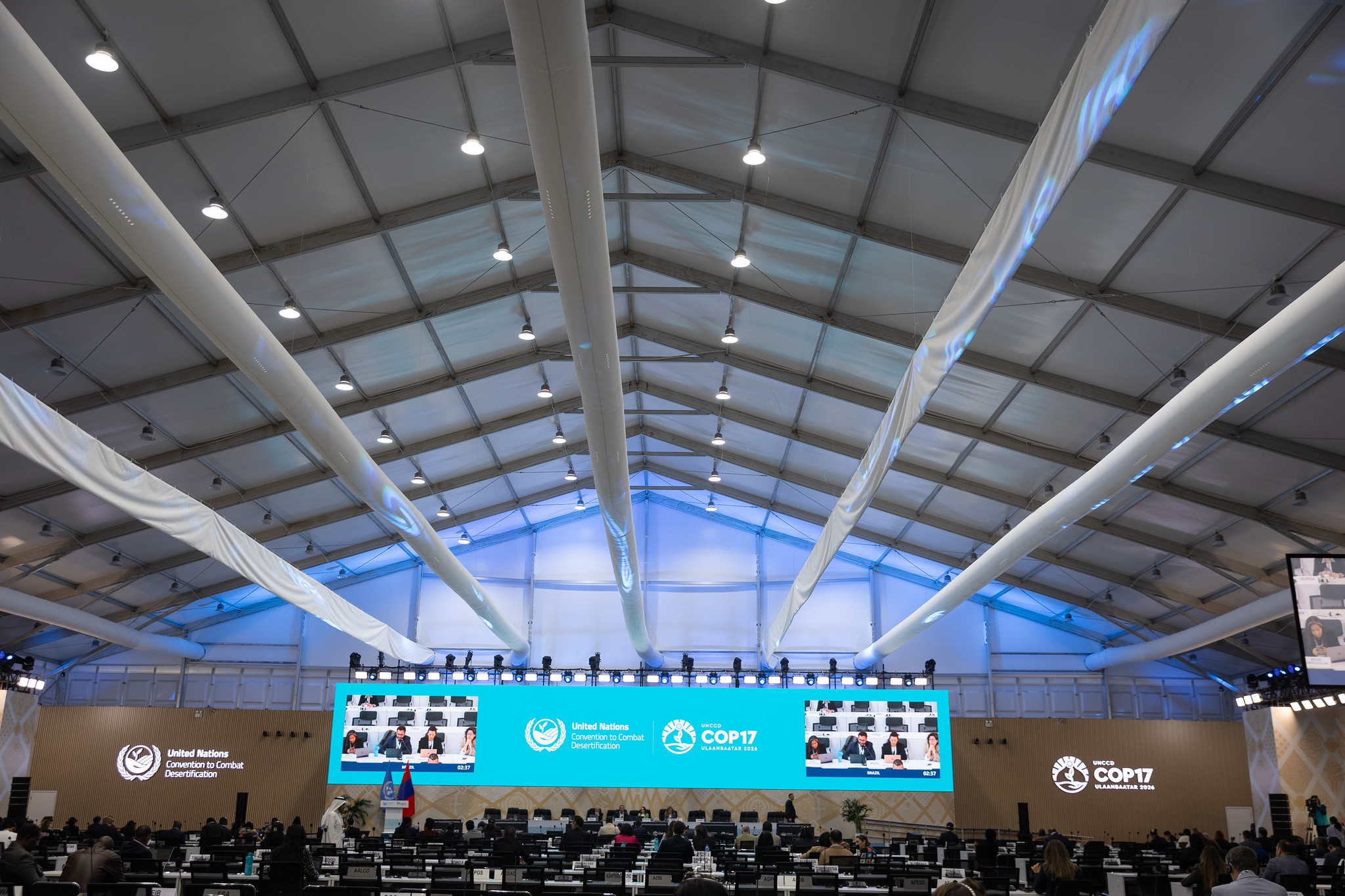
Mongolia and UNCCD unveil thematic days five months ahead of COP17 in Ulaanbaatar Ulaanbaatar/Bonn, 17 March 2026 — Five months ahead of the seventeenth session of the Conference of the Parties (COP17), Mongolia and the United Nations Convention to Combat Desertification (UNCCD) today unveiled the thematic days and action agenda for the conference, to be held in Ulaanbaatar from 17–28 August 2026 under the theme ‘Restoring Land, Restoring Hope.’ Delegates from UNCCD’s 197 Parties will join scientists, businesses and land stewards in Ulaanbaatar for COP17 to advance action for healthy land as a cornerstone of global resilience, stability and prosperity. Scaled-up finance for land restoration and drought resilience, alongside the future of the world’s rangelands and pastoralists will shape the COP17 agenda, with the conference aimed at translating global commitments into measurable progress on the ground. As the first of the three Rio Conventions COPs—on land, biodiversity and climate—meeting this year, UNCCD COP17 will set the pace for the rest of 2026 and beyond. UNCCD Executive Secretary Yasmine Fouad said: “Over the past decade, countries have committed to restoring one billion hectares of degraded land by 2030, and more than 70 now have national drought plans. COP17 is our opportunity to turn these commitments into real change on the ground That means mobilizing finance at scale for land restoration and drought resilience, investing in preparedness rather than costly crisis response, and recognizing rangelands as vital assets for economies, cultures and climate. The thematic days and action agenda for COP17 reflect a simple truth: healthy land underpins food security, water availability, economic resilience and stability everywhere —and the time to act is now.” Mongolia’s Minister of Environment and Climate Change, Batbaatar Bat, stated: “For the Government of Mongolia, the Riyadh–Ulaanbaatar Action Agenda is a strategic, participatory framework to mobilize citizens, businesses, cities and all stakeholders to restore critical ecosystems, including rangelands and agricultural lands. It drives investment in the land–water nexus and strengthens drought resilience. We call on leaders from all sectors to join us at COP17 to accelerate solutions for resilient economies and societies.”To help focus discussions and mobilize action, COP17 will feature thematic days dedicated to key priorities on the global land and drought agenda. These will bridge political decisions with real-world solutions, making everyone part of a powerful Action Agenda to advance land restoration and drought resilience. The four thematic days planed for COP17 are: Finance (24 August): Restoring land at scale requires around one billion US dollars per day, but current funding falls far short. Finance Day will bring together ministers of finance, development banks and the private sector to help close this gap and unlock large-scale investment. Water (25 August): By 2050, three out of four people worldwide are projected to face drought. Water Day will advance proactive drought risk management and strengthen cooperation on the integrated management of water resources. Land and People (26 August): Rangelands support the livelihoods of some 500 million people, but remain among the most undervalued ecosystems globally. Land and People’s Day will place the voices of land stewards at the heart of discussions, highlighting the perspectives of Indigenous Peoples, local communities, pastoralists, youth, women and civil society organizations. Food Systems and Soil Health (27 August): By 2050, the world will need to produce at least 50 per cent more food, even as food systems remain the leading driver of land degradation globally. Food Systems and Soil Health Day will connect soil restoration to food security, agricultural productivity and the livelihoods of farming communities. “The thematic days of COP17 are designed to focus global attention where it matters most — on the solutions and partnerships needed to restore land, strengthen drought resilience and support the people who take care of our ecosystems. By bringing together governments, scientists, businesses, local and pastoralist communities as well as Indigenous people around shared priorities, we aim to move from commitments to implementation and help ensure that healthy land continues to sustain communities, economies and ecosystems for generations to come.” added Executive Secretary Fouad. For media enquiries UNCCD Press Office: press@unccd.int Notes to editors More information about UNCCD COP17 is available here: https://www.unccd.int/cop17 Applications for the UNCCD COP17 Land and Drought Media Reporting Fellowship are open until 15 April 2026.About UNCCD The United Nations Convention to Combat Desertification (UNCCD) is the global vision and voice for land . We unite governments, scientists, policymakers, private sector and communities around a shared vision and global action to restore and manage the world’s land for the sustainability of humanity and the planet. Much more than an international treaty signed by 197 Parties, UNCCD is a multilateral commitment to mitigating today’s impacts of land degradation and advancing tomorrow’s land stewardship to provide food, water, shelter and economic opportunity to all people in an equitable and inclusive manner.
