News & stories

Latest

In the past decade, the world has made a historic push to prepare for drought before it strikes, unlocking solutions in policy, practice, and finance. Humanity has never been better equipped to face this growing challenge. The next step, experts say, is using all the available knowledge and expertise to build drought resilience for everyone, everywhere. At World Water Week, held in Stockholm from 24 to 28 August, The Nature Conservancy (TNC), the German Agency for International Cooperation (GIZ), and the UN Convention to Combat Desertification (UNCCD), co-convened leading experts to highlight success cases and new initiatives for drought resilience.Here are five takeaways from the session ‘Accelerating Drought Resilience in a Changing Climate:’Systemic measures for a systemic riskFar from only affecting agriculture, drought can have long-lasting impacts on all sectors of society, the economy and ecosystems —-uprooting people from their lands, stunting the development of entire generations, and causing GDPs to plummet by up to 10 per cent. Drought is a systemic risk, but too often, it is addressed with piecemeal measures.“Water crosses so many boundaries as it moves from the tops of mountains through ecosystems towards the ocean: administrative, legal, cultural, ecological boundaries,” said Global Director of Freshwater Outcomes at TNC Nicole Silk. “That is why we need to work across systems, sectors, borders, and scales to build drought resilience”.In that spirit, the nonprofit is supporting the implementation of nature-based solutions across entire watersheds in collaboration with communities, the private sector, and governments. Protecting key ecological functions is a nature-based solution, as are financial innovations.One example is TNC's work in the Tana River in Kenya, which supplies 95% of the water for Nairobi’s 4 million residents, feeds one of the country’s main agricultural areas, and provides half of the country’s hydropower output. In the past 50 years, the substitution of agricultural fields for forests and wetlands had reduced the ability of the land to store runoff water and hold the soil, compromising the water security of millions.Enter the Upper Tana-Nairobi Water Fund. The mechanism, which TNC kickstarted in 2015 as is now an independent Kenyan-registered entity, has public and private donors and major water consumers downstream contribute resources to support water and soil conservation measures upstream, which is improving water quality and supply.No-regret investments Protecting ecosystems, managing land and water resources sustainably, and restoring degraded land are some of the most effective and sustainable ways of building drought resilience. But the benefits of nature-based solutions go way beyond drought.Every dollar invested in nature-based solutions (NbS) can generate up to US$27 in improved ecosystem services and livelihoods —-a no-regret investment, according to a recent report launched at UNCCD COP16 and as evidenced by the Economics of Land Degradation (ELD) Initiative.“More intense and frequent droughts are the new normal,” said Senior Policy Officer at BMZ Mario Lootz-Petersen. “Our goal is to make nature-based solutions a new normal, as well. The evidence and the tools are definitely there.” For the expert, one of the keys is continuing to build robust business cases and models around sustainable land and water management with a view to scaling up the many successful initiatives around the world.Tailored approaches While the pillars of drought resilience are universal, each context requires its own tailored solutions. Hence the importance of adapting drought resilience approaches to different realities.“A key question is how we can localize drought resilience solutions such as climate-smart agriculture, drought insurance, and water-storage innovation,” said Giriraj Amarnath, Principal Researcher on Disaster Risk Management and Climate Resilience at the International Water Management Institute (IWMI).Through the Drought Action Catalyst, experts, decision-makers, and communities can come together to co-design and scale solutions for drought. The IWMI-led platform, launched at UNCCD COP16, also promotes South-South learning; an integrated action across sectors like agriculture, health, and infrastructure, and even an AI-based chatbot to help farmers tackle drought.From policies to practice With support from UNCCD, more than 70 countries have put in place national plans to manage drought risk, up from three only a decade ago. In parallel, the convention is hosting two major initiatives on drought resilience and is collaborating with academic, research and civil society organizations to bridge policy and practice.One of the UNCCD-hosted initiatives is the International Drought Resilience Alliance (IDRA), which is building political momentum and developing tools to help countries anticipate, prepare for, and adapt to drought —for example, the International Drought Resilience Observatory (IDRO). The other is the Riyadh Drought Resilience Partnership (RDRP), which will financially support 74 vulnerable countries in implementing their national drought plans from early 2026, as explained by Policy Officer with the UNCCD Daniel Tsegai. The idea is to invest in people, land, and ecosystems today, so that communities can thrive tomorrow.Additionally, the Convention and the Global Water Partnership (GWP) have launched a series of regional and global Communities of Learning and Practice (CLP) —an agora where practitioners, decision-makers and scientists can learn from each other, ask for advice, and share new developments on drought-related matters.“I cannot overstate how important peer-to-peer learning is when it comes to accelerating drought action on the ground,” said Tsegai, who stressed the importance of sustainable land and water management. “Together, we can go further, faster —and the CLPs provide a safe space to do just that.”Beyond early warningIn Africa, UNCCD teamed up with the Sahara and Sahel Observatory (OSS) —an IDRA partner— and the National Drought Mitigation Center/ University of Nebraska-Lincoln (NDMC/UNL) to create a drought impact tracker for countries in the region. The tool looks to empower farmers to report on drought signs and impacts using their phones, contributing to improve drought management.A project led by the GWP is now integrating the impact tracker into efforts to improve early warning systems in Eastern Africa. For GWP specialist Anjali Lohani, the move shows the importance of integrating existing tools and insights, instead of trying to reinvent the wheel.“So much knowledge already exists, so a priority is to make it available and accessible to those who need it,” said Lohani, who also noted the importance of building the capacity of communities to act on early warning messages. “Knowing that drought is coming is not enough; you need to have preparedness and response capabilities in place.”

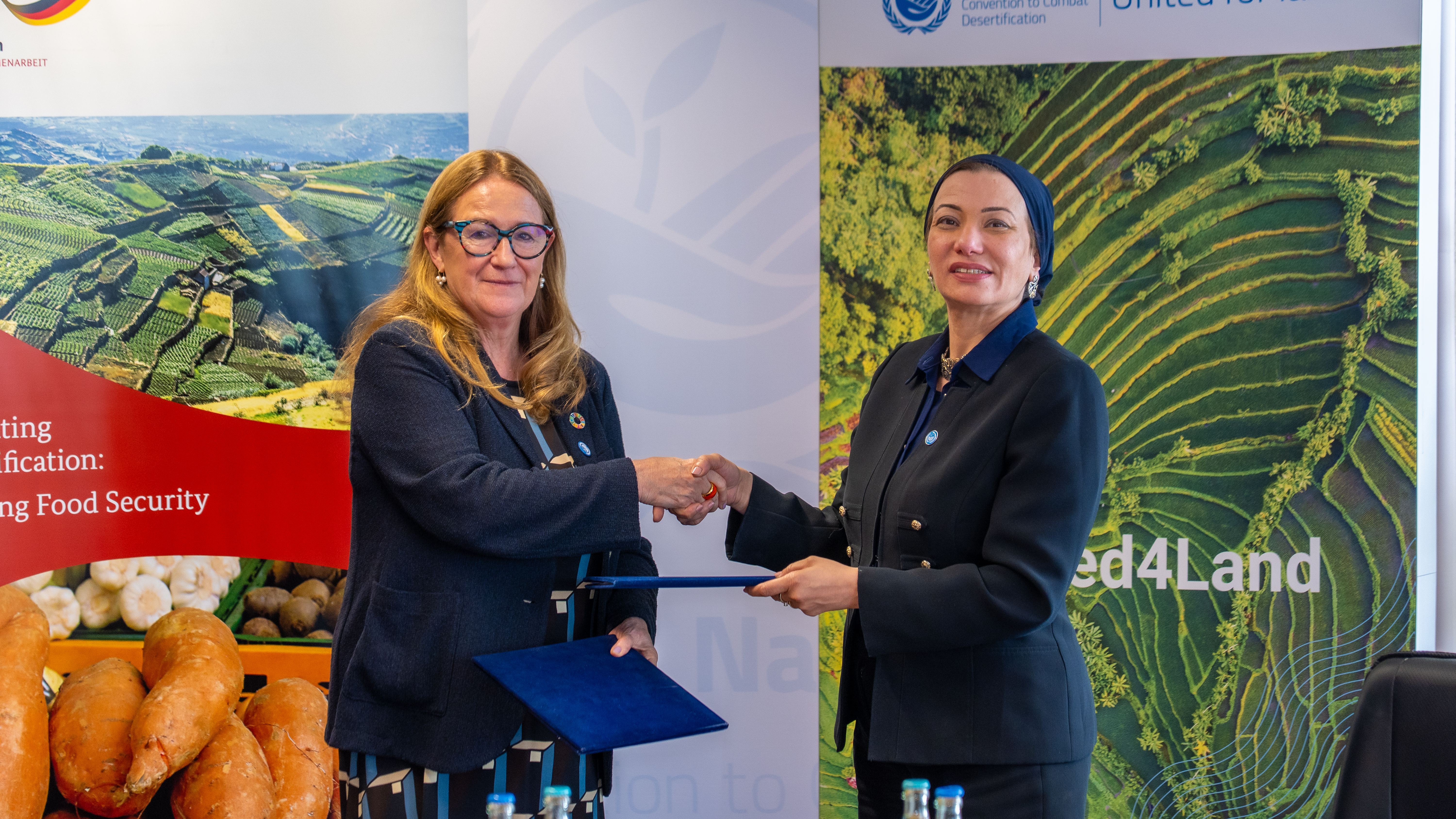
Riyadh, 14 September 2025 – On her first official mission as UNCCD Executive Secretary, Yasmine Fouad met with HE Eng. Abdulrahman Al-Fadley, Saudi Minister of Environment, Water and Agriculture and COP16 President, at the Ministry’s headquarters in Riyadh."My visit to Riyadh was an opportunity to reinforce our shared commitment and emphasize the critical leadership of the Saudi COP16 Presidency as we work toward COP17," said Dr. Fouad. "To address the profound impacts of land degradation on food insecurity and economic uncertainty, we must act decisively and collectively. Our partnership is key to mobilizing political will and resources to restore land and hope."Discussions focused on shared priorities, including accelerating efforts toward drought resilience, transforming food systems, and creating new opportunities for private sector engagement in land restoration.On drought resilience, the meeting followed up on the launch of the Riyadh Global Drought Resilience Partnership at COP16, emphasizing the need for a proactive, global approach to preparedness and response, and for strong policies that support vulnerable communities and ecosystems.On food systems, the two leaders highlighted the crucial link between healthy land and sustainable food production. Building on the landmark COP16 decision on productive agricultural lands, they noted that agriculture remains a major driver of land degradation, deforestation, freshwater extraction and biodiversity loss worldwide, and must be transformed to become part of the solution.On private sector engagement, discussions built on the Business for Land Initiative endorsed by leaders at COP16, concentrating on strategies to unlock financing and innovation, reduce investment risks, and develop a compelling business case for companies to become key partners in achieving Land Degradation Neutrality, supporting sustainable agricultural practices and restoring land.Hosted by the Kingdom of Saudi Arabia in December 2024, UNCCD COP16 was the largest and most inclusive in the Convention’s history, resulting in 39 decisions adopted by UNCCD’s 197 Parties."I am confident that through the Saudi COP16 Presidency and the upcoming Mongolian COP17 Presidency, we will be able to showcase that we can be united for land, united for people and united with hope," Ms. Fouad added.For more information, please contact: UNCCD Press Office press@unccd.int; About UNCCD The United Nations Convention to Combat Desertification (UNCCD) is the global vision and voice for land. We unite governments, scientists, policymakers, private sector and communities around a shared vision and global action to restore and manage the world’s land for the sustainability of humanity and the planet. Much more than an international treaty signed by 197 parties, UNCCD is a multilateral commitment to mitigating today’s impacts of land degradation and advancing tomorrow’s land stewardship in order to provide food, water, shelter and economic opportunity to all people in an equitable and inclusive manner.

As the planet continues to warm, harsher droughts, extreme heat and erratic rainfall are eroding the food security and livelihoods of millions – especially the smallholder farmers who produce one third of the world’s food. Over the past three decades, disasters have caused US$3.8 trillion in crop and livestock losses globally. But in regions like Africa, only three per cent of family farmers have agricultural insurance, leaving millions exposed to shocks. Meanwhile, land degradation and drought are pushing rural communities deeper into poverty, jeopardizing the ability to feed a growing world population. One way to address the challenge is reducing insurance premiums for farmers who manage the land sustainably, as explained by a new report commissioned by UNCCD and funded by the International Drought Resilience Alliance (IDRA) This innovative model leverages mobile and satellite technologies, behavioral science and systems thinking to provide financial protection while promoting sustainable land use. The report, called ‘Securing Land and Livelihoods: Insurance for Drought Resilience,’ shows the practical and economic benefits of the model through case studies from Ethiopia, Kenya, Malawi and the Horn of Africa. To put it in practice, authors recommend building public-private partnerships, establishing pilot projects and embedding these solutions into national development plans and climate risk strategies. This integrated model reflects UNCCD’s commitment to solutions that align land management, insurance innovation and resilience-building for the communities most affected by land degradation and drought. A pilot project is underway in Namibia, with progress to be shared at UNCCD CRIC23 this December, and the project findings to be presented at a dedicated insurance event during UNCCD COP16 in 2026.

由联合国防治荒漠化公约(UNCCD)与美国国家干旱缓解中心(NDMC)联合发布 权威分析详细介绍2023-2025年全球范围内 粮食、水资源和能源危机以及人道主义灾难 一份联合国支持的最新报告今日发出警示:自2023年以来,受气候变化及对土地与水资源的持续压力推动,全球发生了若干次有史料记载以来最广泛、最具破坏性的干旱事件。 这份标题为《2023–2025年全球干旱热点》的报告,由美国国家干旱缓解中心(NDMC)与《联合国防治荒漠化公约》(UNCCD)联合撰写,并获得国际抗旱联盟(IDRA)的支持,全面呈现了干旱如何加剧贫困、饥饿、能源不安全和生态系统崩溃。 UNCCD执行秘书易卜拉欣·蒂奥表示:“干旱是一名沉默的杀手。它悄然袭来,抽干资源,以缓慢却毁灭性的方式摧残生命,造成深刻而持久的伤痕。” 蒂奥补充说道:“干旱已不再是遥不可及的威胁。它正在我们眼前加剧,并迫切需要全球携手应对。当能源、粮食和水资源三重危机同时爆发,社会结构就会开始解体。而这是我们必须为之做好准备的新常态” 报告合著者、NDMC中心主任马克·斯沃博达博士指出:“这绝非一次普通的干旱,而是一场缓慢蔓延的全球性灾难,我有生以来见过最严重的一次。报告凸显出,对干旱如何影响人类生命、生计以及我们赖以生存的生态系统健康状况进行系统性监测的重要性与紧迫性。” 斯沃博达博士还表示:“地中海国家就像‘矿井中的金丝雀’,对所有现代经济体发出了早期预警。西班牙、摩洛哥和土耳其在持续干旱下为保障水、粮食和能源安全所经历的困境,为我们揭示了在全球变暖未受遏制的未来,水资源可能面临的严峻挑战。无论一个国家多么富裕或多么具备应对能力,都不应对此掉以轻心。” 危机正在蔓延 这份最新报告综合了数百个政府部门、科研机构和媒体渠道的信息,重点呈现了全球最严重干旱热点地区的灾情,其中包括非洲(索马里、埃塞俄比亚、津巴布韦、赞比亚、马拉维、博茨瓦纳、纳米比亚)、地中海地区(西班牙、摩洛哥、土耳其)、拉丁美洲(巴拿马、亚马逊流域)、东南亚及其他区域。 非洲: 东部和南部非洲超过9,000万人面临严重饥饿。一些地区正经历有史以来最严重的干旱。 干旱易发的南部非洲在2024年8月再次遭遇重大旱情,约六分之一人口(6,800万人)需要粮食援助。 埃塞俄比亚、津巴布韦、赞比亚和马拉维的玉米和小麦作物连续歉收。仅津巴布韦一国,2024年玉米作物产量同比骤降70%,玉米价格翻倍,9,000头牛因饥渴而亡。 索马里政府估算,仅2022年就有4.3万人死于干旱引发的饥饿。截至2025年初,全国四分之一人口——约440万人,面临危机级别的粮食不安全状况,其中78.4万人的粮食不安全状况预计将达到紧急级别。 赞比亚爆发了全球最严重的能源危机之一。2024年4月赞比西河水量跌至其长期平均值的20%,全国最大的水电站卡里巴大坝发电能力仅为7%,导致最长每天21小时的停电,医院、面包坊和工厂被迫停工。 地中海地区: 西班牙:水资源短缺严重影响农业、旅游业和居民用水。到2023年9月,连续两年干旱加上创纪录的高温导致橄榄产量下降50%,全国橄榄油价格翻倍。 摩洛哥:相比2016年,2025年全国羊群数量减少38%。摩洛哥王室发出呼吁,建议取消古尔邦节传统的祭祀宰牲活动。 土耳其:干旱加速地下水枯竭,诱发地陷,不仅威胁居民和基础设施安全,也永久削弱了含水层的蓄水能力。 拉丁美洲: 亚马逊流域:2023和2024年,河流水位创历史新低,导致大量鱼类和濒危的亚马逊河豚死亡,数十万人的饮水和交通受到严重干扰。随着毁林和火灾加剧,亚马逊正面临由“碳汇”转变为“碳源”的风险。 巴拿马运河:水位骤降导致航行量锐减超过三分之一(2023年10月至2024年1月期间,每日通过船只从38艘降至24艘),严重干扰全球贸易。由于面临数周延误,许多船只被迫选择更长、更昂贵的航线,例如改道苏伊士运河或南非臭名昭著的好望角航线,造成的连锁反应包括美国大豆出口放缓,英国超市报告水果和蔬菜供应短缺及价格上涨。 东南亚: 干旱扰乱了稻米、咖啡、糖等关键农产品的生产和供应链。2023至2024年间,泰国和印度的干旱导致供应短缺,使得美国市场糖及甜品价格上涨8.9%。 厄尔尼诺与气候变化的“完美风暴” 2023–2024年厄尔尼诺现象进一步放大了气候变化带来的严峻影响,在全球主要农业与生态区引发严重旱情。在饱受气温上升、人口压力和基础设施脆弱等问题困扰的气候变化热点地区,干旱造成的影响最为严重。 报告合著者、NDMC助理主任及干旱影响研究员凯莉·史密斯博士说:“这是一场完美风暴。厄尔尼诺给气候变化火上浇油,让许多原本就十分脆弱的社会和生态系统超出了承受极限。” 报告合著者、NDMC干旱规划研究负责人科迪·克努森博士指出,经济合作与发展组织(OECD)近期估算,跟2000年相比,当前一次干旱事件所造成的经济成本至少翻了一倍,且预计到2035年这一数字将再上升35%到110%。 “干旱的连锁效应可能让区域性灾害变成全球性经济冲击。”她补充道,“当关键的水资源系统开始崩溃时,没有任何国家可以独善其身。” 妇女和儿童受灾最严重 妇女、儿童、老人、牧民、自给自足型农民以及慢性病患者最容易受到旱灾的影响,由此引发的健康风险包括霍乱爆发、严重营养不良、脱水和饮用受污染水源所导致的疾病。 报告特别指出,妇女和儿童受到的冲击尤为严重: 在东非,家庭因无力负担生计,被迫将女儿嫁人换取嫁妆,造成童婚数量翻倍上升。在埃塞俄比亚,尽管法律禁止童婚,干旱最严重的四个地区童婚发生率依然翻了一番。对许多家庭而言,女童出嫁既能带来嫁妆的收入,也能减轻口粮和及其他必须支出的负担。 在津巴布韦,许多学区的女童因饥饿、费用与缺乏卫生设施而被迫大量辍学。 在亚马逊地区,干旱彻底改变了偏远土著和农村社区的生活。在一些地区,亚马逊河水位降至有记录以来的最低点,导致居民(包括产妇)受困,整个城镇饮用水中断。 “我们看到,在这场干旱中,人们采取的应对手段越来越绝望无助。”报告首席作者、NDMC干旱影响研究员保拉·瓜斯特罗表示,“女童被迫辍学、为了生存早早嫁人;医院陷入停摆;家庭在干涸的河床上挖坑,只为找到一口被污染的水……这些,都是严重危机的警示信号。” “随着干旱日益加剧,全球必须携手保护最脆弱的人群和生态系统,并反思我们当前的用水方式在今日气候条件下是否可持续。” UNCCD副执行秘书安德丽娅·梅萨表示:“这份报告展示了在一个相互关联的世界中,干旱所造成的深远而广泛的影响:从东南亚和地中海地区基本商品如大米、食糖和食用油价格的连锁反应,到亚马逊地区由于河流水位降低造成的饮用水和食物获取困难,再到非洲数千万民众受到营养不良和流离失所的影响。” 梅萨补充道: “证据非常明确。我们必须紧急投资于可持续的土地和水资源管理、基于自然的解决方案、适应性作物以及综合性的公共政策,以增强我们对干旱的抵御能力——否则将面临日益严重的经济冲击、不稳定局势和被迫迁徙。 野生动物大量死亡 除了亚马逊干旱导致200头濒危河豚和数千条鱼死亡外,野生动物遭受的其他影响包括: 2023年8月至12月,津巴布韦万基国家公园的100头大象因饥饿和缺水死亡 2024年博茨瓦纳的河床干涸,河马被困。 2024年一些国家为了解决农村社区的粮食问题并防止过度放牧对生态系统造成破坏,对野生动物进行了猎杀(例如,津巴布韦和纳米比亚共猎杀200头大象)。 教训与建议 报告呼吁立即加大对干旱应对能力的投入,包括: 加强早期预警系统及对干旱和干旱影响的实时监测,包括导致粮食和水资源短缺的因素。 基于自然的解决方案,如流域修复和乡土作物利用。 韧性基础设施,包括离网能源和替代供水技术。 促进性别平等的适应措施,确保妇女和女孩不会进一步边缘化。 全球合作,特别是保护跨界河流流域和贸易路线。 “干旱不仅仅是一场天气事件,它完全可能演变为社会、经济乃至环境层面的紧急危机。”史密斯博士指出,“关键问题不是它是否会再次发生,而是下一次我们是否能做好更充分的准备去应对。” “干旱对资源匮乏人群的打击尤为沉重。我们可以立即行动起来,通过确保每个人都能获得食物、水源、教育、医疗和经济机会,来减轻未来干旱的影响。” “世界各国已经拥有足够的资源和知识,可以避免大规模灾难。”她补充道,“问题是,我们是否有足够的政治意愿和行动决心?” 来自国际抗旱联盟的声音 西班牙第三副总统兼生态转型和人口挑战部部长萨拉-阿格森强调了国际抗旱联盟(IDRA, 由塞内加尔和西班牙共同担任主席)在调动政治、技术和金融资本支持抗旱工作,特别是在支持最脆弱和受影响的人群方面:"在塞维利亚举行的发展筹资问题国际会议上,我们呼吁进一步调动财政资源。我们所处的环境很复杂,资源有限,有多重紧迫性和许多相互竞争的优先事项,这意味着我们必须采取战略性的协作行动"。 塞内加尔环境与生态转型部部长达乌达-恩戈姆教授表示: "各种形式的干旱都是全球性挑战,需要共同应对。加强社区、国家和地区的能力必须成为国际合作的核心,以确保公平和可持续发展。我们不要忘记,投资于抗旱能力也是实现更大气候正义的决定性一步"。 关于报告 内布拉斯加大学林肯分校国家干旱缓解中心和《联合国防治荒漠化公约》力图全面记录近期干旱造成的影响,以期为全球政策提供参考,并帮助各类社会体系日后更好地应对干旱。 《2023–2025年全球干旱热点》报告参考了来自十余个国家和地区的250多篇经同行评审的研究、官方数据来源和新闻报道。* * * * * 数字速览 6,800 万:南部非洲需要粮食援助的人口 2,300 万:东非面临严重饥饿的人口 70%:2024年津巴布韦玉米减产幅度 21 小时:赞比亚每日停电的时长 200+:2023 年 9 月亚马逊河中因高温死亡的濒危河豚数量 38艘:干旱前巴拿马运河的日均通行船只数量;24艘:干旱期间的数量 50%:西班牙橄榄油产量下降幅度 100万+:2022 年索马里因干旱而流离失所的人数;2025 年初440 万人处于危机级别的饥饿状态;2025 年 4-6 月170 万儿童严重营养不良 70%: 2024 年赞比亚一侧维多利亚瀑布水位比 2023 年下降比例 100+:津巴布韦万吉国家公园因干旱死亡的大象头数 1,600+:图尔基耶因地下水枯竭而出现地陷的估计数量 近一倍:赞比亚玉米价格上涨幅度 228.4 亿欧元:西班牙在灌溉和水利基础设施方面的投资 关于UNCCD 《联合国防治荒漠化公约》(UNCCD)是全球土地的愿景和代言人。我们将各国政府、科学家、决策者、私营部门和社区团结在一个共同愿景和全球行动周围,为人类和地球的可持续发展恢复和管理世界土地。UNCCD不仅仅是一个由197个缔约方签署的国际条约,它还是一项多边承诺,旨在减轻当今土地退化的影响,促进未来的土地管理,从而以公平和包容的方式为所有人提供食物、水、住房和经济机会。 关于 IDRA 国际抗旱联盟(IDRA)是首个致力于创造政治动力,筹集财政和技术资源,以实现具有抗旱韧性的未来的全球联盟。作为一个由 30 多个国家和 20 个机构组成、不断发展壮大的平台,IDRA汇集其成员力量,推进干旱防范的政策制定、行动落实和能力建设。联盟深知,我们应对干旱和气候变化的韧性,取决于土地的韧性。IDRA的工作方向与《联合国防治荒漠化公约》(UNCCD)的职责范围高度契合,并为其提供支持。IDRA秘书处设于UNCCD。更多信息请访问:https://idralliance.global.

The signs are everywhere: cracked earth, dry rivers, failed crops and families forced to abandon their land. What was once seen as a rare natural disaster has become a persistent and intensifying threat. Drought is no longer confined to distant deserts or erratic seasons. It is advancing—slowly, silently—across borders and climate zones, placing unprecedented stress on people and ecosystems alike. Since 2000, the frequency and intensity of droughts have risen by 29 per cent. More than 1.4 billion people have already been affected. Economically, drought can slash a country’s GDP by up to 10 per cent and drag down growth for years. By mid-century, as much as three-quarters of the global population could face its impacts. For millions, it means far more than dry weather—it means food insecurity, water shortages, price spikes and the erosion of homes and livelihoods. And yet, unlike earthquakes or floods, drought gives us one rare advantage: time. Time to anticipate, adapt and build resilience. The challenge is not only to recognize the warning signs, but to act before the emergency unfolds. That imperative brought a wide range of stakeholders to Cologne, Germany, for the Inaugural Conference of the Riyadh Global Drought Resilience Partnership held on 23-24 June 2025. Over two days of discussion and collaboration, government representatives, UN entities, financing institutions and technical experts worked to transform political intent into practical momentum. “This partnership is not another global fund. It is not just a trust fund. It is not about reacting to drought when it's too late. It is about building integrated, national systems of resilience—rooted in transparency, equity and the voices of local communities. This is how we protect lives, livelihoods and ecosystems before the crisis hits,” said the United Nations Convention to Combat Desertification (UNCCD) Executive Secretary Ibrahim Thiaw. “If we wait until drought hits, it’s already too late. The cost—in human lives, in resources, in stability—is simply too high. This initiative is about shifting from reaction to resilience. It’s about building early warning systems, strengthening national drought plans, investing in risk mitigation and creating partnerships that are inclusive, science-based and focused on the communities most at risk. No one actor can do this alone—we need a collective, global response.” said H.E. Dr. Osama Faqeeha, Deputy Minister of Environment, Water and Agriculture, KSA. Launched at UNCCD COP16 under the leadership of the host country, the Kingdom of Saudi Arabia, the Riyadh Global Drought Resilience Partnershipwas established to help countries move beyond crisis response toward proactive drought risk reduction. At its core is the belief that resilience is not forged in crisis, but through long-term preparation—by enhancing early warning systems, adopting climate-smart agriculture, managing land and water sustainably and putting financial safeguards in place before disaster strikes. The Riyadh Partnership brings these elements together into a coordinated global framework. It offers countries access to technical assistance and funding through a dual financing model: pooled contributions to a multi-donor trust fund and direct bilateral support aligned with nationally identified priorities. The Partnership draws on existing alliances and tools, including the International Drought Resilience Alliance (IDRA), the Integrated Drought Management Programme and regional initiatives such as the Middle East Green Initiative (MGI). Moving from vision to action In Cologne, delegates reached consensus on the Riyadh Partnership's core governance structure and began outlining its operational roadmap. Financing featured prominently, with calls to mobilize diverse instruments and align efforts across existing initiatives. Key announcements included a one-billion-dollar commitment from the Islamic Development Bank for drought resilience projects by 2030, and an indication from the Global Environment Facility that its upcoming funding cycle will call for a greater focus on drought. The United Nations Capital Development Fund also proposed a de-risking mechanism to facilitate access to financing. Several partners—including the United Nations Development Programme (UNDP), the World Meteorological Organization (WMO), the International Water Management Institute (IWMI) and the Consultative Group on International Agricultural Research (CGIAR)—offered technical expertise, while others committed to strengthening synergies with frameworks such as IDRA and MGI to ensure national actions are reinforced by global coordination. Importantly, the first Steering Committee was successfully identified during the Conference, marking a critical milestone in establishing the Partnership’s long-term governance. The agreed governance structure includes a Steering Committee, Secretariat, Fund Trustee, Independent Review function and an Assembly of Partners. The UNCCD will host the Secretariat and the UN Multi-Partner Trust Fund Office will act as Trustee. Work is now underway to finalize the Riyadh Partnership’s governance document—a foundational charter that will define roles, responsibilities and processes. This document, to be completed in the coming months, will reflect the Partnership’s inclusive, regionally representative and institutionally diverse approach. The conference concluded with broad agreement on a shared path forward. In the months ahead, work will focus on finalizing the Steering Committee, launching early flagship projects and putting in place practical financial delivery mechanisms for the most drought-prone countries. “This is just the beginning,” said Louise Baker, Managing Director of the UNCCD Global Mechanism. “We’ve built strong momentum and now we move to implementation—bringing this partnership to life on the ground.” This energy will carry into UNCCD COP17 in Mongolia next year, where countries are expected to review initial progress, share lessons and formally integrate the Partnership into the Convention’s future work. What began in Riyadh as a bold pledge is now taking shape as a long-term platform for action—helping countries anticipate and withstand one of the most pressing environmental challenges of our time.

Following a key decision at COP16 in Riyadh in December 2024, the process to shape the future direction of the UN Convention to Combat Desertification (UNCCD) is now officially underway. The COP Bureau has approved the Terms of Reference for the Intergovernmental Working Group on the Future Strategic Framework (IWG-FSF), paving the way for nominations. The IWG-FSF will lead the development of a post-2030 strategy for the Convention. Its mandate includes identifying key elements, including possible goals and targets, for the future strategic framework, and conducting a thorough analysis of the current indicators used in national reporting. Building on the milestones of the 2018–2030 Strategic Framework, the IWG-FSF will also consider lessons from its midterm evaluation, insights from the IWG on Drought and broader UN indicators, such as the Sustainable Development Goals. Each regional annex will nominate three representatives. In addition, the group will include five technical experts: one each from civil society and international organizations and three independent experts. The deadline to nominate civil society representatives is 26 May 2025The deadline to nominate independent science experts is 13 June 2025The deadline to nominate regional representatives is 4 July 2025 Final appointments will be made within two months of the Terms of Reference approval. The approved Terms of Reference will be shared with Parties through the UNCCD national focal points and science and technology correspondents. The IWG-FSF is expected to deliver an interim progress report at the 23rd session of the Committee for the Review of the Implementation of the Convention (CRIC 23) in December 2025.
