News & stories

Related news
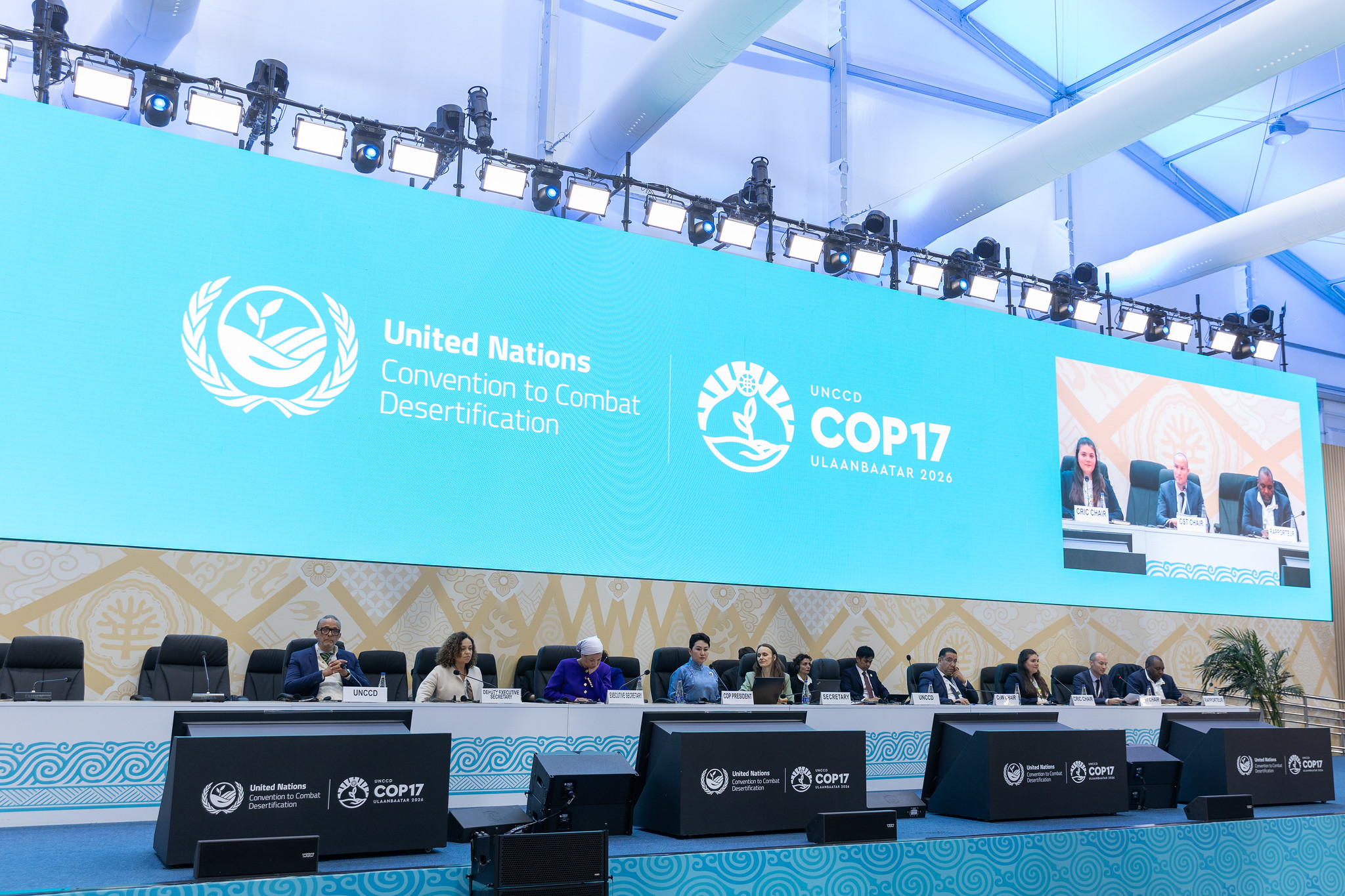

As negotiators meet in Panama City for the 23rd session of the UNCCD Committee for the Review of the Implementation of the Convention (CRIC 23), they gather in a country that treats climate change, biodiversity loss and land degradation as interlinked challenges. The new Panama’s Nature Pledge is set to bring the next-generation climate promise, updated biodiversity strategy and Land Degradation Neutrality (LDN) strategy into a single national framework, also covering oceans and plastics. It shows how one country can align all three Rio Conventions and unlock finance to accelerate action. That same logic has been at the heart of the LDN Target Setting Programme (LDN TSP) for almost a decade. Since 2016, the programme has helped 131 countries commit to voluntary LDN targets, with 124 reporting their baselines and targets through the UNCCD, and collectively aiming to restore close to 600 million hectares of degraded lands. Restoration work done in the field by a volunteer groupA global shift from pledges to plans LDN stems from a simple idea: the world’s productive land base should at least remain stable and grow where possible. In less than ten years, the LDN TSP has given governments a common language and toolkit to map where degradation is happening, agree on measurable, time bound targets and identify measures that fit national realities. LDN TSP 2.0: More ambitious, more bankable If the first eight years of LDN TSP were about enabling countries to set and validate LDN targets based on best- available data, the second phase of this programme (LDN TSP 2.0) is about making those targets sharper and more actionable. Eighteen countries from every region are refining their voluntary commitments to achieve land degradation neutrality so they are more specific, time-bound, quantitative, spatially explicit, gender responsive and tied to land-use planning following a COP15 mandate. These priorities were clearly reflected in a recent global knowledge exchange webinar on LDN TSP 2.0, where 100 representatives of countries and partner agencies reviewed progress to date ahead of CRIC23. Integrated land use planning inception workshop May 2025 South Africa Photo : © Dr. Ernest Daemane, South African National ParksIn Sri Lanka, for example, updated LDN work is being used to align land-use decisions with national climate and biodiversity strategies and to prioritize the most vulnerable landscapes for action. In Central Asia, countries are using LDN targets to connect land restoration with drought resilience and more sustainable management of rangelands and drylands. In Argentina, new LDN targets seek to improve the sustainable management of their wetlands. This second phase also pushes governments to think like investors, by helping them identify priority landscapes, estimate costs and benefits and structure projects and programmes that can attract climate and development finance. Negotiations training for national focal points and a write-shop on development of large-scale investment programme for Pacific SIDS, Seoul, Korea 2023Why this matters for everyone, not just negotiators Up to 40 per cent of the planet’s land is already degraded, affecting billions of people. When land is degraded, harvests decline, food becomes more expensive, rural livelihoods weaken and people are forced to move. LDN helps reverse this pattern by restoring land, strengthening ecosystems and generating economic benefits that far outweigh the initial investments. The Rio synergies dividend Panama’s reference to its Nature Pledge during CRIC23 reinforces a clear message: climate, biodiversity and land are not three separate problems. Land is the common thread that allows us to materialize synergies. Country stories on the new Rio Conventions platform show how land restoration is becoming a practical link between climate, biodiversity and land agendas. Examples range from national work in Sri Lanka to regional initiatives in Central Asia, where managing land degradation is central to climate resilience and food security. In Uzbekistan, hectares of sturdy saxaul shrubs are planted as the first line of defense against desertification and sand and dust storms originating from the dried-up Aral seabedNigeria is updating its land targets in parallel with its National Net Zero Nature Positive plan (NZNP) ensuring that both processes reinforce each other. By aligning these efforts, countries can stretch limited public finance further and create stronger cases for private investment. From targets to transformative projects Ambitious targets need equally ambitious implementation plans. That is where Land Degradation Neutrality Transformative Projects and Programmes (LDN TPPs) come in. These are large-scale, country driven programmes that bundle individual projects into coherent packages aligned with national LDN priorities. Under the second phase of the programme, participating countries are defining TPPs through the Global Mechanism’s Partnership for Project Preparation to turn revised targets into concrete funding proposals. In Benin and the Central African Republic, work supported by the Sahara and Sahel Observatory is helping to define priority landscapes, integrate gender analysis and structure programmes for submission to climate and development funds. In Argentina, two strategic projects are being developed to strengthen integrated land-use planning and create synergies between the country’s updated land targets and its wetlands conservation goals under RAMSAR. At CRIC23 in Panama, the new phase of the LDN work is moving from technical workshops into the political spotlight. The Global Mechanism is presenting progress on revised targets, new tools and emerging project pipelines in plenary, while land degradation neutrality features throughout the week’s programme, from interactive discussions on resource mobilization to country-led side events. Landscape view of lush, green hills and farmland in Jimma, Ethiopia, highlighting the positive impact of sustainable agriculture and land restorationTracking progress – and the remaining gap Transparent data is essential to convince citizens, partners and investors that LDN commitments are a sound investment. Key UNCCD knowledge tools – notably the LDN targets tracking tool and the UNCCD Data Dashboard – allow users to see how much land is degrading or being restored and to follow progress towards voluntary LDN targets. New tools are also being developed to support the integration of LDN as a guiding principle for smarter and better-informed land use planning decisions that avoid future land degradation. “A decade of LDN target setting has proved that restoring land is not a luxury, it is basic infrastructure for our economies,” says Louise Baker, Managing Director of the UNCCD Global Mechanism. “If we invest now in LDN TSP 2.0, we are not just planting trees, we are stabilizing food systems, protecting biodiversity and creating new jobs where they are needed most.” In Panama this integrated vision becomes the highlight of the side event “Restoring Land, Building Sustainable Futures: Success Stories from the Changwon Initiative,” hosted by the Republic of Korea. It gives participants a front-row insight into how the Changwon Initiative has supported the development of the LDN Target Setting Programme and its second phase, strengthened science–policy linkages through the UNCCD Science-Policy Interface and invested in capacity building that helps countries move from pilot projects to nationwide implementation. Success stories – from local pilot sites to national-scale programmes – demonstrate how long-term, strategic donor engagement is enabling countries to translate land targets into concrete action on the ground. As Barron Orr, Chief Scientist of the UNCCD, put it: “Land Degradation Neutrality is about doing the right things in the right places at the right scale. The scientific guidance produced by the UNCCD Science-Policy Interface has helped countries pursue all of their economic, social and environmental objectives in an inclusive and integrated way — so that biodiversity is protected where it is highest, food is grown where soils are most productive and new development does not harm either. This approach places a strong foundation of healthy land underneath global efforts to achieve all the SDGs.” Amina, leader of a women’s collective in Jimma, Ethiopia, proudly standing in front of her community members engaged in agroforestry and land restoration activitiesWith the right support from development banks, climate and biodiversity funds, impact investors and philanthropy, LDN TSP 2.0 can enable countries to turn degraded hectares into thriving landscapes and resilient communities. As countries gear up for next year’s UNCCD COP17 that will mark ten years of this global effort, the focus shifts from targets agreed to real results delivered on the ground.

A national effort to re-green a war-torn landscape is now part of the world's documentary heritage—and a living model for land restoration efforts supported by the UNCCD and embodied in the Changwon Initiative.When Korea emerged from the devastation of war, its mountains stood bare and lifeless. Yet in one of the most remarkable environmental transformations of the 20th century, the country mobilized a generation to bring back its forests—tree by tree, hillside by hillside.In April 2025, UNESCO added the Korea Reforestation Archives to its Memory of the World Register — recognizing them as a vital record of environmental recovery and a source of global inspiration. This milestone comes as countries urgently seek effective solutions to fight desertification and climate change — often with the support of the Changwon Initiative, Korea’s global contribution to land restoration.A story rooted in restoration, governance and communityThe archives document more than 9,600 items chronicling Korea’s ambitious reforestation journey, which began with the First 10-Year National Forest Plan (1973–1978). What made Korea’s approach unique wasn’t only its scale, but its foundation in sound public policy and broad civic participation.Through erosion control, rural engagement and the restoration of degraded land, forest volume surged from 5.6㎥/ha in the 1960s to 165㎥/ha in 2020—making Korea one of the few countries to achieve true national-scale forest recovery.This legacy of bold, coordinated and inclusive land restoration would later serve as the inspiration for the Changwon Initiative, launched in 2011 by the Korea Forest Service and the UNCCD to share Korea’s model with the world.From national success to global support: The Changwon InitiativeThe principles and practices of Korea’s forest recovery are now channeled into the Changwon Initiative, which helps countries design and implement land restoration strategies aligned with the UNCCD’s Land Degradation Neutrality (LDN) goals. Through technical assistance, capacity-building and policy alignment, the Initiative has supported restoration efforts in over a dozen countries—helping others plant the seeds of sustainability that once transformed Korea’s barren hills into thriving forests.As former UNCCD Executive Secretary Ibrahim Thiaw noted:"Korea’s reforestation legacy is not just history—it is a roadmap. It shows what can be achieved when policy, science and local communities come together to heal the land."This roadmap continues to guide the Changwon Initiative’s work—translating Korea’s past experience into present-day solutions for countries facing land degradation, drought and environmental fragility.A model for a crisis-prone eorldIn early 2025, as wildfires once again swept across parts of South Korea, the resilience of restored ecosystems was put to the test. Such events highlight a key lesson: restoration must be ongoing, adaptive and inclusive.The timing of UNESCO’s recognition — just months after UNCCD COP16 in Riyadh, where global attention turned to land restoration, resilience and partnerships — underscores the continued relevance of Korea’s experience.A natural ally for the Peace Forest InitiativeThe Korea Reforestation Archives also serve as a guiding resource for the Peace Forest Initiative (PFI), a joint programme by the UNCCD and the Korea Forest Service. Like the Changwon Initiative, PFI builds on Korea’s legacy by promoting cooperation and peacebuilding through shared environmental action in fragile and conflict-affected areas.Korea’s historical experience—restoring not only ecosystems but also national morale and rural economies—offers practical and inspirational support for both initiatives. Whether in divided regions or degraded landscapes, the model forged in Korea proves that land restoration can be a unifying force.Looking aheadAs the world prepares for COP17 in Mongolia in 2026, Korea’s archived journey stands as both a benchmark and a toolkit. The Changwon Initiative ensures that this legacy remains dynamic — no longer confined to history books, but alive in the forests and fields of countries striving for environmental recovery today.Korea’s forest story is now part of the world’s story — and it continues to grow, one restored landscape at a time, wherever countries choose to reclaim their land and their future.

In a world where tensions often flare over shrinking resources, the Peace Forest Initiative (PFI) offers a quiet revolution. Launched by the UNCCD in 2019, the initiative brings together countries — sometimes even former adversaries—to restore degraded land and rebuild trust through nature.This isn’t about top-down diplomacy. It’s about neighbors planting trees side by side, transforming contested borders into corridors of collaboration. The logic is powerful: when land thrives, so do the communities that depend on it. Healthy soil, clean water and green landscapes can help stabilize economies, improve food security and reduce the risk of displacement or violence.From vision to action: The role of the Changwon InitiativeWhile the Peace Forest Initiative officially launched in 2019, its foundation was laid out much earlier — in 2011 — through the Changwon Initiative, a visionary programme led by the UNCCD and the Korea Forest Service (KFS). Between 2018 and 2020, Changwon provided critical start-up support, from technical expertise to catalytic funding, helping translate the PFI concept into action. Since then, the Korea Forest Service has continued to fund and expand the initiative, enabling it to grow its reach and ambition.Restoring land, rebuilding trustAt its core, the Peace Forest Initiative turns contested land into common ground. In regions fractured by conflict, shared reforestation projects are rewriting narratives—replacing suspicion with collaboration. Here, planting a tree isn’t just ecology; it’s diplomacy.In places once marked by mistrust, shared reforestation is opening doors to cooperation — helping communities see one another not as threats, but as partners.This approach is gaining traction. Countries like Bosnia and Herzegovina, Indonesia, Timor-Leste and several in Central Asia are exploring ways to join the initiative. Their interest sends a powerful message: even in regions touched by instability or division, land restoration can become a tool for healing.Central Asia’s dust storm diplomacyIn March 2024, the Peace Forest Initiative brought together all five Central Asian nations — Kazakhstan, Kyrgyzstan, Tajikistan, Turkmenistan and Uzbekistan — for a landmark workshop in Tashkent. The stakes were high: sand and dust storms choke the Ferghana Valley, water scarcity threatens high mountain regions and climate stress is intensifying across borders.But the Tashkent meeting was more than technical — it was political. For the first time, these countries agreed to share transboundary data on environmental risks, a breakthrough after years of mutual caution. They also outlined joint strategies to align their efforts with the Rio Conventions on land, climate and biodiversity, and pledged to prioritize regional cooperation at UNCCD COP16.“This wasn’t just about trees,” said one delegate. “It was about building a common language for peace.” The message was clear: in a region once marked by mistrust, restoring land is becoming a path toward restoring relationships.Greening borders and shaping policyBeyond the local impact, the Peace Forest Initiative is helping shift how global institutions think about land. Land restoration is no longer just about conservation or carbon — it’s increasingly seen as a pathway to peace. As a result, international organizations like the Food and Agriculture Organization (FAO), the International Union for Conservation of Nature (IUCN)and the United Nations Development Programme (UNDP) are beginning to integrate land restoration into their peacebuilding agendas.The PFI has also influenced policymaking more broadly. A roadmap has been developed to help other countries design and implement their own peace-driven restoration efforts. And the goals of the initiative are now aligned with key global commitments such as Land Degradation Neutrality and Sustainable Development Goal 16, which promotes peace, justiceand strong institutions.A model for the futureWith strong backing from the Korea Forest Service and the strategic vision provided by the Changwon Initiative, the Peace Forest Initiative is poised to grow. Its next chapter includes expanding into transboundary regions affected by desertification and resource stress, deepening partnerships with local communities to ensure long-term impact and developing new financing models to attract private sector investment.A legacy rooted in hopeIn an era defined by environmental stress and geopolitical uncertainty, the Peace Forest Initiative offers something rare: a solution that is both tangible and transformative. By restoring the land, we restore the conditions for peace. And in that shared soil of effort and purpose, trust can grow.As more countries step forward to take part, the PFI reminds us that peace does not have to be negotiated in conference rooms alone. Sometimes, it begins with the quiet act of planting a tree — together.

International negotiations on land degradation and drought are becoming increasingly complex — and the stakes couldn’t be higher. Yet many of the people expected to speak on behalf of their countries in these spaces often find themselves underprepared.

Media Advisory - 23rd Committee to Review the Implementation of the Convention (CRIC23) to convene in Panama City, 1-5 December 2025

On March 26, 2010, a massive dust storm rose from the exposed bed of the South Aral Sea and swept across southern Kazakhstan. Within hours, skies darkened, visibility collapsed and toxic dust blanketed towns and farmland. The storm carried more than just sand and silt—it spread salt, pesticides and heavy metals, the legacy of decades of environmental mismanagement. It disrupted transport, damaged crops and strained hospitals with respiratory cases—highlighting how land degradation can trigger public health emergencies and economic instability.This wasn’t an isolated event. Over the past two decades, sand and dust storms (SDS) in Kazakhstan have grown more frequent and intense, particularly across the Aral Sea Basin and the country’s southern and central regions. What were once seasonal disturbances are now recognized as chronic climate and land-use threats.Sand and dust storms—vast natural phenomena capable of transporting fine particles across borders and continents—pose grave risks to public health, agriculture, infrastructure and national development. They aggravate respiratory and cardiovascular illnesses, damage crops and livestock and interrupt transport and trade. In Kazakhstan, these storms are primarily driven by land degradation, unsustainable farming, deforestation and climate change—a combination that continues to erode natural resilience.While SDS play a role in global ecological systems—such as fertilizing distant ecosystems like the Amazon—their local impact in Kazakhstan is urgent and deeply disruptive.The Changwon Initiative: Building resilience from the ground upIn response to the growing SDS threat, Kazakhstan turned to partnerships that combined local action with global expertise. One of the most influential has been the Changwon Initiative, launched under the United Nations Convention to Combat Desertification (UNCCD) as a key driver of global dryland restoration efforts.Between 2015 and 2017, the Changwon Initiative—through the Greening Drylands Partnership—helped Kazakhstan lay essential groundwork for SDS preparedness. Though originally aimed at enhancing drought resilience, the project quickly evolved to address overlapping environmental risks. In the Makhtaral and Shardara districts, the initiative strengthened early warning systems, raised awareness among farmers and herders and supported climate risk assessments. Over 140 sustainable land management practices were identified and promoted, including the restoration of 64 hectares of degraded dryland. These measures didn’t just address symptoms—they helped local communities build long-term resilience to future storms.Advancing forecasting and preparednessBuilding on earlier progress, Kazakhstan has significantly expanded its SDS forecasting and preparedness systems. In collaboration with the World Meteorological Organization’s Sand and Dust Storm Warning Advisory and Assessment System (SDS-WAS), the country now uses integrated regional and global forecasting models that provide SDS predictions every three hours, with up to 72 hours of lead time.Improved forecasting helps farmers protect crops, health agencies prepare for respiratory surges and officials respond with faster, data-driven decisions. Kazakhstan’s active participation in the SDS-WAS Asia Regional Centre has also enhanced regional cooperation, particularly with China, Mongolia, Japan and Korea, through data exchange and collaborative research.From reactive to proactive: A shift in national strategyPerhaps the most transformative outcome has been the shift in national mindset—from reacting to each storm to anticipating and managing risk. SDS are now integrated into broader climate adaptation and sustainable land use policies and early warnings are reaching more rural communities.Farmers, local officials and frontline workers are increasingly adopting practical mitigation strategies—from planting vegetation that stabilizes soil, to modifying planting schedules based on storm forecasts.The Changwon Initiative’s contribution goes beyond project outcomes: it has helped embed environmental risk reduction into Kazakhstan’s long-term development planning.A Scalable example for the regionKazakhstan’s efforts show what’s possible when scientific forecasting, policy innovation and local action work in concert. While climate change and land degradation continue to fuel SDS across Central Asia, Kazakhstan is charting a course toward resilience. What began with emergency response—like that triggered by the 2010 dust storm—has evolved into a national model for proactive environmental management. With ongoing backing — including from the Changwon Initiative — Kazakhstan’s approach offers a practical, scalable model for other dryland countries. It shows that early warning, land restoration and local engagement are not only feasible but essential to safeguarding lives, livelihoods and development in vulnerable landscapes.
