Mechanical Surface Roughening
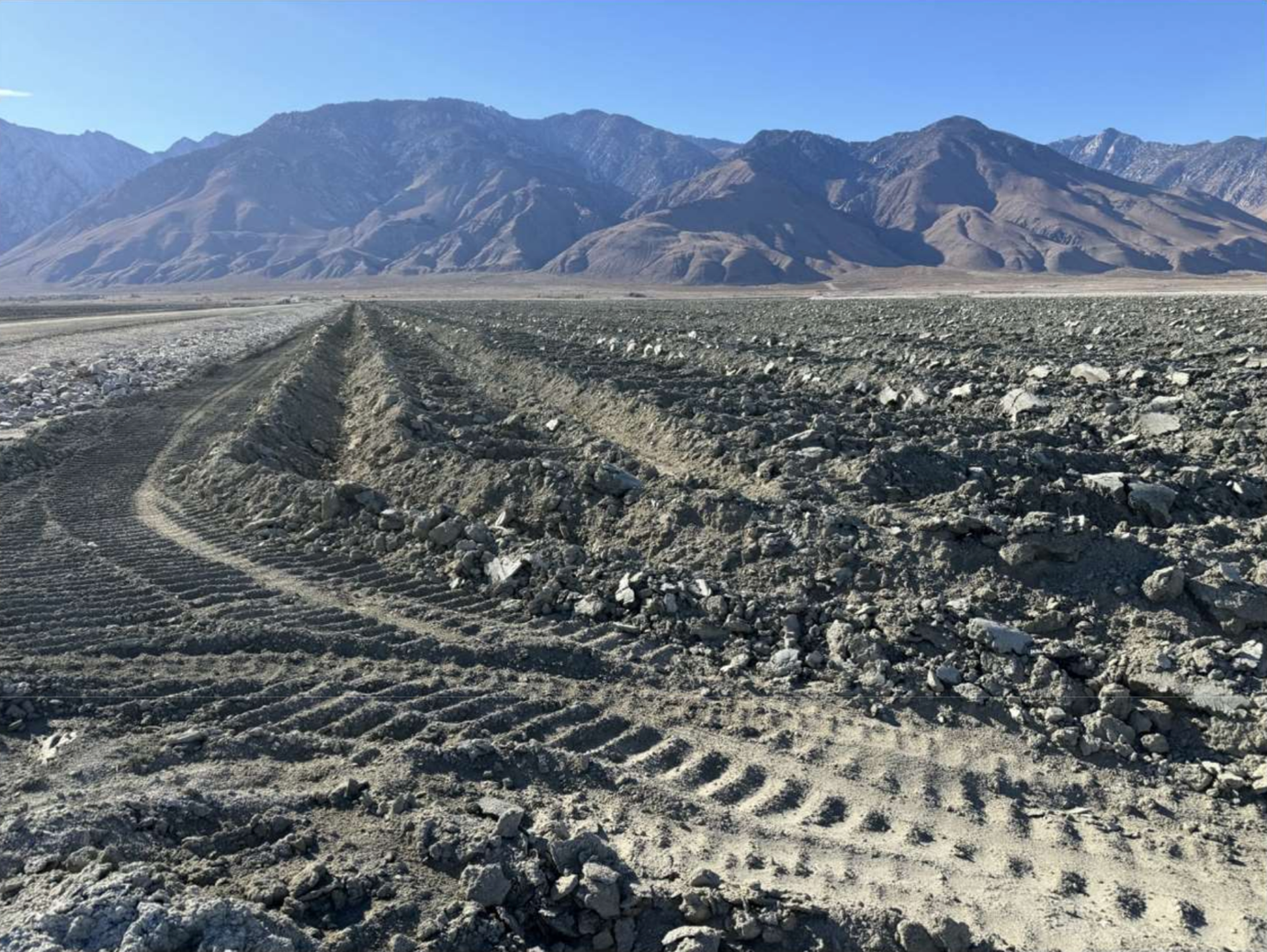
Mechanical surface roughening involves ploughing deep furrows in the soil to reduce wind speeds at the surface by increasing roughness and trapping particles to create soil aggregates. It is a technique used to create unevenness in bare soil, reducing erosion potential by decreasing runoff velocities, trapping sediment, and increasing water infiltration. Ideally, this practice should be performed on wet soil, as dry ploughing can release large amounts of fugitive dust itself and fail to produce large soil aggregates. It is a cheap, easy, and short-term solution, which does not require any water or maintenance if carried out during moist soil conditions. In soils with greater than 50% silt and clay content, this practice can be effective for longer periods, up to five years, however, there is a gradual reduction in efficacy as rainfall and freeze-thaw cycles erode ridges.
Surface roughening usually requires the use of heavy vehicles, so it may not be suitable for boggy soils or areas with poor soil structure. When ploughing, create rows at right angles to the direction of the wind, but also consider contours to avoid water erosion. In areas with variable wind patterns, curvilinear patterns are optimal. In areas with compacted soil, tillage can promote water infiltration, enabling vegetation to regenerate more quickly. This practice can also be used as an emergency mitigation measure in any land use class before high-risk dry conditions or high winds occur. Methods of surface roughening may include tilling, disking or harrowing. These must be carried out across the slope and along the contour. By contrast, tracking must be done up and down the slope. When choosing a method, factors to consider include slope steepness, mowing requirements, soil type (biocrust formation), and whether the slope was formed by cutting or filling.
Mechanical Surface Roughening in the Great Salt Lake
Case Study
In the semi-arid Khanasser Valley in Syria, cumin and barley stubble are intensively grazed by sheep during the long, dry summer months. The combination of hoof action and insufficient residues to protect the soil surface results in high levels of wind erosion. One-pass post-harvest summer tillage reduced sediment movement by 20%, compared to no tillage. However, two-pass tillage increased sediment movement by 42%, as the initial aggregates were destroyed by the second round of tilling.
References and Good Practice Guidance
Biome/Climatic Zone
Anthropogenic/Land Use