News & stories

Latest

In the past decade, the world has made a historic push to prepare for drought before it strikes, unlocking solutions in policy, practice, and finance. Humanity has never been better equipped to face this growing challenge. The next step, experts say, is using all the available knowledge and expertise to build drought resilience for everyone, everywhere. At World Water Week, held in Stockholm from 24 to 28 August, The Nature Conservancy (TNC), the German Agency for International Cooperation (GIZ), and the UN Convention to Combat Desertification (UNCCD), co-convened leading experts to highlight success cases and new initiatives for drought resilience.Here are five takeaways from the session ‘Accelerating Drought Resilience in a Changing Climate:’Systemic measures for a systemic riskFar from only affecting agriculture, drought can have long-lasting impacts on all sectors of society, the economy and ecosystems —-uprooting people from their lands, stunting the development of entire generations, and causing GDPs to plummet by up to 10 per cent. Drought is a systemic risk, but too often, it is addressed with piecemeal measures.“Water crosses so many boundaries as it moves from the tops of mountains through ecosystems towards the ocean: administrative, legal, cultural, ecological boundaries,” said Global Director of Freshwater Outcomes at TNC Nicole Silk. “That is why we need to work across systems, sectors, borders, and scales to build drought resilience”.In that spirit, the nonprofit is supporting the implementation of nature-based solutions across entire watersheds in collaboration with communities, the private sector, and governments. Protecting key ecological functions is a nature-based solution, as are financial innovations.One example is TNC's work in the Tana River in Kenya, which supplies 95% of the water for Nairobi’s 4 million residents, feeds one of the country’s main agricultural areas, and provides half of the country’s hydropower output. In the past 50 years, the substitution of agricultural fields for forests and wetlands had reduced the ability of the land to store runoff water and hold the soil, compromising the water security of millions.Enter the Upper Tana-Nairobi Water Fund. The mechanism, which TNC kickstarted in 2015 as is now an independent Kenyan-registered entity, has public and private donors and major water consumers downstream contribute resources to support water and soil conservation measures upstream, which is improving water quality and supply.No-regret investments Protecting ecosystems, managing land and water resources sustainably, and restoring degraded land are some of the most effective and sustainable ways of building drought resilience. But the benefits of nature-based solutions go way beyond drought.Every dollar invested in nature-based solutions (NbS) can generate up to US$27 in improved ecosystem services and livelihoods —-a no-regret investment, according to a recent report launched at UNCCD COP16 and as evidenced by the Economics of Land Degradation (ELD) Initiative.“More intense and frequent droughts are the new normal,” said Senior Policy Officer at BMZ Mario Lootz-Petersen. “Our goal is to make nature-based solutions a new normal, as well. The evidence and the tools are definitely there.” For the expert, one of the keys is continuing to build robust business cases and models around sustainable land and water management with a view to scaling up the many successful initiatives around the world.Tailored approaches While the pillars of drought resilience are universal, each context requires its own tailored solutions. Hence the importance of adapting drought resilience approaches to different realities.“A key question is how we can localize drought resilience solutions such as climate-smart agriculture, drought insurance, and water-storage innovation,” said Giriraj Amarnath, Principal Researcher on Disaster Risk Management and Climate Resilience at the International Water Management Institute (IWMI).Through the Drought Action Catalyst, experts, decision-makers, and communities can come together to co-design and scale solutions for drought. The IWMI-led platform, launched at UNCCD COP16, also promotes South-South learning; an integrated action across sectors like agriculture, health, and infrastructure, and even an AI-based chatbot to help farmers tackle drought.From policies to practice With support from UNCCD, more than 70 countries have put in place national plans to manage drought risk, up from three only a decade ago. In parallel, the convention is hosting two major initiatives on drought resilience and is collaborating with academic, research and civil society organizations to bridge policy and practice.One of the UNCCD-hosted initiatives is the International Drought Resilience Alliance (IDRA), which is building political momentum and developing tools to help countries anticipate, prepare for, and adapt to drought —for example, the International Drought Resilience Observatory (IDRO). The other is the Riyadh Drought Resilience Partnership (RDRP), which will financially support 74 vulnerable countries in implementing their national drought plans from early 2026, as explained by Policy Officer with the UNCCD Daniel Tsegai. The idea is to invest in people, land, and ecosystems today, so that communities can thrive tomorrow.Additionally, the Convention and the Global Water Partnership (GWP) have launched a series of regional and global Communities of Learning and Practice (CLP) —an agora where practitioners, decision-makers and scientists can learn from each other, ask for advice, and share new developments on drought-related matters.“I cannot overstate how important peer-to-peer learning is when it comes to accelerating drought action on the ground,” said Tsegai, who stressed the importance of sustainable land and water management. “Together, we can go further, faster —and the CLPs provide a safe space to do just that.”Beyond early warningIn Africa, UNCCD teamed up with the Sahara and Sahel Observatory (OSS) —an IDRA partner— and the National Drought Mitigation Center/ University of Nebraska-Lincoln (NDMC/UNL) to create a drought impact tracker for countries in the region. The tool looks to empower farmers to report on drought signs and impacts using their phones, contributing to improve drought management.A project led by the GWP is now integrating the impact tracker into efforts to improve early warning systems in Eastern Africa. For GWP specialist Anjali Lohani, the move shows the importance of integrating existing tools and insights, instead of trying to reinvent the wheel.“So much knowledge already exists, so a priority is to make it available and accessible to those who need it,” said Lohani, who also noted the importance of building the capacity of communities to act on early warning messages. “Knowing that drought is coming is not enough; you need to have preparedness and response capabilities in place.”

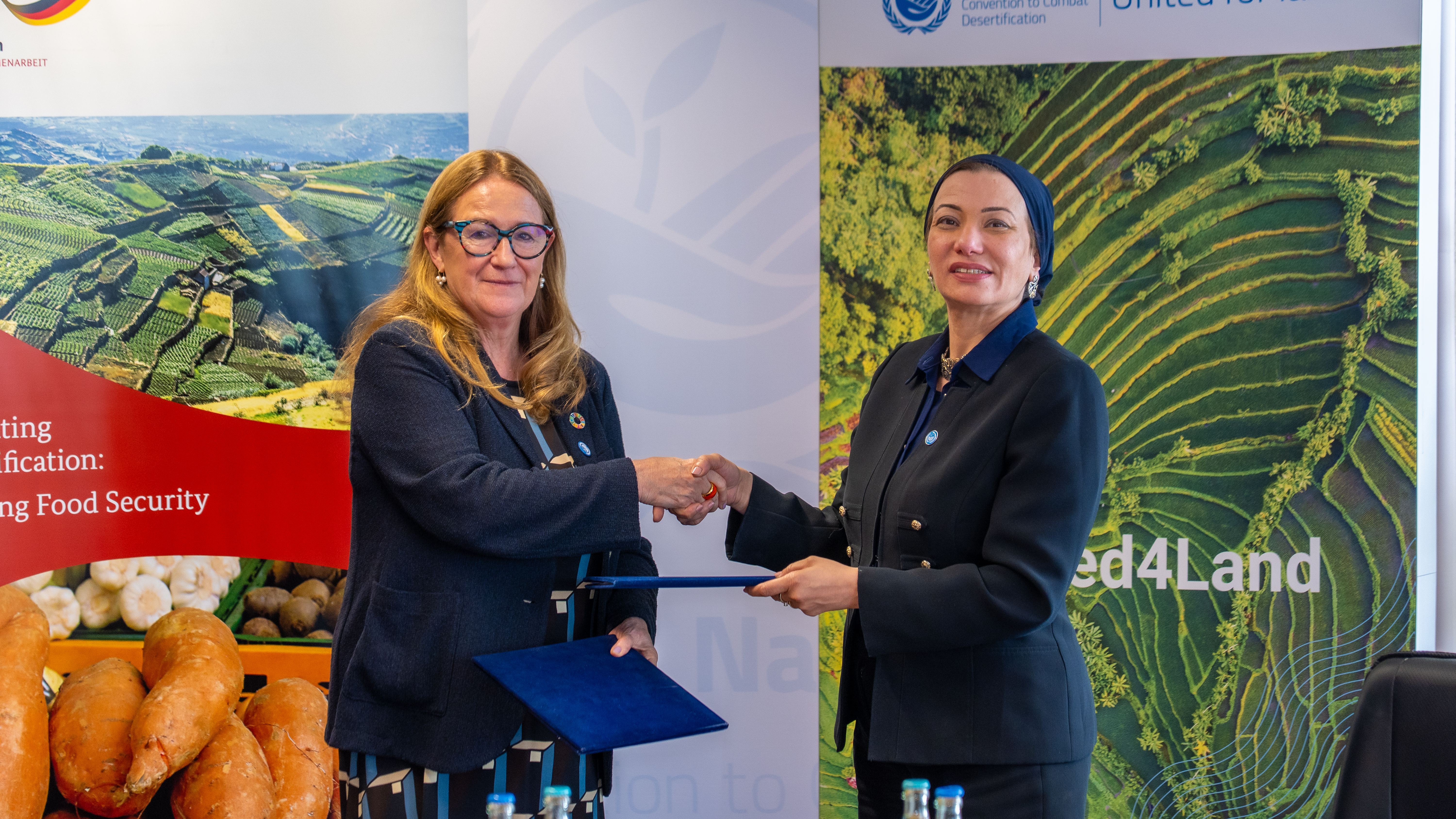
Riyadh, 14 September 2025 – On her first official mission as UNCCD Executive Secretary, Yasmine Fouad met with HE Eng. Abdulrahman Al-Fadley, Saudi Minister of Environment, Water and Agriculture and COP16 President, at the Ministry’s headquarters in Riyadh."My visit to Riyadh was an opportunity to reinforce our shared commitment and emphasize the critical leadership of the Saudi COP16 Presidency as we work toward COP17," said Dr. Fouad. "To address the profound impacts of land degradation on food insecurity and economic uncertainty, we must act decisively and collectively. Our partnership is key to mobilizing political will and resources to restore land and hope."Discussions focused on shared priorities, including accelerating efforts toward drought resilience, transforming food systems, and creating new opportunities for private sector engagement in land restoration.On drought resilience, the meeting followed up on the launch of the Riyadh Global Drought Resilience Partnership at COP16, emphasizing the need for a proactive, global approach to preparedness and response, and for strong policies that support vulnerable communities and ecosystems.On food systems, the two leaders highlighted the crucial link between healthy land and sustainable food production. Building on the landmark COP16 decision on productive agricultural lands, they noted that agriculture remains a major driver of land degradation, deforestation, freshwater extraction and biodiversity loss worldwide, and must be transformed to become part of the solution.On private sector engagement, discussions built on the Business for Land Initiative endorsed by leaders at COP16, concentrating on strategies to unlock financing and innovation, reduce investment risks, and develop a compelling business case for companies to become key partners in achieving Land Degradation Neutrality, supporting sustainable agricultural practices and restoring land.Hosted by the Kingdom of Saudi Arabia in December 2024, UNCCD COP16 was the largest and most inclusive in the Convention’s history, resulting in 39 decisions adopted by UNCCD’s 197 Parties."I am confident that through the Saudi COP16 Presidency and the upcoming Mongolian COP17 Presidency, we will be able to showcase that we can be united for land, united for people and united with hope," Ms. Fouad added.For more information, please contact: UNCCD Press Office press@unccd.int; About UNCCD The United Nations Convention to Combat Desertification (UNCCD) is the global vision and voice for land. We unite governments, scientists, policymakers, private sector and communities around a shared vision and global action to restore and manage the world’s land for the sustainability of humanity and the planet. Much more than an international treaty signed by 197 parties, UNCCD is a multilateral commitment to mitigating today’s impacts of land degradation and advancing tomorrow’s land stewardship in order to provide food, water, shelter and economic opportunity to all people in an equitable and inclusive manner.

As the planet continues to warm, harsher droughts, extreme heat and erratic rainfall are eroding the food security and livelihoods of millions – especially the smallholder farmers who produce one third of the world’s food. Over the past three decades, disasters have caused US$3.8 trillion in crop and livestock losses globally. But in regions like Africa, only three per cent of family farmers have agricultural insurance, leaving millions exposed to shocks. Meanwhile, land degradation and drought are pushing rural communities deeper into poverty, jeopardizing the ability to feed a growing world population. One way to address the challenge is reducing insurance premiums for farmers who manage the land sustainably, as explained by a new report commissioned by UNCCD and funded by the International Drought Resilience Alliance (IDRA) This innovative model leverages mobile and satellite technologies, behavioral science and systems thinking to provide financial protection while promoting sustainable land use. The report, called ‘Securing Land and Livelihoods: Insurance for Drought Resilience,’ shows the practical and economic benefits of the model through case studies from Ethiopia, Kenya, Malawi and the Horn of Africa. To put it in practice, authors recommend building public-private partnerships, establishing pilot projects and embedding these solutions into national development plans and climate risk strategies. This integrated model reflects UNCCD’s commitment to solutions that align land management, insurance innovation and resilience-building for the communities most affected by land degradation and drought. A pilot project is underway in Namibia, with progress to be shared at UNCCD CRIC23 this December, and the project findings to be presented at a dedicated insurance event during UNCCD COP16 in 2026.

Las crisis alimentarias, hídricas y energéticas, y las tragedias humanas ocasionadas por la sequía en 2023-2025, detalladas en un amplio análisis del Centro Nacional de Mitigación de la Sequía de EE.UU. y la Convención de las Naciones Unidas de Lucha contra la DesertificaciónDesde 2023 el mundo está experimentando algunas de las sequías más extensas y dañinas de la historia, según un informe presentado hoy con el respaldo de la ONU, que apunta al cambio climático y la incesante presión sobre la tierra y los recursos hídricos como causas.Elaborado por el Centro Nacional de Mitigación de Sequías (NDMC) de EE.UU. y la Convención de las Naciones Unidas de Lucha contra la Desertificación (CNULD) con el apoyo de la Alianza Internacional para la Resiliencia a la Sequía (IDRA), ‘Puntos calientes de la sequía en el mundo 2023-2025’ describe de forma exhaustiva cómo las sequías agravan la pobreza, el hambre, la inseguridad energética y el colapso de los ecosistemas.El Secretario Ejecutivo de la CNULD, Ibrahim Thiaw, ha señalado: "la sequía es un asesino silencioso. Penetra sigilosamente, agota los recursos y devasta vidas a cámara lenta. Sus cicatrices son profundas"."La sequía ya no es una amenaza lejana,” ha añadido Thiaw. “Está aquí, va en aumento y exige una cooperación mundial urgente. Cuando la energía, los alimentos y el agua desaparecen a la vez, las sociedades empiezan a desmoronarse. Esa es la nueva normalidad para la que tenemos que estar preparados".El coautor del informe y director del NDMC, Mark Svoboda, ha remarcado que no estamos en un período puntual de sequía: "Se trata de una catástrofe mundial de evolución lenta, la peor que he visto nunca. Este informe subraya la necesidad de un seguimiento sistemático de cómo la sequía afecta a las vidas, los medios de subsistencia y la salud de los ecosistemas de los que todos dependemos.""Los países mediterráneos son señales de alerta para todas las economías modernas", ha añadido. "La lucha de España, Marruecos y Turquía para asegurar el agua, la producción de alimentos y la energía frente a una sequía persistente augura el futuro del agua ante un calentamiento global descontrolado. Ningún país, con independencia de su riqueza o capacidad, puede permitirse ser complaciente".Una crisis de gran alcanceEl nuevo informe sintetiza la información procedente de cientos de fuentes gubernamentales, científicas y de los medios de comunicación para poner de relieve las repercusiones en principales focos de sequía de África (Somalia, Etiopía, Zimbabue, Zambia, Malawi, Botsuana, Namibia), el Mediterráneo (España, Marruecos, Turquía), América Latina (Panamá, cuenca del Amazonas), el Sudeste Asiático y más allá.África: Más de 90 millones de personas en África oriental y meridional padecen hambre aguda. Algunas zonas han sufrido la peor sequía jamás registrada.El sur de África, ya de por sí propenso a la sequía, ha quedado devastado, con aproximadamente 1/6 de la población (68 millones) necesitando ayuda alimentaria en agosto de 2024.En Etiopía, Zimbabue, Zambia y Malawi, las cosechas de maíz y trigo han fracasado repetidamente. Sólo en Zimbabue, la cosecha de maíz de 2024 se redujo un 70% interanual, y los precios del maíz se duplicaron mientras 9.000 cabezas de ganado morían de sed e inanición.En Somalia, el gobierno estimó que 43.000 personas murieron sólo en 2022 debido al hambre vinculada a la sequía. A principios de 2025, 4,4 millones de personas —una cuarta parte de la población— se enfrentan a una crisis de inseguridad alimentaria y 784.000 van camino de alcanzar niveles de emergencia.Zambia sufrió una de las peores crisis energéticas del mundo, ya que en abril de 2024 el caudal del río Zambeze se desplomó al 20% de su media a largo plazo. La mayor central hidroeléctrica del país, la presa de Kariba, cayó al 7% de su capacidad de generación, provocando apagones de hasta 21 horas al día y el cierre de hospitales, panaderías y fábricas.MediterráneoEspaña: La escasez de agua afecta a la agricultura, el turismo y el abastecimiento doméstico. En septiembre de 2023, dos años de sequía y un calor récord provocaron un desplome del 50% en la cosecha de aceitunas en España, lo que hizo que los precios del aceite de oliva se duplicaran en todo el país.Marruecos: La población de ovejas era un 38% menor en 2025 en relación con 2016, lo que provocó una petición Real para cancelar los sacrificios tradicionales de Eid.Turquía: La sequía aceleró el agotamiento de las aguas subterráneas, provocando socavones que suponen un peligro para las comunidades y sus infraestructuras, al tiempo que reducen de forma permanente la capacidad de almacenamiento de los acuíferos.América LatinaCuenca del Amazonas: Los niveles récord de los ríos en 2023 y 2024 provocaron la muerte masiva de peces y delfines en peligro de extinción, e interrumpieron el suministro de agua potable y el transporte para cientos de miles de personas. A medida que se intensifican la deforestación y los incendios, la Amazonia corre el riesgo de pasar de ser un sumidero de carbono a una fuente de carbono.Canal de Panamá: El nivel del agua bajó tanto que los tránsitos se redujeron en más de un tercio (de 38 a 24 barcos diarios entre octubre de 2023 y enero de 2024), causando importantes interrupciones en el comercio mundial. Ante los retrasos de varias semanas, muchos buques fueron desviados a rutas más largas y costosas a través del Canal de Suez o el infame Cabo de Buena Esperanza sudafricano. Entre las repercusiones: las exportaciones de soja estadounidense se ralentizaron y las tiendas de comestibles del Reino Unido informaron de la escasez y el aumento de los precios de frutas y verduras.Sudeste asiáticoLa sequía interrumpió la producción y las cadenas de suministro de cultivos clave como el arroz, el café y el azúcar. En 2023-2024, las condiciones de sequía en Tailandia e India, por ejemplo, provocaron una escasez que condujo a un aumento del 8,9% en el precio del azúcar y los dulces en Estados Unidos.El Niño y el cambio climático: una tormenta perfectaEl fenómeno de El Niño de 2023-2024 amplificó los ya de por sí duros efectos del cambio climático, desencadenando condiciones de sequía en importantes zonas agrícolas y ecológicas del planeta. Los efectos de la sequía se dejaron sentir con más fuerza en los puntos calientes climáticos; o sea, regiones que ya venían sufriendo los efectos combinados del calentamiento global, la presión demográfica e infraestructuras frágiles."Ha sido una tormenta perfecta", ha afirmado la Dra. Kelly Helm Smith, coautora del informe, Subdirectora del NDMC e investigadora de los efectos de la sequía. "El Niño echó leña al fuego del cambio climático, agravando los efectos para muchas sociedades y ecosistemas vulnerables más allá de sus límites".El Dr. Cody Knutson, coautor y encargado de supervisar la investigación sobre planificación de sequías del NDMC, ha señalado que un episodio actual de sequía cuesta por lo menos el doble que en el año 2000, lo que está previsto que aumente entre el 35% y el 110% para 2035, según una reciente estimación de la OCDE. "El efecto dominó puede convertir las sequías regionales en crisis económicas mundiales", ha añadido Knutson. "Ningún país es inmune cuando empiezan a colapsarse sistemas críticos dependientes del agua".Las mujeres y los niños, entre los más afectadosLos más vulnerables a los efectos de la sequía: Mujeres, niños, ancianos, pastores, agricultores de subsistencia y personas con enfermedades crónicas. Los riesgos para la salud incluyen brotes de cólera, desnutrición aguda, deshidratación y exposición a aguas contaminadas.El informe destaca en particular el desproporcionado número de víctimas entre las mujeres y los niños.En África Oriental, los matrimonios infantiles forzados aumentaron más del doble, ya que las familias buscaban dotes para sobrevivir. A pesar de estar prohibidos en Etiopía, los matrimonios infantiles se duplicaron con creces en las cuatro regiones más afectadas por la sequía. Las jóvenes que se casan pueden aportar ingresos a su familia en forma de dote, al tiempo que alivian la carga financiera que supone proporcionar alimentos y otras necesidades.En Zimbabue, distritos escolares enteros sufrieron abandonos masivos debido al hambre, los costes y los problemas sanitarios de las niñas."Los mecanismos de supervivencia que vimos durante esta sequía se volvieron cada vez más desesperados", dice la autora principal Paula Guastello, investigadora del impacto de la sequía del NDMC. "Niñas sacadas de la escuela y obligadas a casarse, hospitales a oscuras y familias cavando hoyos en lechos de ríos secos sólo para encontrar agua contaminada: son signos de crisis grave".En el Amazonas, la sequía trastornó la vida de comunidades indígenas y rurales remotas. En algunas zonas, el río Amazonas cayó a su nivel más bajo jamás registrado, dejando a los residentes desamparados -incluidas las mujeres que daban a luz- y a pueblos enteros sin agua potable."A medida que se intensifican las sequías, es fundamental que trabajemos juntos a escala mundial para proteger a las personas y los ecosistemas más vulnerables y reevaluar si nuestras prácticas actuales de uso del agua son sostenibles en el cambiante mundo actual", ha indicado Guastello.La Secretaria Ejecutiva Adjunta de la CNULD, Andrea Meza, ha afirmado: “El informe muestra las profundas repercusiones de la sequía en un mundo interconectado: desde sus efectos en cadena sobre los precios de productos básicos como el arroz y el azúcar del Sudeste Asiático y el aceite del Mediterráneo; hasta la dificultad de acceso al agua potable y los alimentos en el Amazonas por la bajada del nivel de los ríos, pasando por las decenas de millones de personas afectadas por la malnutrición y los desplazamientos en África".“Las pruebas son claras”, ha concluido Meza. “Debemos invertir urgentemente en la gestión sostenible de la tierra y el agua, en soluciones basadas en la naturaleza, en cultivos adaptados y en políticas públicas integradas para aumentar nuestra resiliencia a la sequía. Esto, o nos enfrentaremos a cada vez más a crisis económicas, inestabilidad y migraciones forzosas”.Fauna salvaje sacrificada en masaAdemás de los 200 delfines de río en peligro de extinción y los miles de peces perdidos por la sequía amazónica, los impactos sobre la fauna salvaje incluyen:100 elefantes murieron en el parque Hwange de Zimbabue por inanición y acceso limitado al agua entre agosto y diciembre de 2023.Los hipopótamos quedaron varados en los lechos secos de los ríos de Botsuana en 2024.El año pasado, algunos países sacrificaron animales salvajes (por ejemplo, 200 elefantes en Zimbabue y Namibia) para alimentar a las comunidades rurales y proteger los ecosistemas del sobrepastoreo.Lecciones y recomendacionesEl informe hace un llamamiento a invertir urgentemente en la preparación ante la sequía:Sistemas de alerta temprana más sólidos y vigilancia en tiempo real de la sequía y sus efectos, incluidas las condiciones que contribuyen a la inseguridad alimentaria e hídrica.Soluciones basadas en la naturaleza, como la restauración de cuencas hidrográficas y el uso de cultivos autóctonos.Infraestructuras resistentes, como energía no conectada a la red y tecnologías alternativas de suministro de agua.Adaptación con perspectiva de género, garantizando que no se margine aún más a las mujeres y las niñas.Cooperación internacional, especialmente para proteger las cuencas fluviales transfronterizas y las rutas comerciales."Las sequías no son sólo un fenómeno meteorológico: pueden ser una emergencia social, económica y medioambiental", ha indicado Smith. "La cuestión no es si volverán a ocurrir, sino si estaremos mejor preparados la próxima vez".La experta ha recordado que la sequía tiene un efecto desproporcionado sobre los que tienen menos recursos, pero que podemos actuar ahora para reducir los efectos de futuras sequías, trabajando para garantizar que todo el mundo tenga acceso a alimentos, agua, educación, atención sanitaria y oportunidades económicas."Las naciones del mundo tienen los recursos y los conocimientos para evitar mucho sufrimiento", ha concluido Smith. "La cuestión es si tenemos la voluntad necesaria".Voces de IDRALa Vicepresidenta Tercera del Gobierno y Ministra para la Transición Ecológica y el Reto Demográfico de España, Sara Aagesen, ha subrayado el trabajo de IDRA — la Alianza co-presidida por Senegal y España— para movilizar capital político, técnico y financiero en favor de la resiliencia a la sequía; sobre todo, entre las sociedades más vulnerables y afectadas: “Desde la Conferencia Internacional de Financiación para el Desarrollo de Sevilla estamos interpelando a aumentar la movilización de recursos financieros. Operamos en un contexto complejo, con recursos limitados, múltiples urgencias y muchas prioridades que compiten entre sí. Por tanto, debemos actuar de manera estratégica y colaborativa.”El Ministro de Medio Ambiente y Transición Ecológica de Senegal Daouda Ngom, declarado: "La sequía, en todas sus formas, es un desafío global que requiere respuestas conjuntas. El fortalecimiento de las capacidades de las comunidades, los países y las regiones debe estar en el centro de la cooperación internacional para un desarrollo equitativo y sostenible. No olvidemos que invertir en la resiliencia a la sequía es también un paso decisivo hacia una mayor justicia climática." Acerca del informeEl Centro Nacional para la Mitigación de la Sequía de la Universidad de Nebraska-Lincoln y la CNULD se propusieron documentar los impactos recientes de la sequía de forma exhaustiva para informar la política mundial y preparar mejor a las sociedades para futuras sequías. El informe se basa en más de 250 estudios revisados por expertos, fuentes de datos oficiales y noticias de más de una docena de países y regiones.* * * * *En cifras:68 millones: Personas que necesitan ayuda alimentaria en África Austral23 millones: Personas que padecen hambre aguda en África Oriental70%: Cosecha de maíz perdida en Zimbabue (2024)Hasta 21 horas al día: Cortes de electricidad en ZambiaMás de 200: Delfines de río en peligro de extinción muertos por el calor en el Amazonas (septiembre de 2023)38: Tránsitos diarios por el Canal de Panamá antes de la sequía; 24 durante la sequía50%: Caída de la producción de aceite de oliva en EspañaMás de 1 millón de personas: Personas desplazadas en Somalia debido a la sequía (2022); 4,4 millones en situación de hambre crítica (principios de 2025); 1,7 millones de niños sufren desnutrición aguda (abril-junio de 2025)70%: Caída del nivel de agua de las cataratas Victoria con respecto a 2023 (lado de Zambia, 2024)100+: Muertes de elefantes relacionadas con la sequía en el Parque Nacional Hwange de Zimbabue1.600+: Número estimado de sumideros en Turquía debido al agotamiento de las aguas subterráneasCasi el doble: Aumento del precio del maíz en Zambia22.840 millones de euros: Inversión española en infraestructuras de regadío y agua* * * * *Sobre la CNULDLa CNULD constituye la visión y voz en favor de las tierras a nivel mundial. Reúne a gobiernos,científicos, responsables de la formulación de políticas, el sector privado y las comunidades en torno auna visión compartida y una acción mundial con vistas a restaurar y ordenar las tierras del mundo enbeneficio de la sostenibilidad de la humanidad y del propio planeta. La CNULD ─que es mucho másque un tratado internacional firmado por 197 partes─ representa un compromiso multilateral paramitigar los efectos actuales de la degradación de las tierras y avanzar en la administración de lastierras del mañana con el fin de proporcionar alimentos, agua, refugio y oportunidades económicas atodas las personas de una manera equitativa e inclusiva.Sobre IDRALa Alianza Internacional para la Resiliencia a la Sequía (IDRA) es la primera coalición mundialdedicada a crear impulso político y a movilizar recursos financieros y técnicos para un futuroresiliente a la sequía. Como plataforma en crecimiento de más de 40 países y 30 instituciones, IDRAaprovecha las fortalezas colectivas de sus miembros para promover políticas, acciones y el desarrollode capacidades para la preparación ante la sequía, reconociendo que sólo somos tan resilientes a lasequía y al cambio climático como lo es nuestra tierra. El trabajo de IDRA está en consonancia con elmandato de la Convención de las Naciones Unidas de Lucha contra la Desertificación (CNULD), quealberga la Secretaría de IDRA, y lo apoya. Para más información: https://idralliance.global.

The signs are everywhere: cracked earth, dry rivers, failed crops and families forced to abandon their land. What was once seen as a rare natural disaster has become a persistent and intensifying threat. Drought is no longer confined to distant deserts or erratic seasons. It is advancing—slowly, silently—across borders and climate zones, placing unprecedented stress on people and ecosystems alike. Since 2000, the frequency and intensity of droughts have risen by 29 per cent. More than 1.4 billion people have already been affected. Economically, drought can slash a country’s GDP by up to 10 per cent and drag down growth for years. By mid-century, as much as three-quarters of the global population could face its impacts. For millions, it means far more than dry weather—it means food insecurity, water shortages, price spikes and the erosion of homes and livelihoods. And yet, unlike earthquakes or floods, drought gives us one rare advantage: time. Time to anticipate, adapt and build resilience. The challenge is not only to recognize the warning signs, but to act before the emergency unfolds. That imperative brought a wide range of stakeholders to Cologne, Germany, for the Inaugural Conference of the Riyadh Global Drought Resilience Partnership held on 23-24 June 2025. Over two days of discussion and collaboration, government representatives, UN entities, financing institutions and technical experts worked to transform political intent into practical momentum. “This partnership is not another global fund. It is not just a trust fund. It is not about reacting to drought when it's too late. It is about building integrated, national systems of resilience—rooted in transparency, equity and the voices of local communities. This is how we protect lives, livelihoods and ecosystems before the crisis hits,” said the United Nations Convention to Combat Desertification (UNCCD) Executive Secretary Ibrahim Thiaw. “If we wait until drought hits, it’s already too late. The cost—in human lives, in resources, in stability—is simply too high. This initiative is about shifting from reaction to resilience. It’s about building early warning systems, strengthening national drought plans, investing in risk mitigation and creating partnerships that are inclusive, science-based and focused on the communities most at risk. No one actor can do this alone—we need a collective, global response.” said H.E. Dr. Osama Faqeeha, Deputy Minister of Environment, Water and Agriculture, KSA. Launched at UNCCD COP16 under the leadership of the host country, the Kingdom of Saudi Arabia, the Riyadh Global Drought Resilience Partnershipwas established to help countries move beyond crisis response toward proactive drought risk reduction. At its core is the belief that resilience is not forged in crisis, but through long-term preparation—by enhancing early warning systems, adopting climate-smart agriculture, managing land and water sustainably and putting financial safeguards in place before disaster strikes. The Riyadh Partnership brings these elements together into a coordinated global framework. It offers countries access to technical assistance and funding through a dual financing model: pooled contributions to a multi-donor trust fund and direct bilateral support aligned with nationally identified priorities. The Partnership draws on existing alliances and tools, including the International Drought Resilience Alliance (IDRA), the Integrated Drought Management Programme and regional initiatives such as the Middle East Green Initiative (MGI). Moving from vision to action In Cologne, delegates reached consensus on the Riyadh Partnership's core governance structure and began outlining its operational roadmap. Financing featured prominently, with calls to mobilize diverse instruments and align efforts across existing initiatives. Key announcements included a one-billion-dollar commitment from the Islamic Development Bank for drought resilience projects by 2030, and an indication from the Global Environment Facility that its upcoming funding cycle will call for a greater focus on drought. The United Nations Capital Development Fund also proposed a de-risking mechanism to facilitate access to financing. Several partners—including the United Nations Development Programme (UNDP), the World Meteorological Organization (WMO), the International Water Management Institute (IWMI) and the Consultative Group on International Agricultural Research (CGIAR)—offered technical expertise, while others committed to strengthening synergies with frameworks such as IDRA and MGI to ensure national actions are reinforced by global coordination. Importantly, the first Steering Committee was successfully identified during the Conference, marking a critical milestone in establishing the Partnership’s long-term governance. The agreed governance structure includes a Steering Committee, Secretariat, Fund Trustee, Independent Review function and an Assembly of Partners. The UNCCD will host the Secretariat and the UN Multi-Partner Trust Fund Office will act as Trustee. Work is now underway to finalize the Riyadh Partnership’s governance document—a foundational charter that will define roles, responsibilities and processes. This document, to be completed in the coming months, will reflect the Partnership’s inclusive, regionally representative and institutionally diverse approach. The conference concluded with broad agreement on a shared path forward. In the months ahead, work will focus on finalizing the Steering Committee, launching early flagship projects and putting in place practical financial delivery mechanisms for the most drought-prone countries. “This is just the beginning,” said Louise Baker, Managing Director of the UNCCD Global Mechanism. “We’ve built strong momentum and now we move to implementation—bringing this partnership to life on the ground.” This energy will carry into UNCCD COP17 in Mongolia next year, where countries are expected to review initial progress, share lessons and formally integrate the Partnership into the Convention’s future work. What began in Riyadh as a bold pledge is now taking shape as a long-term platform for action—helping countries anticipate and withstand one of the most pressing environmental challenges of our time.

Following a key decision at COP16 in Riyadh in December 2024, the process to shape the future direction of the UN Convention to Combat Desertification (UNCCD) is now officially underway. The COP Bureau has approved the Terms of Reference for the Intergovernmental Working Group on the Future Strategic Framework (IWG-FSF), paving the way for nominations. The IWG-FSF will lead the development of a post-2030 strategy for the Convention. Its mandate includes identifying key elements, including possible goals and targets, for the future strategic framework, and conducting a thorough analysis of the current indicators used in national reporting. Building on the milestones of the 2018–2030 Strategic Framework, the IWG-FSF will also consider lessons from its midterm evaluation, insights from the IWG on Drought and broader UN indicators, such as the Sustainable Development Goals. Each regional annex will nominate three representatives. In addition, the group will include five technical experts: one each from civil society and international organizations and three independent experts. The deadline to nominate civil society representatives is 26 May 2025The deadline to nominate independent science experts is 13 June 2025The deadline to nominate regional representatives is 4 July 2025 Final appointments will be made within two months of the Terms of Reference approval. The approved Terms of Reference will be shared with Parties through the UNCCD national focal points and science and technology correspondents. The IWG-FSF is expected to deliver an interim progress report at the 23rd session of the Committee for the Review of the Implementation of the Convention (CRIC 23) in December 2025.
