Principles and Guidelines
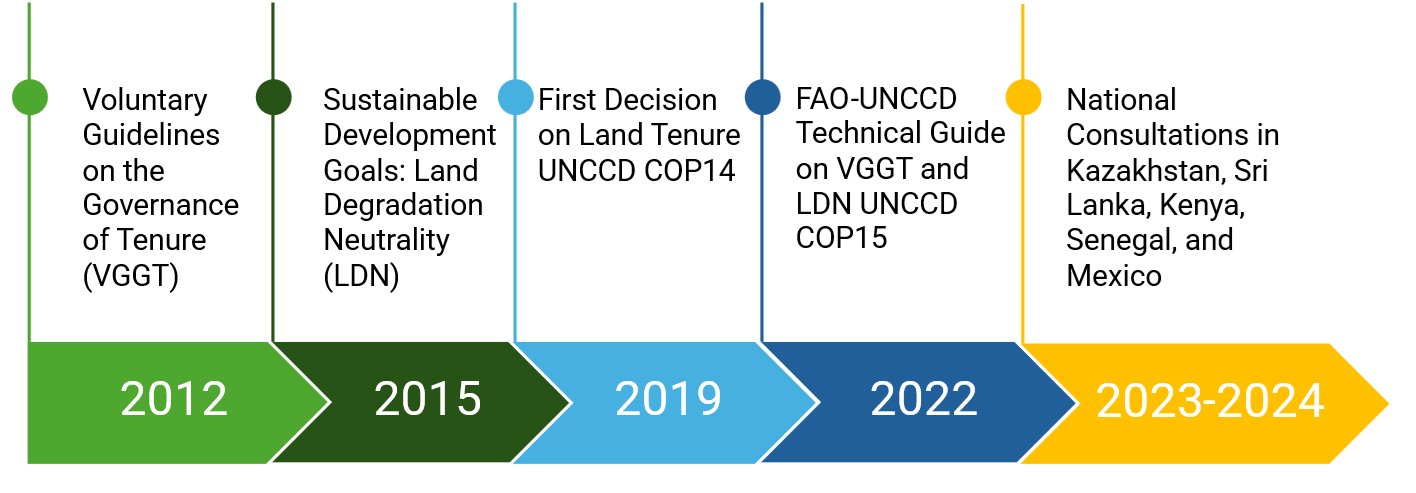
A major milestone in the consideration of land tenure in natural resource management was the adoption of the Voluntary Guidelines on the Responsible Governance of Tenure (VGGT) of Land, Fisheries and Forests in the Context of National Food Security published by the Committee on World Food Security in 2012. The VGGT was negotiated in response to food price spikes and a financial crisis caused by the collapse of equity markets which created a global rush for land for agriculture, biofuels and hedged investments. In some cases, domestic and foreign investors took control of large tracts of community land with little or no regard for customary governance arrangements, particularly in Asia and Africa.
The VGGT provides guidance on how to improve tenure governance to support food security, eradicate poverty and ensure sustainable social and economic development for all while protecting the environment. The VGGT emphasises the need to recognise legitimate tenure rights under different land governance systems – whether public, private, informal or customary – and to safeguard against the violation of these rights. The Food and Agriculture Organization (FAO) of the United Nations has produced 13 technical guides to help translate VGGT principles into practical mechanisms, processes and actions – using examples of good practices and tools to inform the design of policy and reform processes, as well as investments in land administration and planning capacities.
In 2015, the UN General Assembly adopted the Sustainable Development Goals (SDGs), which included targets on women’s land rights and secure access to land. In 2019, the Conference of the Parties (COP) to the United Nations Convention to Combat Desertification (UNCCD) adopted a landmark decision on land tenure, becoming the only multilateral environmental agreement to explicitly address tenure issues. Decision 26/COP.14: (i) invited Parties to review and, where appropriate, to recognise legitimate tenure rights, including customary rights, and enhance women’s equal access to land, and (ii) encouraged Parties to follow the VGGT in the implementation of activities to combat desertification, land degradation and drought (DLDD) and achieve land degradation neutrality (LDN). The decision also requested the preparation of a technical guide on integrating the VGGT into the implementation of the UNCCD and LDN, encouraging the UNCCD secretariat and FAO to work together.
Subsequent UNCCD COP decisions on land tenure in 2022 (27/COP.15) and 2024 (28/COP.16) have focused on:
Supporting Parties in the integration of the VGGT through national consultations implemented within the framework of the UNCCD-FAO Initiative on Land Tenure;
Developing a business case for responsible and sustainable public and private investments in land tenure;
Exploring the use of existing global indicators and data sets and assessing the potential to integrate these in future UNCCD reporting processes;
Creating a land tenure toolbox for easy access to relevant documents and information;
Undertaking awareness raising actions on accountability and grievance mechanisms related to land tenure; and
Considering the nomination of land tenure focal points within the UNCCD process.
Further reading

The guidelines set out principles and internationally accepted standards of responsible practices for the use and control of land, fisheries and forests.

Governance of Tenure technical guides help develop capacities to improve tenure governance and assist countries in applying the VGGT

The framework promotes coordinated, synergistic use of VGGT and F&G to strengthen land tenure governance in Africa.

The book evaluates Germany-funded FAO projects applying VGGT principles to advance inclusive, sustainable land governance worldwide.