Natural Windbreaks
Natural windbreaks are linear plantings of trees and shrubs that slow down the speed of ground winds and reduce soil erosion. Also known as shelterbelts, hedgerows, or living fences, these vegetative features dissipate ground wind force, reducing SDS emissions and creating favourable conditions for soil, crops, and livestock. Windbreaks can be designed to function as livestock exclosures, restricting access to grazing.
Windbreaks can reduce wind erosion in agricultural fields by up to 20%, with porosity levels of 40–60% offering the greatest protection. Unlike artificial windbreaks, natural windbreaks are a cost-effective solution due to their relatively low establishment and maintenance costs. However, they require more space and suitable soils with sufficient water availability, and it can take up to 20 years for them to develop their full protective function. While natural windbreaks can provide beneficial agronomic and environmental co-benefits, they may also compete with adjacent crops for water, soil nutrients, and light. Trees and shrubs must be carefully selected based on their suitability for the local soils, climate, and wind conditions.
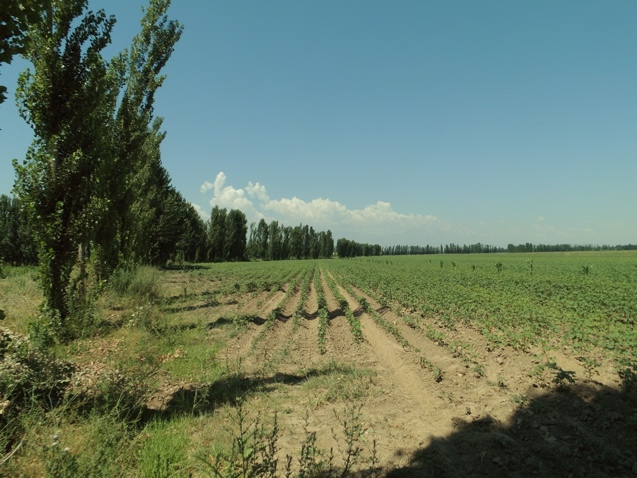
Natural Windbreak in Kyrgyzstan
Case Studies
The Shiraki valley in Georgia has deep, humus-rich soils that offer significant agricultural potential. However, more than 90% of the windbreaks that once protected highly productive wheat fields have been destroyed since the Soviet era, either by fire or by being cut down for firewood. This has increased wind erosion and evaporation, reducing agricultural yields and contributing to dust emissions. A rehabilitation project involving the planting of mixed tree species showed that it is important to choose species of tree that are suitable for the local ecology and to carry out ongoing maintenance, such as watering and weeding.
The Bashang area of northern China is a hotspot for wind erosion, generating dust that has negative impacts on the Beijing-Tianjin-Hebei region. This has led to the large-scale installation of windbreaks under the government-led Three-North Shelterbelt Programme. Soil loss in windbreak patches was 20% lower than in open farmland, and wind speeds were reduced by 27–30% at low heights. The effective protection distance on the leeward side was 7–9 times the height of the trees for the most effective configurations.
References and Good Practice Guidance
- USDA Windbreaks
- USDA Conservation practice standard: Windbreak/shelterbelt establishment
- Citrus Australia Windbreaks for Citrus
- University of Florida Living and Artificial Windbreaks for Citrus
- Utah State University Windbreak Benefits and Design
- Dove Horticultural Consultants Windbreaks
- WOCAT List of case studies of natural windbreaks.
- Windbreak efficiency in controlling wind erosion and particulate matter concentrations from farmlands
- Competition for light in windbreak-millet systems in the Sahel.
- Windbreaks in the United States: A systematic review of producer-reported benefits, challenges, management activities and drivers of adoption
- Field windbreaks: Design criteria
- Layout and design criteria for livestock windbreaks
- Optimal windbreak design for wind-erosion control
- Discussion on the design of Caragana windbreaks layout: Comprehensive analysis of windbreak layout and seasonal factors
Biome/Climatic Zone
Anthropogenic/Land Use