News & stories


Latest news & stories
UNCCD Executive Secretary Dr. Yasmine Fouad visited the students of TH Köln with a simple message: land belongs to all of us.

Un hito institucional en el que la Dra. Yasmine Fouad advierte sobre los riesgos sistémicos derivados de la degradación de las tierras y la sequíaBonn, Alemania, 2 de abril de 2026 — La secretaria ejecutiva de la Convención de las Naciones Unidas de Lucha contra la Desertificación (CNULD), la Dra. Yasmine Fouad, tomó posesión de su cargo el 31 de marzo en la sede de las Naciones Unidas en Nueva York, completando así formalmente su incorporación al sistema de las Naciones Unidas.Prestó juramento ante el Secretario General de las Naciones Unidas, comprometiéndose a desempeñar sus funciones “teniendo únicamente en cuenta los intereses de las Naciones Unidas”. Este momento subraya su papel en el seno del sistema de las Naciones Unidas en un momento de crecientes desafíos globales.La ceremonia marca un hito institucional, confirmando su condición de funcionaria internacional de las Naciones Unidas, con el mandato de servir con independencia, integridad y en el interés exclusivo de la Organización.Tras la ceremonia, la secretaria ejecutiva Fouad se reunió con el secretario general para debatir cómo se puede dar mayor relevancia a la degradación de tierras y a la resiliencia a la sequía dentro de la agenda general de las Naciones Unidas. Ello incluye prioridades como la Agenda 2030 para el Desarrollo Sostenible, la acción climática, los sistemas alimentarios y la estabilidad.Reflexionando sobre la urgencia del desafío, la Dra. Fouad afirmó: “Las tierras no son solo una cuestión medioambiental. Son la base de nuestras economías, nuestros sistemas alimentarios y nuestra estabilidad. Sin embargo, se está degradando a un ritmo sin precedentes. Si no actuamos ahora, los riesgos seguirán extendiéndose, impactado la disponibilidad de agua, la producción alimentos y los medios de vida. Esto requiere una acción sostenida para restaurar tierras y aumentar la resiliencia ante la sequía como pilares esenciales de la estabilidad global y el desarrollo sostenible.”Hay un reconocimiento creciente de que la degradación de tierras y la sequía son riesgos sistémicos globales —riesgos que hoy en día que afectan a casi la mitad de la humanidad y generan importantes pérdidas económicas. Solo la degradación de tierras le cuesta a la economía mundial casi 900.000 millones de dólares al año, mientras que las sequías representan al menos 300.000 millones de dólares en pérdidas anuales. Sus efectos se propagan a través de los sistemas alimentarios, la disponibilidad de agua, las cadenas de suministro y los medios de vida. Cerrar la brecha entre los niveles actuales de inversión y la magnitud del desafío será fundamental para acelerar la acción en materia de restauración de tierras y resiliencia a la sequía.La CNULD trabaja en la intersección de estas prioridades mundiales. Como plataforma especializada de las Naciones Unidas en materia de tierras, la Convención conecta las agendas de medio ambiente, desarrollo, clima y paz. Impulsa los Objetivos de Desarrollo Sostenible, refuerza la resiliencia climática y apoya la estabilidad en las regiones vulnerables. La degradación de tierras y la sequía también actúan como multiplicadores de riesgos, contribuyendo a la tensión económica, los desplazamientos forzados y la fragilidad.En este contexto, durante su estancia en Nueva York, la Secretaria Ejecutiva se reunió también con la Vicesecretaria General de las Naciones Unidas, Amina Mohammed, y mantuvo contactos con los Estados miembros, incluidos representantes de las presidencias de la Conferencia de las Partes (COP), Arabia Saudí (COP16) y Mongolia (COP17). Asimismo, celebró una serie de reuniones bilaterales para fortalecer las alianzas y movilizar el apoyo a la restauración de las tierras y la resiliencia ante la sequía.Estas conversaciones se centraron en acelerar la implementación sobre el terreno. Esto incluye un aumento de la financiación, una mayor participación del sector privado y una cooperación más estrecha en todo el sistema de las Naciones Unidas y con los socios internacionales. Se prestó especial atención a la necesidad de traducir el impulso político en soluciones e inversiones escalables. También se destacó la importancia de abordar desafíos interconectados, como el nexo entre la tierra, el agua y los alimentos, la gestión del riesgo de sequía y los crecientes impactos de las tormentas de arena y polvo.A medida que avanzan los preparativos para la 17.ª sesión de la Conferencia de las Partes (COP17), que se celebrará en Ulán Bator (Mongolia) en agosto de 2026, la CNULD está trabajando con sus socios para promover acciones concretas, ampliando la restauración de tierras, fortaleciendo la resiliencia ante la sequía y movilizando la inversión necesaria.Al situar la tierra en el centro de la agenda mundial, la CNULD busca apoyar a los países en la construcción de economías más resilientes, sociedades más estables y un futuro más sostenible. La COP17 será un momento crucial para demostrar resultados y acelerar la acción global.-FIN- Para más información, póngase en contacto con la oficina de prensa de la CNULD: press@unccd.intAcerca de la CNULD La Convención de las Naciones Unidas de Lucha contra la Desertificación (CNULD) es la visión y la voz mundial en materia de tierras. Unimos a gobiernos, científicos, responsables políticos, el sector privado y las comunidades en torno a una visión compartida y una acción global para restaurar y gestionar las tierras del mundo en pro de la sostenibilidad de la humanidad y del planeta. Mucho más que un tratado internacional firmado por 197 partes, la CNULD es un compromiso multilateral para mitigar los impactos actuales de la degradación de tierras y promover la gestión responsable de la tierra en el futuro, con el fin de proporcionar alimentos, agua, refugio y oportunidades económicas a todas las personas de manera equitativa e inclusiva.

Standing on a rocky stretch just outside Riyadh, the land opens out in every direction, sand, stone and dry air, with little to interrupt it. It is a landscape shaped by scarcity, where water is limited and vegetation survives under pressure. That strain is increasing as temperatures rise and rainfall becomes more unpredictable.This pressure is not unique to Saudi Arabia. Globally, land degradation is accelerating. It affects up to 40 per cent of the land globally and puts nearly half of humanity at risk, even as countries have committed to restoring one billion hectares by 2030.In this context, Saudi Arabia, in just four years, has restored its first one million hectares of degraded land under the Saudi Green Initiative, its national programme launched as part of Vision 2030 to scale up land restoration, increase vegetation cover and strengthen ecosystem resilience.What makes this milestone relevant beyond the country are its scale, and where and how it was delivered.The challenges, where restoration is happening and how it is being doneThe restored land is not located in a single area. It spans multiple regions and ecosystems, including the King Salman bin Abdulaziz Royal Reserve, the Imam Abdulaziz bin Mohammed Royal Reserve, Sharaan Nature Reserve in AlUla and Qassim National Park, among others.These areas vary in their ecological conditions and land-use pressures. They include landscapes under stress and protected areas undergoing active rehabilitation. Working across such varied conditions requires a structured approach. In Saudi Arabia, restoration efforts are guided by ecological assessments that determine what each landscape can sustain. Native species are used to improve survival rates, while water use is carefully managed to reduce pressure on already limited resources.Restoration is supported by complementary measures, including expanding protected areas, improving early warning systems for sand and dust storms, and strengthening climate adaptation tools.Equally important is how results are verified. Satellite monitoring, geographic information systems and field inspections are combined to assess changes in vegetation cover, soil stability and land productivity.This makes it possible to track progress consistently and helps build confidence that restoration efforts are delivering tangible ecological outcomes.Going to scale and linking national action to global targetsThe scale of land degradation has led to global targets that are equally ambitious. Through the United Nations Convention to Combat Desertification (UNCCD), countries are committed to restoring one billion hectares of degraded land by 2030. To advance these global commitments, the Group of 20 countries (G20) through the Global Land Initiative hosted by UNCCD, is committed to reducing degraded land by 50 per cent by 2040, underscoring the importance of scaling restoration across all ecosystems. Through this initiative, countries are promoting large-scale restoration, exchanging practical experiences across different contexts and engaging the private sector to mobilize the required investments.Saudi Arabia’s progress provides one example of how to restore land at scale across different landscapes, including in environments where water scarcity and climate conditions make recovery more complex. UNCCD Executive Secretary Dr Yasmine Fouad notes: “The priority now is scaling what works. What this experience shows is that restoration can be delivered across vastly different landscapes, including in water-scarce environments, when it is supported by the right policies, science and long-term commitment. This is essential if global targets are to be met.”This work also draws on approaches supported by UNCCD, including monitoring frameworks, tracking land degradation in real time and knowledge-sharing across countries.Restoring land brings a wide range of benefits. Improved land productivity, more stable soils and restored vegetation help communities withstand drought, protect livelihoods and reduce long-term risks linked to land degradation. In many of these areas, restoration is closely linked to livelihoods, particularly in rangelands where land conditions directly affect pastoral communities. By engaging the private sector, there is growing momentum to create new jobs built on a budding restoration industry. Carrying momentum forwardSaudi Arabia hosted the sixteenth session of the Conference of the Parties (COP16) to the UNCCD in Riyadh in December 2024, where countries called for scaling up action on land restoration, strengthening drought resilience and increasing investment. Often, the vital role COP hosting plays in mobilizing political will to restore land at country level is often underestimated. The COP16 shift and momentum from commitment to implementation is expected to continue at COP17, which will take place in Ulaanbaatar, Mongolia, from 17 to 28 August 2026.The challenge now is less about identifying solutions and more about applying them at scale across different regions and ecosystems.Restoring land in arid environments is complex. Limited water availability, long recovery periods and the need for sustained monitoring mean that results depend on long-term commitment.What this experience makes clear is that restoration is already moving from commitment to implementation, including in the most constrained environments, and bringing with it multiple benefits – from jobs and livelihoods to resilience, long-term stability and security.

The Kingdom of Saudi Arabia has reached a major milestone in restoring degraded land, announcing the rehabilitation of one million hectares under the Saudi Green Initiative.

In the name of God, the Most Gracious, the Most MercifulYour Excellency Eng. Abdulrahman Abdulmohsen Al-Fadley,Minister of Environment, Water and Agriculture of the Kingdom of Saudi Arabia,Distinguished guests, ladies and gentlemen,It is a pleasure to join you today, through this recorded message, on this important occasion that celebrates a remarkable national achievement of the Kingdom of Saudi Arabia.What we celebrate today—the rehabilitation of one million hectares of degraded land—is not merely a number. It is tangible proof that land restoration is possible, even in the most challenging environments. It is an achievement realized on the ground, supported by science, guided by an integrated approach, and driven by a clear determination to create change.At a time when the world is facing an unprecedented acceleration in land degradation and worsening drought impacts, this achievement sends a powerful message:that solutions exist, and that collective action can turn challenges into opportunities.The Kingdom of Saudi Arabia has demonstrated how countries—even in arid environments with limited water resources—can lead a global model in ecosystem restoration by adopting nature-based solutions, leveraging innovation, and strengthening the integration between policies and practices.This achievement also stands as part of a broader national vision under the Saudi Green Initiative, which aims not only to plant trees, but to restore ecosystem functions, enhance biodiversity, and ensure the sustainability of natural resources for future generations.What further distinguishes this effort is its reliance on rigorous scientific methodologies for measurement and verification, enhancing the credibility of results and offering a model that can be replicated globally.Ladies and gentlemen,Land restoration is not only an environmental issue—it is a development and humanitarian imperative.This achievement directly contributes to:Strengthening food security,Supporting local economies,Creating jobs,Enhancing resilience to climate change,And improving the quality of life for communities. At both regional and global levels, land restoration is a key tool for addressing broader challenges, including reducing drivers of displacement and migration linked to land degradation, enhancing stability in fragile regions, and supporting international efforts for climate adaptation and resilience.What we are witnessing today in the Kingdom also reflects the power of partnerships, where government, private sector, and society have come together to achieve this milestone. It confirms that multilateral action is not an option, but a necessity to deliver the transformation required.In this context, the United Nations Convention to Combat Desertification highly values the Kingdom’s leadership role—through the Middle East Green Initiative, the Global Land Initiative, and its Presidency of the Conference of the Parties—contributing to raising global ambition and strengthening collective action.Ladies and gentlemen,Land restoration is an investment in people, in stability, and in a more sustainable future.What has been achieved today is not the end of the journey, but an important step along a longer path that requires continued commitment, accelerated action, and expanded partnerships.In closing, I would like to express my sincere appreciation to the Kingdom of Saudi Arabia for this outstanding achievement and for its continued role in advancing the global environmental agenda.We look forward to continuing this constructive collaboration toward a more sustainable and prosperous future for all.Thank you, and peace be upon you.

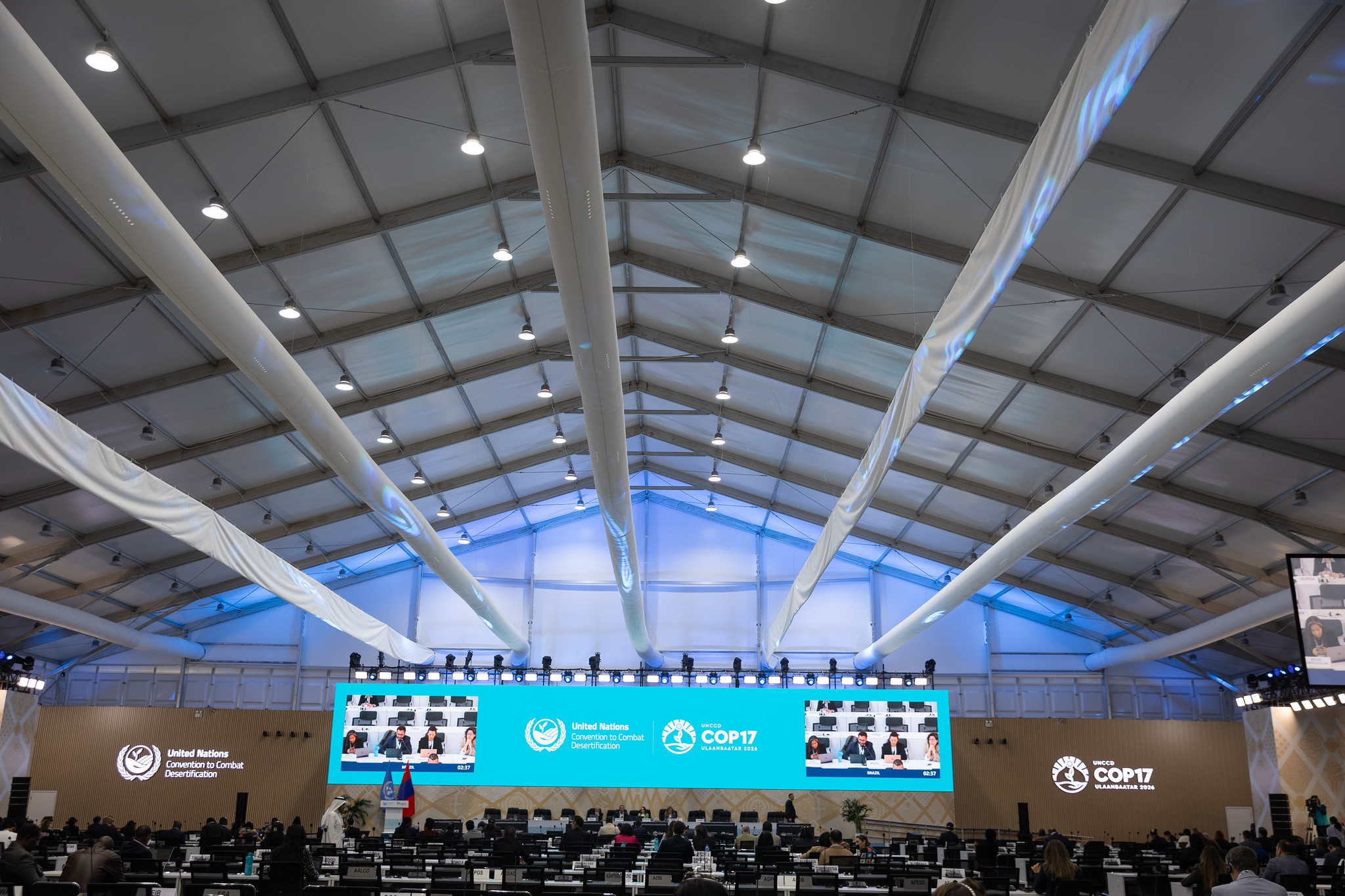
Mongolia y la CNULD dan a conocer las jornadas temáticas cinco meses antes de la COP17 en Ulán Bator
