Agroforestry (Silvopasture)
Agroforestry is the collective term for land use systems and practices that deliberately integrate woody perennials, such as trees and shrubs, with crops and/or animals within the same management unit. Trees and shrubs, along with their understorey vegetation and leaf litter, protect soils from wind erosion. Their extensive root systems stabilise and anchor the soil, while the microclimate created above ground reduces moisture loss. Agroforestry is highly adaptable and can be tailored to local climatic and ecological conditions. There is evidence to suggest that agroforestry systems enhance soil fertility, boost biodiversity, increase carbon sequestration, and improve water cycling. These systems provide farmers and herders with food security and diversified income streams through the production of timber, fruit and fuel. Although establishing trees on agricultural land involves significant initial costs and a delayed return on investment while the trees mature, the long-term environmental and livelihood benefits can be substantial. Farmer-managed natural regeneration can reduce establishment costs in the development of some agroforestry systems.
References and Good Practice GuidanceICRAF An Introduction to AgroforestryCIFOR-ICRAF An Agroforestry Guide for Field PractitionersUniversity of Missouri Handbook of Agroforestry Planning and DesignIFAD Strengthening Agroforestry in Rural InvestmentsUSDA Agroforestry PracticesFAO The Agroforestry Handbook
- Tree Legumes in Agroforestry Systems
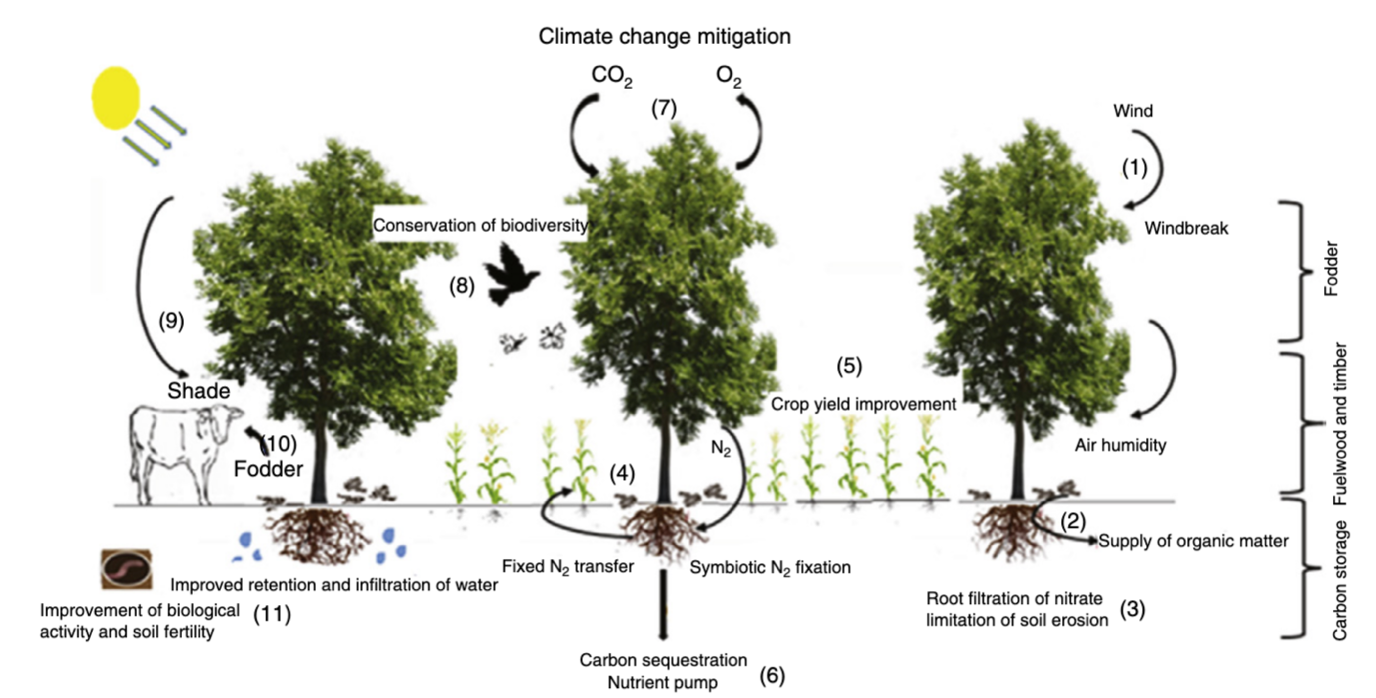
- Silvopasture is an agroforestry arrangement that combines fodder plants, such as grasses and leguminous herbs, with shrubs and trees to provide nutrition for livestock and for other purposes. Depending on the density and composition of the vegetation, silvopasture systems can mitigate wind erosion, increase forage availability, and provide shade and wind protection for livestock. Silvopasture is a farming system that employs agronomic principles to maximise plant growth, forage availability and tree harvesting. It typically includes introduced or native pasture grasses, shrubs, and trees (e.g. nitrogen-fixing legumes), as well as rotational grazing systems. Although this practice involves initial costs and requires ongoing maintenance, it can generate significant environmental benefits (e.g. improved soil health and water quality) without reducing productivity when compared with conventional grazing. A closely related term is 'agro-silvopastoralism', which integrates the three main components of agroforestry systems (trees/woody perennials, forage/crops and livestock) on the same unit of land, either simultaneously or sequentially.
References and Good Practice Guidance
- An integrative approach to silvopastoral system design: perspectives, potentials and principles
- Potential of tree legumes in agroforestry systems and soil conservation
- Impact of silvopasture on soil health and water quality in the Southeast USA
- University of Missouri Silvopasture Training Manual
- Greener Land SilvopastureFAO Grazing with treesWWF Implementing silvo-pastoral practices
- Alley cropping is an agroforestry technique in which crops are planted between widely spaced rows of trees. If oriented perpendicular or diagonal to the prevailing winds, the tree rows act as windbreaks and can reduce wind speed by up to 67% and potential wind erosion by over 80%. The spacing between the rows is designed to accommodate farm machinery without sacrificing any of the benefits that the tree rows provide. While alley cropping requires moderate initial investment and careful consideration of water and nutrient requirements, the practice can significantly increase resilience by diversifying farmers' income streams and creating the conditions for long-term land use efficiency and profitability. This practice is similar to the use of natural windbreaks to reduce wind erosion.
References and Good Practice GuidanceAlley cropping practicesReducing wind erosion through agroforestryAlley cropping increases land use efficiency and economic profitability across the combination cultivation periodGreener Land: Alley CroppingUniversity of Missouri Alley Cropping Training ManualUSDA Alley Cropping
Biome/Climatic Zone
Anthropogenic/Land Use