Conservation Tillage
Conservation tillage is a cultivation system that reduces soil disturbance and retains at least 30% of crop residue on the surface after planting, in order to minimise water and wind erosion. These practices can be employed as part of the transition from conventional tillage to conservation agriculture, minimising soil disturbance and maintaining land cover during fallow periods to reduce wind erosion. While conservation tillage has benefits for soil microbial health, it usually necessitates more active weed management through intercropping, crop rotation with cover crops, and increased herbicide use. It also requires an initial investment in specialised seeding and residue-handling equipment. Conservation tillage practices have often proven to be cost-effective in managing SDS sources due to reduced labour and fuel costs, increased water infiltration, and improved soil health.
Case Studies
In the Columbia Plateau of the northwestern United States, a common crop rotation of winter wheat and summer fallow leaves the land susceptible to wind erosion in the summer, as tillage degrades and exposes the soil to high winds. Various conservation tillage methods (e.g. reduced tillage, reduced and delayed tillage, reduced and delayed tillage with herbicides, sweep tillage, and no-till) have been trialled to minimise dust emissions. Sediment and PM10 fluxes were reduced by all of the tested practices, most significantly by no-till. While early adopters of no-till experienced significant yield reductions, advances in wheat varieties, herbicides, equipment and improved management have enabled no- and low-tillage to match or exceed the yields of conventional tillage while reducing wind erosion. Consequently, by 2013, 70% of the region’s farmland was being cultivated using conservation tillage practices, significantly reducing dust emissions.
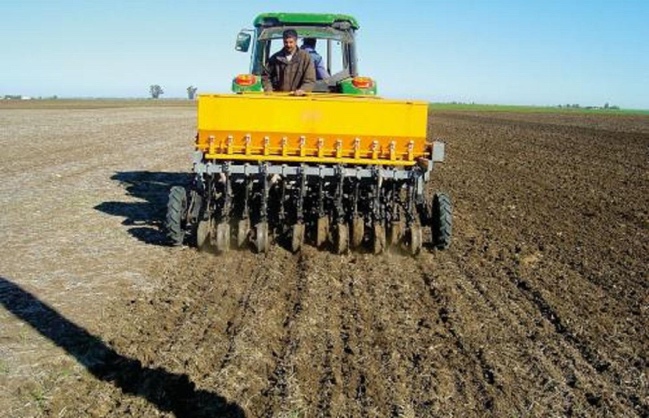
In no-till farming, the soil is left completely undisturbed from harvest to planting. Seeding and fertilising are carried out using specialised, one-pass equipment that minimally disturbs the soil and surface residues. Switching to no-till systems on farms in Poland, Chile and Morocco, helped to conserve soil structure, reduce erosion and runoff, and increase soil organic matter and moisture retention. It also often lower fuel and labour costs compared with conventional tillage. Although these practices require a high initial investment in specialised equipment, farmer training, and adjustments to weed and disease management, they can deliver positive long-term returns and improved resilience to wind erosion.
Conservation Tillage Tractor in Morocco
Mulch tillage and reduced tillage both involve tilling the entire soil surface before planting, but in a way that minimises the number of operations and leaves significant crop residue, a form of organic mulching. In Slovenia, mulch tillage reduced disturbance and improved soil structure, moisture retention, and erosion control compared to conventional ploughing. This led to positive long-term returns despite significant initial investment costs, yield losses, and increased weed pressure. In Norway, reduced tillage prevented soil erosion and nutrient loss, while rebuilding soil organic matter and aggregate stability, as opposed to conventional autumn tillage. However, this also increased weed and disease pressure, reducing crop production and resulting in slightly negative long-term agronomic returns which was offset by a subsidy for reduced erosion.
In ridge tillage and strip tillage farming, most of the field is left untilled, but narrow permanent ridges or shifting strips are tilled where the seeds are placed, often using sweeps or row cleaners. This allows for deeper fertiliser placement while keeping most of the crop residue in place. In Germany, strip tillage improved infiltration, reduced soil erosion, and made efficient use of organic fertilisers, while lowering fuel and labour costs compared to full tillage. Despite the increased costs of machinery, the technical complexity, and the losses incurred during the transition period due to weed pressure and delayed soil warming, the system generated positive long-term returns by improving soil quality and reducing input costs.
References and Good Practice Guidance
- An evaluation of conservation tillage based on long-term experiments in winter crop rotations in NE Spain
- Economics of conservation tillage in a wheat–fallow rotation
- Windblown dust affected by tillage intensity during summer fallow
- Minimum tillage and no-tillage winter wheat–summer fallow for low precipitation regions
- Wind erosion and PM10 emissions from no‐tillage cropping systems in the Pacific Northwest
- FAO Manual on integrated soil management and conservation practices
- FAO Chapter: Conservation tillage for increased crop production
- FAO Technical manual of recommended sustainable soil management ‘Recarbonizing global soils’
- ECHO Best Practices in Conservation Agriculture
Anthropogenic/Land Use