Intercropping
Intercropping is the practice of growing different crops simultaneously in the same field. Alternating rows of tall and short crops, such as wheat and potatoes, reduces wind velocity and traps soil particles. Intercropping with perennial crops (also known as 'live mulching') can reduce gaps in ground cover, providing greater vegetation cover to protect the soil from wind erosion. Similar to grass strips, intercropped rows or strips are often planted along contours to reduce water erosion or perpendicular to the prevailing wind direction to optimise wind erosion reduction.
Intercropping systems are more complex and require greater management expertise, as well as increased labour or specialised equipment for sowing and harvesting. However, this practice provides numerous agronomic and ecological benefits and forms the basis of many traditional farming systems worldwide. It utilises the functional complementarity of different species to increase resource utilisation, nutrient use efficiency, and crop productivity with little to no need for fertilisers or pesticides. Therefore, this practice can support more resilient and profitable farming systems while providing safeguarding critical ecosystem services.
In row intercropping, one crop is grown in typical rows, while one or more additional crops are cultivated either within or between those rows. This strategy maximises the efficiency of harvesting the main crop while incorporating the benefits of interaction with other crops.
In strip intercropping, different crops are grown in wider strips than in row intercropping; each strip contains a single crop. These strips are wide enough to allow independent cultivation, often mechanised, but still close enough to allow beneficial interaction.
In mixed intercropping, crops are grown without any distinct row arrangement, with different species interspersed throughout the field. This maximises biodiversity, pest resistance, and soil health, while reducing seeding complexity, as the seeds can simply be mixed together. However, this arrangement can be more difficult to harvest in cropping systems, especially at larger scales. In pastures, mixed grass-legume intercropping can effectively boost forage yield and quality while reducing weeds.
Relay intercropping involves planting a second crop into a standing first crop before the first crop is harvested, creating an overlap in their growth cycles. This approach reduces fallow periods and maximises resource use. Unlike crop rotation, where crops are grown sequentially, relay intercropping enables different crops to be grown simultaneously for part of their life cycles, thereby enhancing land productivity within the same season.
Case Studies
In the semi-arid regions of Morocco, agricultural yields are generally declining due to climate change causing increasingly irregular rainfall and frequent extreme weather events. While cultivating lentils as the sole crop was once common practice, it left farmers vulnerable to price and climatic variability. To address this challenge, ICARDA introduced chickpeas as a relay intercrop within established lentil rows. This had no significant effect on lentil yields, while producing an additional harvest and increasing farm income and resilience. The extended cropping season prolonged soil cover and reduced land degradation; both crops also contributed to soil nitrogen fixation. However, it should be noted that chickpeas require supplemental irrigation during late-season drought years, which was unavailable to several local farmers.
Relay Intercropping in Morocco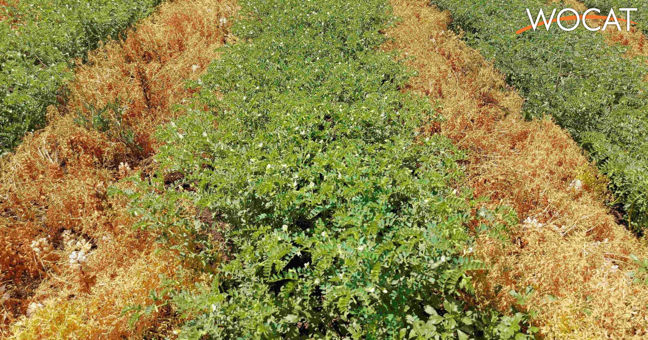
In Uganda, soybeans and maize were grown together to combine a cash crop with a subsistence crop on the same land. This reduced the risk of total crop failure and minimised labour compared to cultivating each crop separately. The nitrogen fixation and residue decomposition from the soybeans reduced the net demand for fertiliser for the maize, and the root systems of the two crops occupied different soil layers, minimising competition for water and nutrients.
In Madagascar, intercropping maize with red cowpeas and other locally adapted legume varieties improved soil fertility compared to maize monoculture and reduced erosion and weed proliferation. The drought tolerance of the cowpea meant that it could survive periods of low rainfall even when the productivity of the maize suffered. This approach was applicable across a range of soil types, slope positions, and farm sizes, making it accessible to a broad range of farming households.
In the Broye catchment area of Switzerland, grain legumes and cereals were sown together at a ratio of 65:35, which improved soil nitrogen levels, increased water infiltration, and boosted biodiversity, all while reducing the use of synthetic fertilisers compared to monoculture plots. Although seed segregation at harvest and weed management posed challenges in certain crop combinations, overall yields were 12–32% higher than in monoculture plots and surface erosion was reduced due to the increased ground cover.
References and Good Practice Guidance
- Intercropping principles and production practices
- Intercropping Practice Guide
- Intercropping systems in sustainable agriculture
- Study on the optimal intercropping width to control wind erosion in North China
- Intercropping a sustainable holistic approach for improving growth and productivity of crops
- The advantages of intercropping to improve productivity in food and forage production–a review
- USDA Intercropping to Improve Soil Health
Anthropogenic/Land Use