Grass Strips
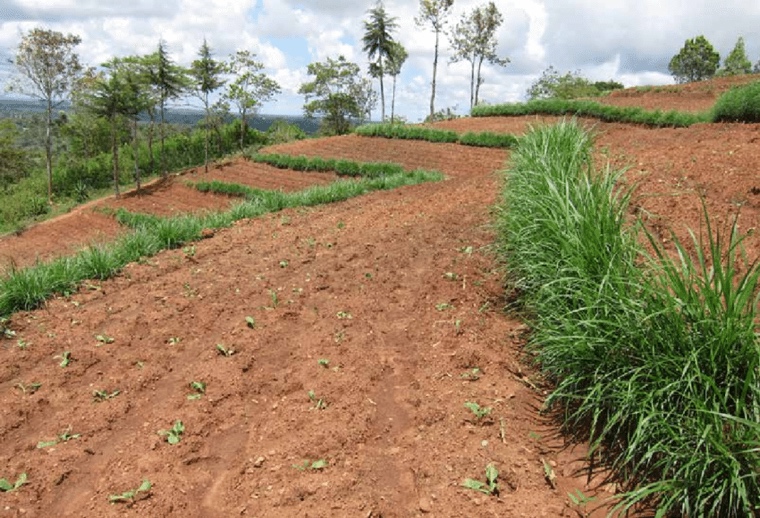
Grass strips are rows of perennial, native or locally adapted grasses that are usually planted at right angles to the prevailing wind direction on field margins or along contours. These strips act as a buffer, reducing surface wind speeds, capturing saltating particles, and stabilising the soil in the immediate vicinity through their extensive root networks. When placed along contours, they can also function as micro-catchment rainwater harvesting structures to improve water infiltration.
As grass strips are considerably smaller than tree-based natural windbreaks, their protective distance is much shorter. Therefore, they are most effective when planted at regular intervals. Initially, grass strips may require the removal of weeds and regular cutting or grazing to remain effective. However, grass strips are cheaper and quicker to establish — typically in a single growing season, depending on the species — and they compete less with adjacent crops for water, space, nutrients, and light. Thus, they are suited to smaller-scale, lower-intensity contexts of wind erosion. They can provide a habitat for a variety of pollinating insects and other wildlife, including predators of agricultural pests. Multi-storey windbreaks can also be developed that incorporate trees, shrubs, and grasses to provide multiple agroecological benefits in the same area. Alternatively, intercropping with tall cereal or perennial crops can have a similar effect to that of grass strips. Grass strips can also be planted in arrays to cover deserts and drylands, desiccated wetlands and basins, and coastal zones, as well as in the context of infrastructure development.
Grass strips integrated with contour furrows in the Sahel
Case Study
In Northeast China, strips of shrubs or grass are planted along the contours of gently sloping croplands. This is combined with small earth embankments to enhance the functionality of the strips. This creates additional income opportunities by diversifying farm outputs and improving water infiltration, while reducing both wind and water erosion. Although some productive land is occupied during establishment and grain output is reduced, in the long term this practice prevents the loss of the most fertile topsoil. As the quantity of intercepted sediment increases, the slope decreases and grain output increases in the long term.
References and Good Practice Guidance
- Green Barriers: Grass Strips as Simple Nature-Based Solutions to Combat Land Degradation
- FAO Strengthening agricultural water efficiency and productivity on the African and global level
- Government of Ontario Best Management Practices of Wind Strips
- Government of Scotland Supporting guidance for Grass Strips in Arable Fields
- Government of the UK Create and maintain grass strips
- University of Missouri Vegetative Barriers for Erosion Control
Biome/Climatic Zone
Anthropogenic/Land Use