Microcatchment Rainwater Harvesting
Microcatchment rainwater harvesting involves creating structures in the landscape, either manually or mechanically, to trap localised runoff and increase soil moisture for agricultural use and to sustain ecosystems. Such structures have been central to sustainable land management practices for thousands of years, particularly in dryland environments. While these practices primarily focus on mitigating water erosion, they can also reduce wind erosion by improving water infiltration and soil stability, and by creating conditions that encourage increased vegetation cover. Costs can vary significantly as materials, such as rocks, soil and woody debris, can generally be sourced on-site. However, the initial labour requirements for manually constructed structures can be relatively high, whereas mechanically constructed structures generally require a farm vehicle with specialised attachments. With proper maintenance, these structures can remain functional for several years.
Case Studies
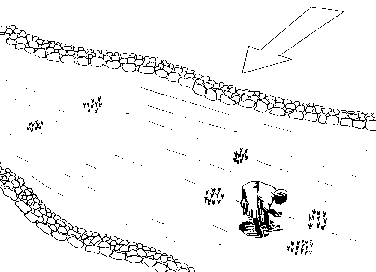
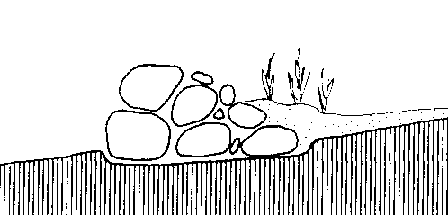
Contour bunds, also known as contour ridges, are linear embankments made of earth, rock or woody material. They are placed along contour lines to intercept and slow surface runoff, thereby increasing infiltration and helping to stabilise soils. They can be created manually or mechanically and are designed to intercept runoff over large areas at relatively low cost. However, as with the other microcatchment rainwater harvesting practices detailed below, they require a substantial initial investment and ongoing maintenance to preserve their structural integrity. In Bhutan, for example, stone bunds were constructed using a combination of government subsidies and community labour, resulting in improved soil moisture, better crop establishment, and higher farm incomes for the entire community. In Burkina Faso, stone bunds were combined with permanent grass strips to minimise ongoing maintenance requirements while improving wind erosion control and providing ecological benefits. In Nepal, a traditional, low-cost approach to bunding uses slashed and dried leafy biomass gathered into contour bunds and anchored in place with locally available materials, such as twigs and stones.
Illustration of Contour Bunds
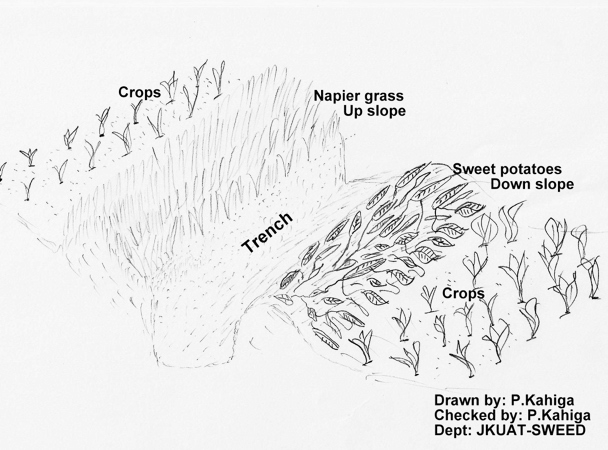
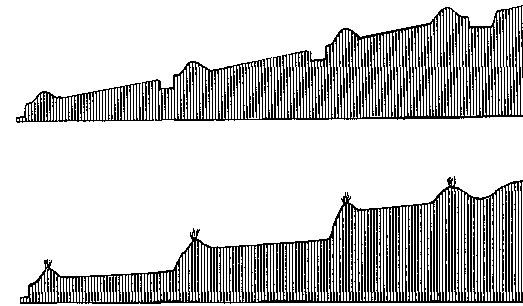
Fanya-Juu terraces are earth embankments formed by manually digging a trench along contour lines and piling the excavated soil uphill to create a bund. This is then typically stabilised with vegetation. This process slows runoff, enhances infiltration, and reduces slope length, helping to conserve soil and moisture on steep croplands. The varying terrain can support intercropping or agroforestry and becomes stabilised over time, forming flat bench terraces. Although the benefits are substantial, Fanya-Juu terraces require dedicated labour for initial construction, as well as for ongoing annual maintenance which can be addressed through community labour-pooling arrangements. This approach has been shown to deliver positive long-term results and is now widely adopted on small-scale farms in semi-arid regions of East Africa.
Illustration of Fanya-Juu Terraces
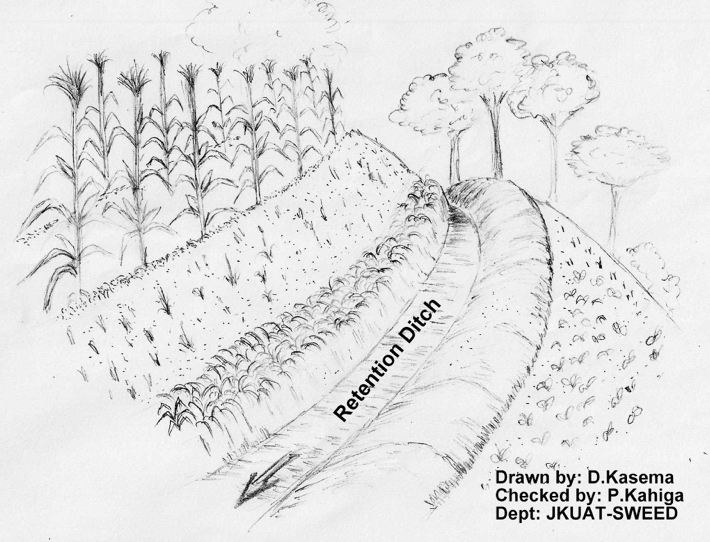
Retention ditches, also known as infiltration or contour ditches, are similar to Fanya-Juu terraces and contour bunds. However, they can handle much more water as they are dug to form a deeper depression along contours, with a downslope bund that allows water to pool and infiltrate into the subsoil as in Namibia and Kenya.
Illustration of Retention Ditches
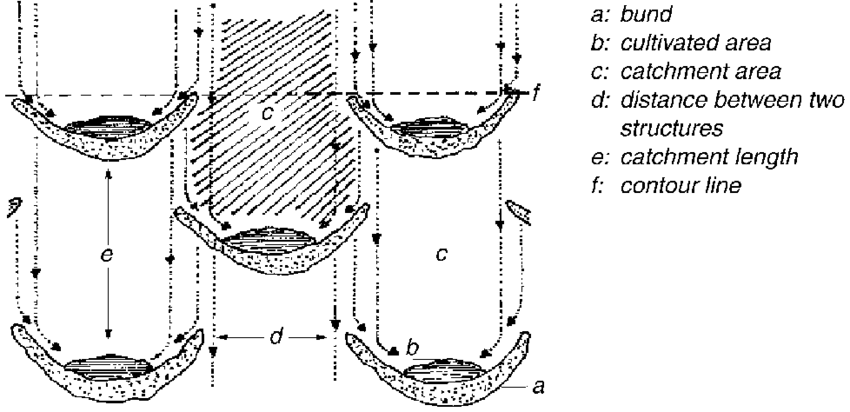
Half-moon bunds, also known as semi-circular bunds, demi-lunes or 'earth smiles', are constructed basins that open upslope and concentrate water around individual or grouped plants. Similarly, trapezoidal or V-shaped bunds are constructed in a similar way. They are a relatively quick and inexpensive intervention that requires minimal construction, while enabling the growth of plants and species that would not previously have been able to survive in dry conditions. They have been used successfully in several cases to restore degraded arid and semi-arid lands with low vegetation cover, improving survival rates and vegetation cover.
Illustration of Half-Moon Bunds
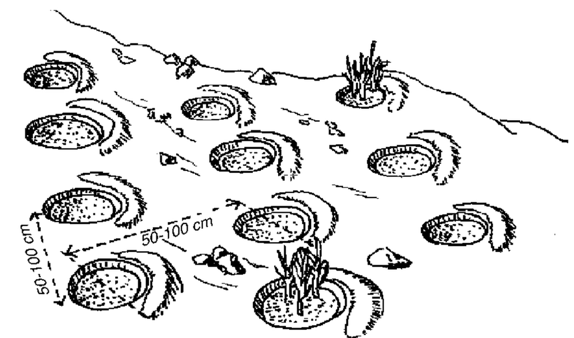
Zai pits, also known as tassa or planting pits, are small planting holes that are manually excavated to focus rainfall and runoff into a concentrated root zone around crops. This reduces runoff and increases infiltration. This practice is often combined with organic soil amendments to increase nutrient concentrations and improve yields by up to 500% if executed well. In West African countries, such as Burkina Faso and Niger, the combination of these pits and organic amendments has been shown to improve crop establishment and ground cover, thereby reducing the exposure of loose soil to wind.
Illustration of Zai Pits
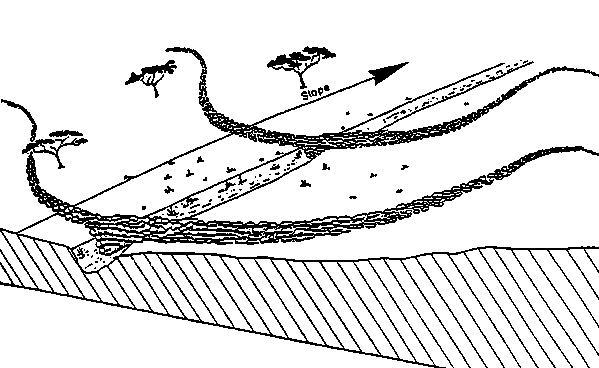
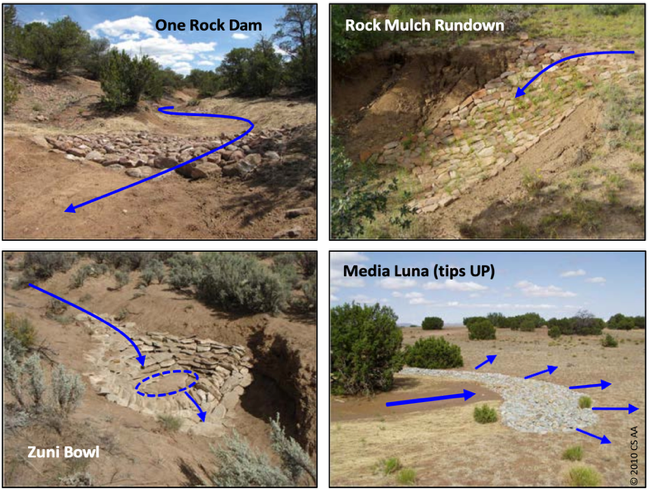
In-channel rock structures, such as check dams, leaky weirs, permeable rock dams, gully plugs, rock mulch runoffs, one-rock dams, Zuni bowls, and Media Lunas, are strategically designed rock structures of various sizes and configurations. They are placed in the path of surface flows to allow water to infiltrate while trapping sediments. This stabilises eroded landscapes and enables vegetation to regrow on previously eroded surfaces. While these practices primarily aim to mitigate water erosion, they can also indirectly reduce SDS source areas. However, without other restoration practices in place, these structures can rapidly fill up with sediment, particularly in arid and semi-arid environments. Larger structures, such as check dams, can also generate complex, unintended geomorphological effects upstream and downstream, depending on their placement within the landscape.
Examples of In-Channel Rock Structures
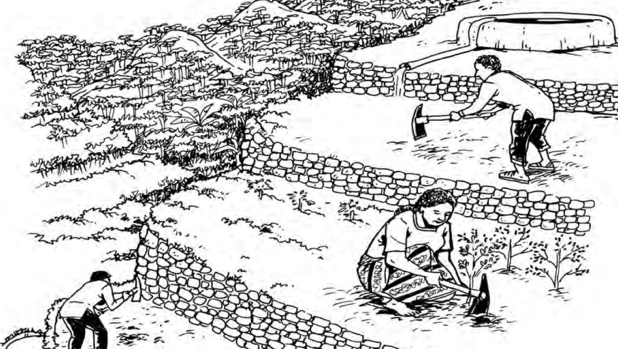
Bench terracing is a common and long-standing agricultural practice in mountainous regions. It involves reshaping the land into a series of level or gently sloping platforms to stabilise steep terrain, prevent gullying, and enhance water retention and infiltration. Over time, this creates conditions for improved soil fertility and crop yields. Compared to the other options presented here, bench terracing requires a high initial investment of manual labour, as well as the optional use of heavy machinery and ongoing maintenance sustain platform integrity. In China and Bhutan, bench terraces have been constructed to stabilise hilly farmland and enable crop cultivation on previously unworkable slopes. Despite the high initial investment costs, including government subsidies, these interventions have produced positive long-term results and increased crop yields on what were previously marginal slopes subject to erosion.
Illustration of Bench Terracing
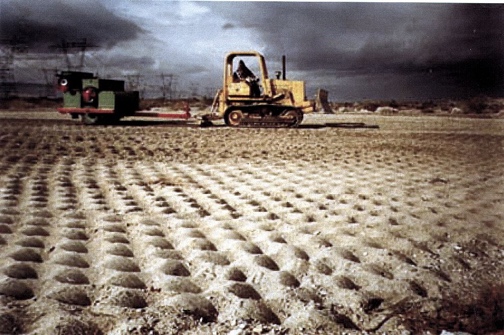
Mechanised imprinting involves pressing small, evenly spaced depressions into the soil. These depressions capture rainfall and windblown seeds, thereby improving water infiltration and revegetation. They also roughen the soil surface, which reduces near-ground wind speeds. This technique requires an imprinter attachment, which was developed in the 1980s and can be fitted with either a direct seeder or a keyline plough for deep water infiltration and surface roughening. This combined practice is described in the Lordsburg Playa Case Study, in which imprinting was used alongside keylining. As with other mechanical approaches, the initial cost is moderate due to the need for specialised equipment. However, imprints can be efficiently applied on a large scale, require no maintenance, and remain effective for several years, making the technique a relatively low-cost option.
Mechanised Imprinting in Lordsburg Playa, USA
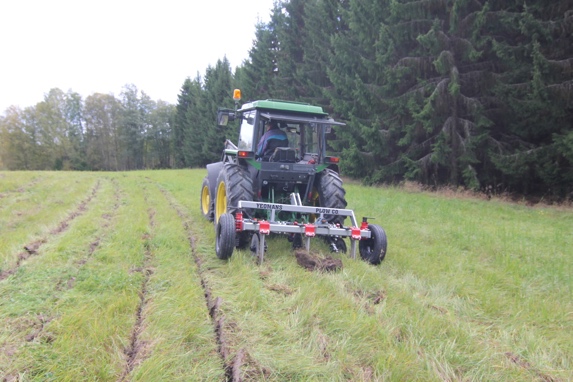
Contour ripping is a type of ploughing where deep lines are cut along contours without turning over the soil. Developed in the 1950s, keylining builds on this principle, but deliberately runs the rips slightly off-contour. This is guided by ‘keypoints’ in the landscape, where the slope shifts from steep to gentle. The aim is to redistribute infiltrating water laterally, from wetter valleys towards drier ridges, to improve soil moisture balance across the landscape. The Lordsburg Playa Case Study describes keylining, which has been used alongside mechanised imprinting. Similar to contour bunds, these lines enable rainwater and runoff to be absorbed into the soil. They are better suited to large areas with access to farm vehicles and specialised equipment. Keylining does not require maintenance and remains effective for several years, making them a relatively low-cost option.
Keylining in Lordsburg Playa, USA
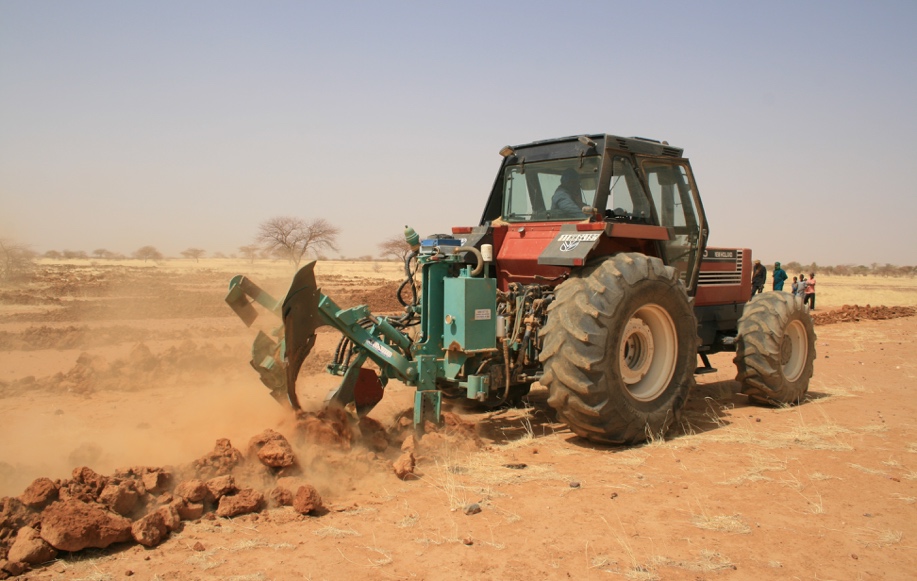
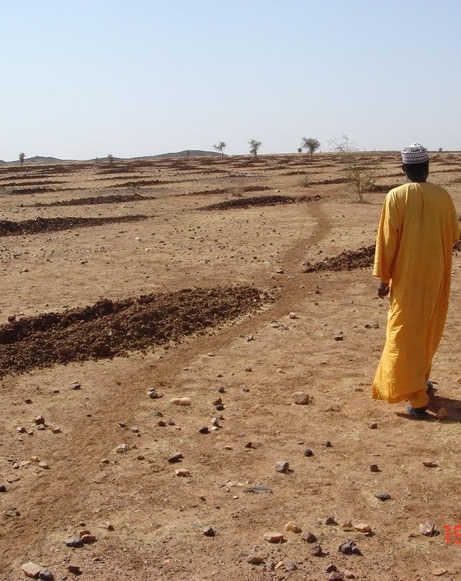
Mechanised pitting, including the Vallerani tractor method, involves creating evenly spaced micro-basins (bunds) across large areas. This increases infiltration, reduces surface wind speeds, and enables rapid large-scale revegetation. The ditches are significantly larger than those created by mechanical imprinting, contour planting, or keylining. They require either a Vallerani tractor plough, which was developed in 1988, or a smaller Camel Pitter attachment. Trees or other vegetation are often planted in the ditches to speed up the revegetation process. In degraded landscapes, including those in Jordan, Niger, Burkina Faso, and Syria, mechanised pitting has enhanced infiltration, reduced surface runoff, and promoted the re-establishment of native grasses and shrubs, thereby restoring degraded rangelands. This has led to improved soil organic matter, biodiversity and fodder production, resulting in very positive long-term ecological and socio-economic outcomes in all four countries, despite the high initial costs of establishment and the need for grazing rest periods to allow vegetation to become established.
Mechanized Pitting in Niger
References and Good Practice Guidance
Biome/Climatic Zone
Anthropogenic/Land Use