Organic Mulching
Organic mulching involves covering the topsoil with plant material, such as leaves, grass clippings, twigs, crop residues, or straw. This creates a physical barrier that reduces the ability of wind to lift soil particles, thereby reducing wind erosion by an order of magnitude in some cases. It also improves soil health and structure. While mulching is relatively easy to establish, it requires a large amount of organic material, as well as labour and transport for application over large areas, and sometimes heavy equipment. In ploughed fields, mulch and cover crops can be incorporated into the soil within a single season. Even in no-till systems (see conservation tillage), organic mulch naturally decomposes over several years depending on the material used and the conditions at the site. While this decomposition benefits soil health by adding soil organic carbon and nutrients and acting as an organic soil amendment, it also requires periodic reapplication. In contrast, gravel mulching is effective over longer periods, conserves soil moisture and helps regulate soil temperatures, but requires higher upfront costs and does not offer the same benefits to the soil microbiome.
Although costs vary depending on the availability of inputs, this practice has proven to be cost-effective in the long term for many crops due to its significant benefits for the soil microbiome, such as reduced water and chemical use, and increased crop productivity. This is particularly true in soils with low nutrient and organic carbon content. Organic mulching can be used in drylands to cover desert sands or desiccated lakebeds, which could increase their suitability for revegetation or cultivation. In India, mulching arid, sandy desert areas successfully reduced sediment transport without depleting the surrounding vegetation. However, in Niger and Morocco, the necessary biomass was either unavailable or required for other essential purposes, such as building hut walls or garden fences.
Case Studies
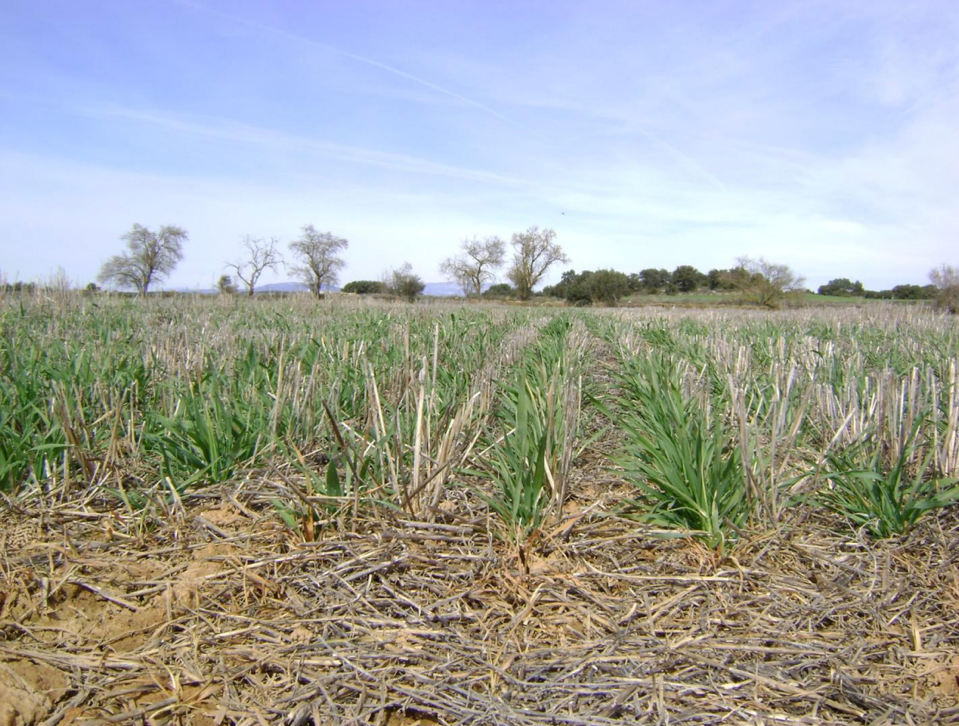
In Benin, combining mulching with cover cropping doubled agricultural production. This was achieved by reducing wind and water erosion, improving soil moisture retention and health, and reducing the need for chemical fertilisers and manual watering. Despite the increased labour requirements and input costs, this led to positive long-term returns. In Spain, applying straw mulch to bare soil significantly reduced runoff and soil erosion under simulated storm conditions, while improving soil surface cover and infiltration compared to non-mulched plots. However, the long-term benefits were deemed neutral due to the high labour and material costs involved.
Organic Mulching for Winter Cereals in Spain
References and Good Practice Guidance
- FAO Mulching in organic agriculture
- FAO Training Manual for Organic Agriculture
- FAO Technical manual of recommended sustainable soil management ‘Recarbonizing global soils’
- CSFD Fighting wind erosion. One aspect of the combat against desertification
- Farmonaut Guide to Mulching in Agriculture
- Evaluating the effectiveness of agricultural mulches for reducing post-wildfire wind erosion
- A comparison of landscape mulches: chemical, allelopathic, and decomposition properties.
- Benefits of straw mulching in crop production: a review
Biome/Climatic Zone
Anthropogenic/Land Use