Straw Checkerboards
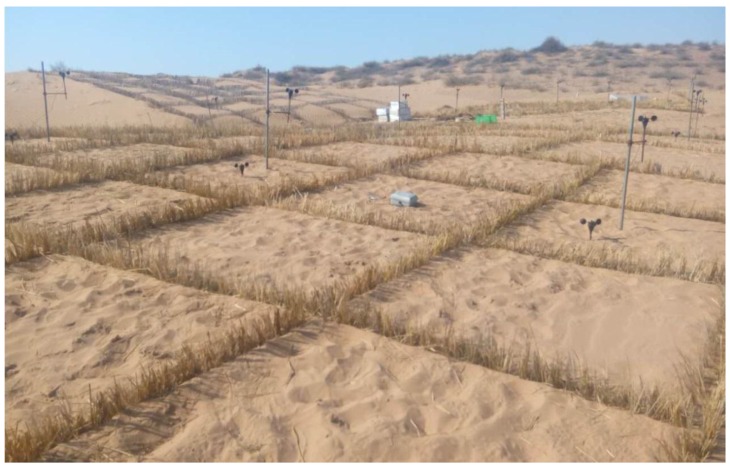
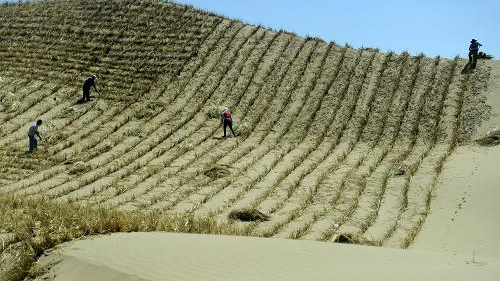
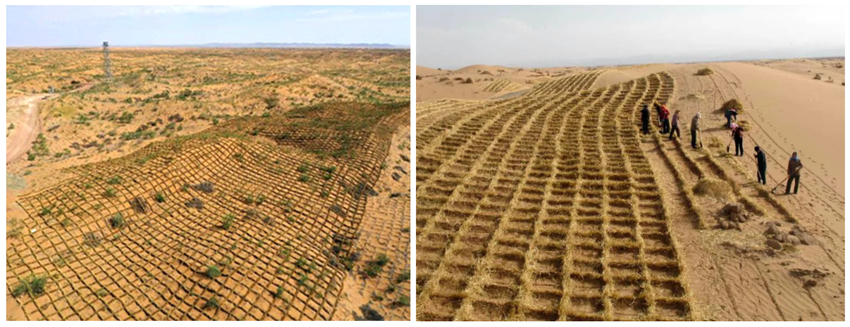
Straw checkerboards involve pressing straw from wheat, rice, and other plants into sandy soil in a checkerboard shape, with one half buried and one half exposed. This increases surface roughness, which reduces wind erosion. Checkerboards can also be designed to trap sand and soil in order to support the re-establishment of vegetation. Straw checkerboards are composed of squares of various sizes, typically ranging from 1 to 3 m² with heights of around 20 cm, and can be interplanted with shrubs and grasses. Smaller, tighter checkerboard patterns are more effective at decreasing sand flux intensity, potentially aiding in the formation of biological soil crusts (see biocrust inoculation/restoration).
Case Study
This practice has been used on a large scale in China to combat desertification and has also been adopted in parts of Eastern Asia, Africa, and Mongolia. Checkerboard methods require limited technical expertise and can be implemented over large areas. They use readily available crop residues such as wheat or rice straw in northern China, palm leaves and stems in Morocco, reeds in Tunisia, and dried khimp in Mauritania. Although the practice can now be implemented mechanically, manual labour is still necessary, particularly on steep slopes or shifting sand dunes. In many arid and semi-arid regions, straw checkerboards require significantly less water and financial resources and offer more sustainable, long-term ecological and socio-economic benefits. In areas with low-frequency grazing, this practice may need to be combined with livestock exclosures while the vegetation recovers. In China, checkerboards have been integrated into the design of large-scale solar installations to create artificial surface roughness.
Different Straw Checkerboard Techniques in China
References and Good Practice Guidance
- Design and Simulation of Portable Paving Vehicle for Straw Checkerboard Barriers
- Principles of sand dune fixation with straw checkerboard technology and its effects on the environment
- Effect of straw checkerboards on wind proofing, sand fixation, and ecological restoration in shifting sandy land
- Sand barriers of straw checkerboards for habitat restoration in extremely arid desert regions
- Modelling the inhibition effect of straw checkerboard barriers on wind-blown sand
- Optimized Combined Layout of Sand Barriers for Photovoltaic Power Stations Based on Wind and Sand Control Performance
- The role of typical low vertical lattice sand barriers in regulating the airflow field on wind-eroded surfaces of photovoltaic power plants
- China's magical straw checkerboard: turning desert into lush land
- Straw checkboard or Afforestation?—Assessment and comparison of combined benefits of two typical sand fixing models
- CSFD Fighting wind erosion. One aspect of the combat against desertification
Biome/Climatic Zone