
Latest news & stories
The Kingdom of Saudi Arabia has reached a major milestone in restoring degraded land, announcing the rehabilitation of one million hectares under the Saudi Green Initiative.

السلام عليكم ورحمة الله وبركاته ... معالي الوزير عبد الرحمن عبد المحسن الفضلي ... وزير البيئة والمياه والزراعة بالمملكة العربية السعودية السيدات والسادة الحضور يسعدني أن أشارككم اليوم، عبر هذه الكلمة المسجّلة، في هذه المناسبة المهمة التي تحتفي بإنجاز وطني بارز للمملكة العربية السعودية.ما نحتفل به اليوم ... إعادة تأهيل مليون هكتار من الأراضي المتدهورة ... ليس مجرد رقم، بل هو دليل ملموس على أن اصلاح الأراضي ممكنة، حتى في أكثر البيئات تحديًا. وهو إنجاز تحقق على أرض الواقع، مدعوم بالعلم، وبنهج متكامل، وبإرادة واضحة لتحقيق التغيير.في عالم يواجه تسارعًا غير مسبوق في تدهور الأراضي وتفاقم آثار الجفاف، يقدّم هذا الإنجاز رسالة قوية:أن الحلول موجودة، وأن العمل الجماعي قادر على تحويل التحديات إلى فرص.لقد أظهرت المملكة العربية السعودية كيف يمكن للدول، حتى في البيئات القاحلة وشحيحة الموارد المائية، أن تقود نموذجًا عالميًا في استعادة النظم البيئية، من خلال تبنّي حلول قائمة على الطبيعة، وتوظيف الابتكار، وتعزيز التكامل بين السياسات والممارسات.ويبرز هذا الإنجاز كجزء من رؤية وطنية أوسع، في إطار مبادرة السعودية الخضراء، التي لا تهدف فقط إلى زراعة الأشجار، بل إلى استعادة وظائف النظم البيئية، وتعزيز التنوع الحيوي، وتحقيق استدامة الموارد للأجيال القادمة.كما أن ما يميّز هذا الجهد هو اعتماده على منهجيات علمية دقيقة في القياس والتحقق، بما يعزز مصداقية النتائج، ويقدّم نموذجًا يمكن البناء عليه عالميًا.السيدات والسادة،إن اصلاح الأراضي ليست قضية بيئية فحسب، بل هي قضية تنموية وإنسانية.فهذا الإنجاز ينعكس بشكل مباشر على:تعزيز الأمن الغذائي،دعم الاقتصادات المحلية،خلق فرص العمل،تعزيز القدرة على التكيّف مع تغيّر المناخ.وتحسين جودة الحياة للمجتمعات.وعلى المستويين الإقليمي والعالمي، فاعادة تأهيل الأراضي تمثّل أداةً محورية لمعالجة تحديات أوسع، مثل الحد من عوامل النزوح والهجرة المرتبطة بتدهور الأراضي وتعزيز الاستقرار في المناطق الهشة الى دعم الجهود الدولية للتكيّف مع تغيّر المناخ وتعزيز القدرة على الصمود.إن ما نشهده اليوم في المملكة يعكس أيضًا قوة الشراكات، حيث اجتمعت جهود الحكومة، والقطاع الخاص، والمجتمع، لتحقيق هذا الإنجاز. وهو ما يؤكد أن العمل متعدد الأطراف ليس خيارًا، بل ضرورة لتحقيق التحول المطلوب.وفي هذا السياق، نُثمّن في اتفاقية الأمم المتحدة لمكافحة التصحر الدور القيادي الذي تضطلع به المملكة، سواء من خلال مبادرة الشرق الأوسط الأخضر، أو المبادرة العالمية للأراضي، أو من خلال رئاستها لمؤتمر الأطراف، وما أسهمت به في رفع مستوى الطموح الدولي وتعزيز العمل الجماعي. السيدات والسادة،إن اصلاح الأراضي تمثل استثمارًا في الإنسان، وفي الاستقرار، وفي مستقبل أكثر استدامة.وما تحقق اليوم ليس نهاية الطريق، بل خطوة مهمة ضمن مسار طويل يتطلب استمرار الالتزام، وتسريع وتيرة العمل، وتوسيع نطاق الشراكات.وفي الختام، أود أن أعرب عن خالص التقدير للمملكة العربية السعودية على هذا الإنجاز المتميز، وعلى دورها المتواصل في دفع الأجندة البيئية العالمية قدمًا.ونتطلع إلى مواصلة هذا التعاون البنّاء، بما يسهم في تحقيق مستقبل أكثر استدامة وازدهارًا للجميع.والسلام عليكم ورحمة الله وبركاته.

منغوليا واتفاقية الأمم المتحدة لمكافحة التصحر تكشفان عن الأيام الموضوعية للمؤتمر قبل خمسة أشهر من انعقاد COP17 في أولانباتار

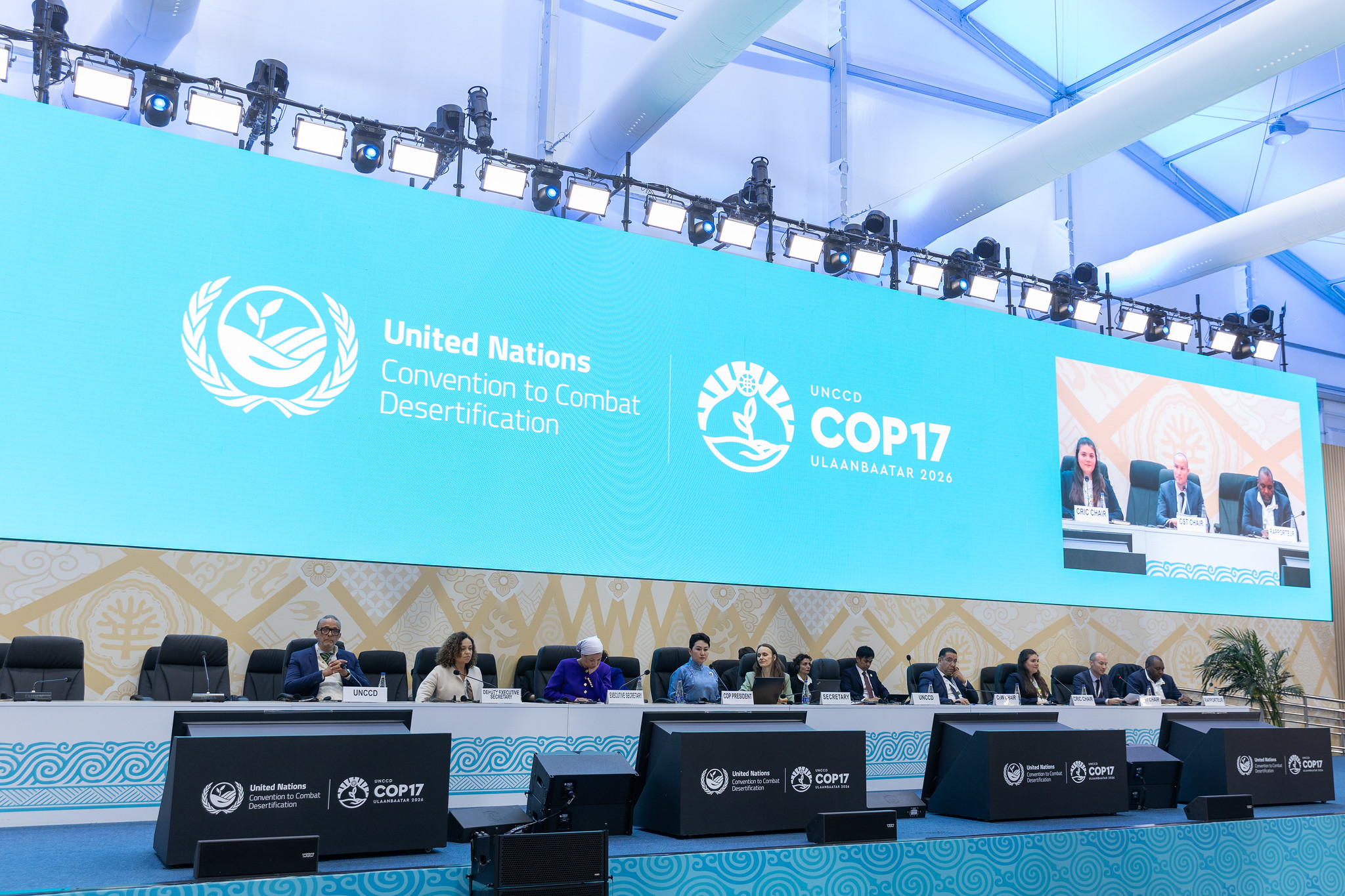
The UNCCD and the International Drought Resilience Alliance (IDRA) are launching the Land and Drought Media Reporting Fellowship for six journalists to cover COP17 in Ulaanbaatar, Mongolia (August 17–28, 2026).

New global assessment reveals deep gaps in land tenure security, governance and women’s land rights For billions of people, land is more than property. It is their livelihood, income, identity and stability. Yet that stability is increasingly fragile. Only about one-third of the world’s land is formally documented. More than one billion people – nearly one in four adults globally – feel insecure about their rights to land or housing and fear they could lose them within the next five years. A new global assessment, The Status of Land Tenure and Governance, sheds light on this growing insecurity. Co-published by the Food and Agriculture Organization of the United Nations (FAO), the International Land Coalition and the French Agricultural Research Centre for International Development (CIRAD), under the Global Land Observatory, it brings together data from governments, researchers and civil society to show who holds land, how secure those rights are and where governance gaps remain. With up to 40 per cent of the world’s land already degraded, secure land tenure is essential to restoring land at scale. A widening gap between land management and recognition Although states legally own most of the world’s land, much of it is governed in practice through customary systems. Indigenous Peoples and local communities manage 42 per cent of global land, yet only a small portion of those territories are formally recognized as theirs. This gap between management and legal recognition means that many communities who depend on land do not have formal protection of their rights. In contexts characterized by high land concentration and ongoing large-scale land acquisitions, the absence of recognition can leave customary landholders with limited legal safeguards. Where land rights are unclear or unprotected, adoption of sustainable land management practices becomes more difficult. Farmers and communities are less likely to invest in restoring degraded soils, conserving water, or adopting sustainable practices if their claims to land are uncertain. “The findings of the Status of Land Tenure and Governance Report confirm that secure and equitable land tenure is a prerequisite for sustainable land management,” said Ward Anseeuw, Senior Land Tenure Officer at FAO. “Strengthening land governance is therefore essential to achieving the objectives of the UNCCD, particularly in advancing land degradation neutrality and enabling local land users to invest confidently in the long-term health and productivity of their land.” Rising insecurity and persistent inequality Land insecurity is increasing globally. Since 2020, the share of adults who feel insecure about their land or housing rights has risen from 19 per cent to 23 per cent worldwide – affecting more than 1.1 billion people. In several regions, more than one-quarter of adults' report feeling insecure, with youth facing particularly high levels of uncertainty. Gender disparities remain pronounced. Across 108 countries assessed, 48 per cent of men report being sole or joint landowners, compared to 40 per cent of women. In agricultural contexts, the gap is often wider. Women produce roughly half of the world’s food yet own less than one-fifth of land globally. Where women lack secure tenure – due to inheritance barriers, limited legal protections or discriminatory customary norms - their ability to invest in soil restoration and sustainable practices is constrained. Advancing women’s land rights is therefore not only a matter of equality. It is essential for resilient food systems and sustainable land management. Customary lands, climate and resilience Customary land systems often overlap with areas of high biodiversity and significant carbon storage. Communities managing these territories have demonstrated long-standing stewardship practices that contribute to ecosystem stability. Healthy land, including soils and water, plays a significant role in climate mitigation and adaptation. According to the UNCCD estimates, drought losses now exceed USD 300 billion annually, and large parts of the world are becoming progressively drier. Billions of people could face increasing aridity in the coming decades. In this context, strengthening recognition of customary tenure is not only about justice – it is about safeguarding ecosystems and supporting communities that are already on the frontlines of climate stress. A structural data and governance gap Land is central to food security, climate action and sustainable development – yet information about land tenure arrangements and the security of those rights remains patchy. Only a limited number of countries report fully on land-related Sustainable Development Goals (SDG) indicators. Compared to sectors such as health or public finance, land tenure data are far less available and often not publicly accessible. The assessment calls for stronger national data systems, clearer legal frameworks and better alignment with international standards, including the Voluntary Guidelines on the Responsible Governance of Tenure of Land, Fisheries and Forests (VGGT), endorsed by the Committee on World Food Security and supported by FAO – the only globally agreed framework that sets standards for how land tenure rights should be recognized and protected. These guidelines form the foundation for a number of critical policy decisions of the UNCCD Conference of the Parties. Without reliable and transparent information, it becomes harder for governments to track progress and meet commitments under the SDGs and the Rio Conventions – the three global agreements on climate change, biodiversity and desertification. Governance at the heart of restoration These themes were further explored during a joint side event convened by the UNCCD together with TMG Think Tank for Sustainability – an independent research and policy institute focused on land governance and environmental justice – as well as the Robert Bosch Foundation and other partners. The discussion underscored that restoration, food security, and resilience cannot be separated from land governance systems. Transparent land administration, inclusive decision-making, and legal certainty are foundational conditions for sustainable land management. Governments have pledged to restore one billion hectares of degraded land by 2030, with nearly half of that commitment under the UNCCD framework. Achieving this ambition will require more than finance and technical solutions. It will require trust and equity for the people who depend on the land. “Land underpins food systems, climate stability and livelihoods,” said Dr Barron Joseph Orr, Chief Scientist of the UNCCD. “Without responsible and inclusive land governance that safeguards land tenure, the intended positive impacts of restoration efforts risk being temporary. Securing land rights is not simply about the four "R's" of Redistribution, Restitution, Recognition, and Regulation - it is about creating the conditions that allow communities to restore land and sustain it for generations to come.” Photo (c) : FORESCA

Across Southern Africa, drought is no longer an occasional shock — it is a recurring reality shaping landscapes, economies and daily life. As climate variability increases, pressure on land, water systems and rural livelihoods continues to grow. In Zimbabwe, Mozambique and Madagascar, the impacts are increasingly severe and they fall hardest on women and local communities who depend on land and natural resources to feed families and earn an income. In Madagascar, more than 9 million hectares (over 15 per cent of the country’s land area) are affected by drought, with some regions experiencing near-total crop failure during prolonged dry events. Mozambique faces frequent seasonal droughts that threaten food security for over 4 million people, particularly in its central and southern provinces. In Zimbabwe, recurring drought episodes have put nearly three million hectares of farmland at risk, with smallholder farmers and pastoralist communities most affected. Across these countries, drought disproportionately impacts women, who make up the majority of smallholder farmers, and other vulnerable groups dependent on agriculture and natural resources for their livelihoods. Yet the story is not only about risk. It is also about opportunity: how these countries are designing gender-smart, community-led solutions that turn drought resilience into livelihoods, restore degraded land and protect food and income while advancing sustainable land management and Land Degradation Neutrality (LDN). A key shift is placing women and local communities at the center — not only as beneficiaries, but as leaders of resilient livelihoods and value chains. This means recognizing women’s role in managing farms, water and household food security while tackling the barriers they face in accessing land, finance, skills, markets and decision-making. It also means strengthening community institutions so local knowledge and priorities shape what resilience looks like on the ground. Another big change is using drought risk data together with economic and livelihood analysis to identify where resilience investments can create real opportunities. In practice, this helps countries move from broad vulnerability profiles to concrete ideas that match local realities: which landscapes are most at risk, which groups are most exposed, what options can reduce pressure on land and water, and which interventions can generate reliable incomes even during dry periods. Countries are also working to develop scalable investment ideas — from climate-resilient agriculture to water management — that can attract blended finance and align with national priorities. Examples discussed through this work include community-based water management that secures access during dry spells, climate-resilient agriculture that stabilizes yields, and women-led enterprises that diversify income while reducing vulnerability and restoring degraded land. These solutions are designed to be practical, locally anchored and capable of expanding beyond pilot sites. “Women and local communities are already on the front line of drought. When they lead the solutions — supported by secure land tenure together with access to finance and investment-ready plans — resilience becomes real: it protects food and incomes today and restores land for generations to come,” emphasizes Louise Baker, Managing Director of the Global Mechanism of the UNCCD. This work is being advanced through the Gender-Transformative Drought Resilience in Transition States in Southern Africa (GRDSA) Project, supporting Madagascar, Mozambique and Zimbabwe to help countries prepare drought investment plans, strategies and pipelines. The GRDSA Project does not finance investments directly. Instead, it focuses on project preparation so countries can later mobilize additional public and private finance, building on existing national policies, drought monitoring systems and vulnerability assessments rather than duplicating them. National inception workshops held in 2025, alongside a regional exchange, helped set this work in motion. The project is financed by the African Development Bank (AfDB) and the Government of Canada and implemented by the Global Mechanism of the UNCCD. Photography (c) : Global Water Partnership Southern Africa, Krees Raharison
